

CII roundtable - Professionalism: The rise of the professional
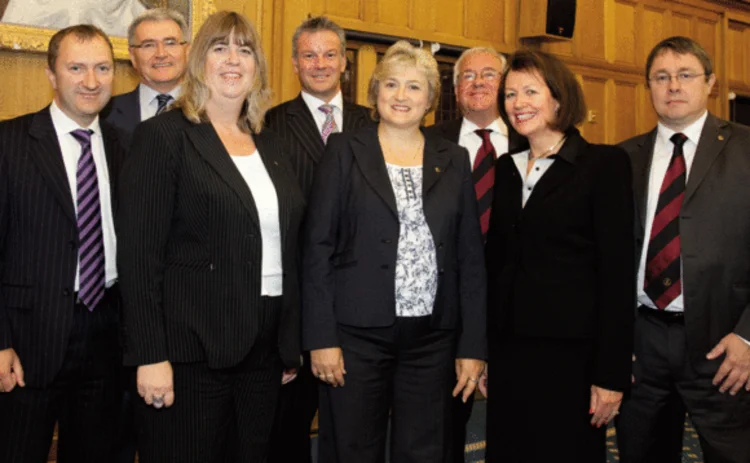

In this PB roundtable discussion, leading figures from the profession discuss the merits of chartered status, the need to educate customers about it and perceived difficulties in achieving it
The participants Fiona Andrews
Group head of people development, Towergate
 Neil Clutterbuck
Director of engineering, Allianz Eric Galbraith
Chief executive officer, British Insurance Brokers' Association Steve Jenkins
Director of financial services and insurance markets, Chartered Insurance Institute Carolyn Marshall
Operations manager, Heartland John Moore
Chairman, Thomas Carroll Group Lynn Richards-Cole
Head of group business development, Perkins Slade Gary Stevens
Operations director, Antur Insurance Andrew Tjaardstra
Editor, PB and chair
Tjaardstra: What investment have you made in professionalism?
Stevens: All staff members have professional development plans. Antur enforces continued professional development and we encourage all our staff to take and pass Chartered Insurance Institute qualifications; we're aiming for 75% of staff to be CII-qualified by the end of next year.
Marshall: Heartland is investing in younger staff, training them and moulding them with our business model. We're investing towards paperless workflow and we've moved to some prestigious offices.
Moore: Thomas Carroll Group helps with study-leave days, tutor visits to the office, books, assessments and membership. We have a study room for CPD or online courses and a link with the University of Wales in Cardiff, where half a dozen of my colleagues have attended 18-month leadership courses.
Andrews: Towergate invested in the development and launch of a target business school with a faculty for insurance in which we align required qualifications to insurance job roles. This is now mandatory. We provide all associated learning materials and support.
Clutterbuck: Allianz has learning and development opportunities for all staff supported by our underwriting academy. Where we've gained accreditation through the CII or progress towards exams, effectively points mean prizes, embedding a culture of learning and development.
Galbraith: The British Insurance Brokers' Association is supporting the CII initiative on professionalism; it's a very big issue for us.
Jenkins: The CII's role is to champion, through membership, professional standards through qualifications, learning support and ethical behaviour in CPD. The focus is the Aldermanbury Declaration initiative.
Richards-Cole: Perkins Slade makes use of the professional support, including training courses, of the CII and Biba. We have a dedicated CII-qualified development person, training and competence manuals, clear development programmes. We recruit qualified people or those with aspirations to improve themselves professionally and are investing in graduates.
Tjaardstra: What are the main advantages to chartered status and how do you promote them?
Marshall: We read all the details and decided that it fitted us and that we were already there; we promote it in all our marketing literature and stationery. Our sales team explain the status to clients. One says that, in the last three months, at least five out of the nine cases he has won were because of our chartered status, although he finds that most clients or prospects do not understand it.
Stevens: Brokers are very good at promoting chartered status; the weakness is the CII and its ability to promote it to the wider public. We would prefer not to have to explain how chartered applies to broking. It would be easier if the professional body could assist us.
Jenkins: We want to create a critical mass within the market to promote the benefits of chartered status. Chartered has a resonance in the consumer's mind that other designations don't have, not least because of the chartered accountants, chartered surveyors and so on.
Moore: Will the industry achieve critical mass without diluting the criteria?
Jenkins: There's no danger of us diluting the criteria.
Marshall: I'd like to see more chartered brokers becoming involved at a local level with the CII. I am the local president of the Coventry branch and am promoting it but the other chartered brokers in my area have no involvement with the local institute. I think that they should.
Stevens: We promote chartered status and it works far better with chartered organisations; it improves relationships with independent financial advisers, solicitors, accountants, surveyors, anybody who is professional: they are aware of the market, so it works well. We need to inform the general public: we've written to all our existing clients but it's making sure that the new prospects appreciate and understand it.
Galbraith: I thought there was to be a programme with the CII of going out to the CBI, the Confederation of Small Business and other bodies to explain it?
Jenkins: It is part of the programme: the wider engagement of stakeholders, not least Business Link and the CBI but also others such as consumer bodies and the media. Again, the credibility comes with critical mass: these have to happen in tandem.
Moore: We're rather exclusive, so that's an advantage.
Jenkins: Some firms have promoted that they are the only firm in a region; you want to balance the cachet and exclusivity. We want to be inclusive to a certain extent but avoid diluting the standards, so it's a balancing act.
Moore: We've used it as an exclusivity issue but also that it's the benchmark of professionalism. When you're talking to a prospect, you can talk to them on price, policy and wordings but it's the intangibles such as service that you can't give them a measure for. When you're chartered, you can say 'this is the measure. We can guarantee you this service because of our chartered status'.
Richards-Cole: It shifts the emphasis from price to professionalism. That is a differentiator; we can't keep selling on price.
Tjaardstra: Did chartered status make you change your approach to investing in training?
Stevens: Chartered status was something we were involved with anyway: investing in people, training competence, the professional qualifications; it's an extension of what good professional brokers are already doing.
Richards-Cole: We put it on the too-difficult pile 18 months ago and the CII said 'no, it's not difficult. Are you doing this?' 'Yes we're doing that.' 'Are you doing that?' 'Yes, we are'. We were ticking all the boxes and all I needed was a hand to hold: we cracked it in a couple of hours.
Marshall: The criteria is 90% customer-facing staff to be members of the CII. Is this far enough?
Jenkins: This goes back to the how exclusive or inclusive should you be and at what point do you evolve the criteria? The criteria will evolve as momentum builds and I suspect it will as more join and the profession starts to mature. If you like, that will give us the opportunity to start raising the bar.
Andrews: We took a decision very early on that we would raise the bar above the standard criteria; we went for 100% CII-member staff. We explain to every member of staff what chartered means.
Tjaardstra: What does it mean to customers?
Andrews: We're increasing the quota of our customer-facing people who are chartered titleholders. There is an underlying drive to have people qualified at the advanced diploma level for the senior roles, which comes with an individual chartered title.
Clutterbuck: This starts to reflect itself in people's behaviour. There is an evolution where it builds its own momentum and people see that the ones who are progressing are those going for qualifications. Talent attracts more talent. Sometimes it's difficult to put a tangible value on the business results but the two things are very much related.
Moore: I sensed that our people were proud; it gives them confidence. They are on a mission of business excellence and not all brokers are the same.
Richards-Cole: Investing in your own business also makes you an employer of choice because it means that staff are being invested in also.
Clutterbuck: Particularly when you play it back against the financial services sector in the last couple of years; its reputation has suffered.
Marshall: We've just been interviewing for new staff and technically competent account handlers. A large number of people want to come to work for us because we're chartered.
Richards-Cole: The internal marketing message is 'invest in your future by investing in the firm's professionalism and its brand, which helps to recruit high-calibre people'. Externally, it is the value-add differentiator, even with the Financial Services Authority. We sent an e-mail to the FSA after our chartered status came through and we had one back saying, 'Congratulations'. I proudly wear my chartered badge and it's a talking point.
Andrews: In the past month, we have given a robust rationale to potential customers wanting to know what criteria we needed. One was a chartered institute and wanted to know if we'd got a badge by paying for it or if we had undergone rigorous assessment and processes.
Galbraith: That's important but we mustn't underestimate the challenges. Some brokers have a culture of being professional but the climate is such that they see this as yet another cost.
Jenkins: All of these different elements knit together. There are increasing numbers of buyers purchasing intelligently or more formally, seeking to understand what investments organisations make in their people because they want to do business with likeminded organisations. Chartered has a role here.
Tjaardstra: What are the difficulties involved in attaining chartered status?
Marshall: Those at the top are struggling to show that they have the board qualified to that degree and this is another major problem. It has to be led from the top downwards and that's where a lot of people will fall, because they might have 30 years' experience but they're not qualified.
Jenkins: On the positive side, this year we have seen a significant increase in people taking qualifications in the general insurance section both at certificate, the entry level and at diploma level.
Moore: The CII's introduction of a certificate diploma five years ago helped and that's inspired some staff that had credits just 'sitting around' for a decade to go back to it. It's helped our journey and made them feel proud.
• For more, search "Investing in the Profession" at www.broking.co.uk.
Only users who have a paid subscription or are part of a corporate subscription are able to print or copy content.
To access these options, along with all other subscription benefits, please contact info@insuranceage.co.uk or view our subscription options here: https://subscriptions.insuranceage.co.uk/subscribe
You are currently unable to print this content. Please contact info@insuranceage.co.uk to find out more.
You are currently unable to copy this content. Please contact info@insuranceage.co.uk to find out more.
Copyright Infopro Digital Limited. All rights reserved.
As outlined in our terms and conditions, https://www.infopro-digital.com/terms-and-conditions/subscriptions/ (point 2.4), printing is limited to a single copy.
If you would like to purchase additional rights please email info@insuranceage.co.uk
Copyright Infopro Digital Limited. All rights reserved.
You may share this content using our article tools. As outlined in our terms and conditions, https://www.infopro-digital.com/terms-and-conditions/subscriptions/ (clause 2.4), an Authorised User may only make one copy of the materials for their own personal use. You must also comply with the restrictions in clause 2.5.
If you would like to purchase additional rights please email info@insuranceage.co.uk
More on Management

AUB completes Prestige deal
AUB Group has completed its acquisition of 95.9% of Prestige Insurance Holdings.

NFP buys Bspoke to expand its UK specialist insurance services
NFP, an Aon company, has purchased Bspoke Insurance Group to strengthen its existing suite of insurance solutions while expanding technical underwriting expertise and specialist product knowledge.
Yutree outlines plans after MBO
Laura Hancock, managing director of Yutree Insurance has outlined plans for the future following a management buyout, including opening an office in Norwich.

Should you sell your broking business to an Employee Ownership Trust?
Tax-efficient exit strategies and staff incentivisation have become hot topics among broker leaders since the recent increases in Capital Gains Tax and Employer National Insurance. In the second part of a series focused on the fallout from the 2024 Labour Budget, Catherine Heyes examines how broker owners can use Employee Ownership Trusts to respond to these developments.

Chaucer CUO named new CII president
Nicola Stacey, chief underwriting officer at Chaucer, has been elected the new president of the Chartered Insurance Institute.

Montagu agrees to sell Open GI to minority shareholder Ares
Ares Management is set to acquire Open GI, with the deal signed on 9 August 2024, Insurance Age can exclusively reveal.

“Nobody came close to AUB” – CEO Cheesbrough on Movo’s new investor
The Movo Group is looking to create larger broking hubs and kickstart its directly authorised network Fusion after AUB took an 80% equity stake, according to Lea Cheesbrough, Movo Partnership CEO.
Ex-Ardonagh MD Barclay takes over as CEO of top 100 broker
Lycetts has appointed Ian Barclay to CEO, succeeding Charles Foster who is retiring after seven years in the role.