

Focus - Start-ups: Making your own space


Edward Murray investigates the key considerations involved in establishing a new broker
Other than getting married, few of life's decisions come bigger than choosing to start a business.
Like any marriage, a new company needs to be handled with care and consideration and can provide long-lasting and rich rewards; where it is ill conceived or poorly managed, its break-up can be financially and emotionally damaging.
Once individuals have decided that they want to go it alone, the key is to lay the best possible foundations and to make sure the blueprint for the enterprise is well thought through. Thorough planning at an early stage will prevent making rushed decisions on the hoof and cut down on the number of surprises that come out of the blue.
There seems no shortage of individuals ready to establish start-up operations after merger and acquisition activity has squeezed them into corporate shoes that are neither their size nor their style. For those brokers that had climbed to the top of their own organisation, consolidation has, in many instances, left them lost in the foothills of the bigger entity that has swallowed them up.
No longer are they major decision makers, able to significantly affect company policy or strategy; increasingly, they are left feeling inconspicuous, unimportant and virtually irrelevant. As such, striking out alone is an attractive option.
There are also those that have developed a specific specialty and feel that working under the auspices of a larger broker does not suit the niche nature of the business they are placing.
How can a generalist broker provide the right level of support to a specialist division dealing with unusual client needs? Is that division going to come under continual pressure from the bigger and more mainstream parts of the business? If so, how is the division ever going to develop or continue to service clients effectively?
Driven characters
Then there are those that feel it is time to plant their own personal flag into the insurance landscape. Young and old alike, the thing that characterises these individuals is a determination and energy to make their own mark and these are qualities that any new business needs in spades.
The first major decision that a broker will have to make is whether they want to operate on a wholly independent basis or in tandem with one of the network or franchise offerings in the market.
James Sharp, business development director at network ten Insurance Services, believes that, unless brokers have a London market or very specialist offering, with their own financial backing, setting up without any outside help is incredibly difficult.
He says: "If you are a branch manager and for the last 10 years you have been focusing on looking after clients, you won't have been dealing with insurers and establishing agency agreements. You will have restrictive covenants in place and will have to go after new business and you will need to look after the IT, the compliance and the insurer relationships."
In short, the logistics of setting up the back office of a new business are significant and, when there are clients to be won, Sharp asks if brokers can afford to spend most of their time working on aspects of the start-up in which they have little knowledge or experience.
It might well be that outsourcing noncore functions to individual suppliers such as local accountants, solicitors and marketing agencies can help, yet is it cost-effective and is it the most efficient way forward?
James Russell, co-founder of broker Building & Land Guarantees, does not think so. His firm is part of the Ten network, on which Russell says: "We thought a network gave us the best opportunity to hit the ground running, providing help with things like IT, compliance and access to underwriters; it allowed us to begin trading within months. To do it without a network would have taken a year but with a network we were trading within three months."
It was not just the administrative help that drove the founders of Building & Land Guarantees into working with Ten, it was also the desire to take control of the business they were placing to offer clients high service levels and dispense with potentially conflicting interests. Russell explains: "Over the years, the consolidator we worked for was focusing on general insurance and we thought a specialist company would do a better job in our markets."
The difference between working as a standalone specialist broker and as part of a general-insurance focused consolidator was highlighted by the restrictive covenants put in place for the founders of Building & Land Guarantees.
Russell says: "We couldn't touch existing clients for a year. However, policies in our market tend to run for 10 years and so all business is essentially new business. The consolidator thought we would have a bank of annual renewals and it shows they did not know or understand the business we were placing. We were not winning business because of the consolidator and its name but because we knew what clients wanted and understood the market very well."
Hamstrung
It is worth noting that, while most brokers setting up on their own will have restrictive covenants in place, this is not always the case and those that have been with a previous employer for many years might have no such clause in their contracts; this is something that individuals will have to investigate for themselves.
One of the major difficulties for new brokers is finding the agencies that will allow them to offer the best of the market to their clients.
Despite the founders of Building & Land Guarantees being well versed in their area and having relationships with all of the carriers through their previous employer, securing new agencies for the start-up firm was not easy. Yet working through a network meant that carriers were quite happy to extend the existing agency agreements to include the lines that the new broker wanted. Sorting these agencies out direct would not have been so easy.
This was a problem Kenny Whitton, founder of Glenavon Insurance in Edinburgh, faced as well. He felt that securing the appropriate agencies would be difficult on his own: "I could fill out applications to insurers asking for agencies but, in this climate, a number of providers would be loathe to issue new ones."
Instead, working with Broker Network meant that he was able to secure the agencies he needed very quickly. Whitton says he was authorised on 16 October last year and, by 23 November, his agencies were locked down and he was ready to start trading.
It was important for Whitton to start trading quickly because he wants to put the business into profit, standing on its own two feet as soon as possible. This might seem obvious but it raises an important point around the expectations that new business owners should have about their enterprises and the way they should run them in their fledgling years.Whitton says: "I hope the business will be profitable by the end of year one, which will be down to the help from the network and being able to get the business up and running quickly.
"Doing your homework is essential. You can't take money out of the business and you have to start trading immediately. The biggest problem for many new companies is that people expect they will have the same lifestyle as they had before. However, they need to wait to let the business gather some momentum."
This is a point echoed by Russell, who comments: "The first priority is the business - you can't take more out than it is making."
Both Glenavon and Building & Land Guarantees are self-funded start-ups and, while this gives the founders full control of the business, it also carries with it a significant degree of risk. It also means that the capital in the business is locked there until the company is in a position to pay it back. Almost four years after starting, the three co-founders of Building & Land Guarantees have now seen the five-figure sum they each invested returned.
Surety
Others looking to go down this route will need to be sure they can afford to commit capital for the medium term and that they are in a position to actually risk it in the first place.
Self-funding might not be the correct option: turning to investors or seeking funding from the high street will have to be considered. This is where a significant number of potential start-up operations can fail to get off the drawing board.
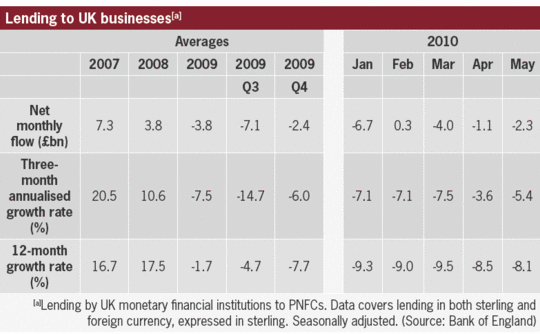
Little more needs to be said here about the perilous state of the economy and the timid approach being taken by banks to lending. Despite public protestations that they are doing all they can to support new businesses, the numbers belie these claims and tell a very different story. Figures from the Bank of England show that net lending to businesses has been contracting, with the exception of February, for almost the last 18 months.
This will not come as a surprise to anyone looking to set up on their own but it does pose problems if they are not in a position to self-fund their ventures. Sharp comments: "It used to be that a decent person could go to the bank and get a £15,000 overdraft with a sound business plan and off they would go. Now that is simply not happening and people are being offered a £1,500 overdraft that has to be reduced to zero each month."
This is a comment that Grant Ellis, chief executive at Broker Network, agrees with: "Cash is difficult to get hold of but if you have a good business plan and you have some skin in the game then it does become easier."
Reduced-risk approach
Ellis believes that the network route offers individuals the opportunity of testing a business plan before exposing it to the open sea of the commercial market.
In presenting a business plan to a network, potential new start-ups will be able to see if their plans are sufficiently robust and find out where they need to invest extra time and effort.
Ellis sums up: "The vetting process is all important." Those that don't come up to scratch will not be taken on, but at least they will have an idea of where they need to improve their offerings and tighten up their plans.
Once funding is in place and all of the administrative logistics have been taken care of, the next big challenge for a new brokerage is to start winning clients. As mentioned, restrictive covenants might mean that old clients are out of bounds in the short term, while persuading businesses to go with a broker without a track record is always difficult.
This was a problem faced by Building & Land Guarantees, particularly because many of its clients were large corporations. Russell explains: "As a small, newly established broker, you have to demonstrate your credentials and prove you are here to stay. In the insurance market, people like security and stability.
"We spent a lot of time seeing people, demonstrating our knowledge and expertise and spending time on a face-to-face basis with them. It is all about creating relationships."
Known quantity
Devoting this sort of time to build a brand is not easy and there are no guarantees of success. This is one reason that some brokers might wish to look at a franchise model, where they are buying into a name that is already established and already carries some clout in the market: the start-up might be a new franchisee but the model is already proved.
This is the view of Bob Darling, franchise director at Coversure Insurance Services, who comments: "One of the big things you get with a franchise is a brand and that is very important."
Darling also believes that franchise operations are used to setting up highstreet operations from scratch and so have developed tried-and-tested means to start brokers trading as quickly as possible with all the support they need.
A franchise is not, he believes, so much about bringing an existing firm in under the wing but rather about giving new businesses wings of their own.
However brokers go about setting up a new venture, there is no substitute for planning. Whether they want to work with a network, a franchise or do it all for themselves, they will need to investigate their options, speak to as many people as possible and seek out as many referrals and testimonials as they can.
Conceiving the idea around a new brokerage and imagining all of its possibilities will not steer the company past the honeymoon, yet having a well considered plan and backing it up with tireless gumption will help the business survive to its first anniversary and position it strongly for many more in the future.
The voice of experience
Kapil Dhir, partner at Holman Fenwick Willan, on how he set up his business
Before doing anything else, decide on the size and shape of your venture.
The legal, tax and accounting input required flows from this.
• What are you going to be? A single product business? Do you have good existing relations with insurers and do they have any requirements? What is the size of the market or markets that you are targeting? Are you going to operate in retail or wholesale markets?
• What is your intended structure? Tax and legal guidance could be useful at this point, even if only high level. Do you need a simple trading company or is a holding company structure needed? Are there fellow co-venturers who are sharing the cost of establishment and does their participation need to be reflected in that corporate structure?
• What legal and regulatory regimes apply? Assuming a UK structure, an application for authorisation will have to be made to the Financial Services Authority. You cannot carry on business as an insurance broker without authorisation and the size of fines for regulatory breaches are increasing.
• What other material contracts need to be in place? Usually, a considerable amount of time is devoted at an early stage to locating premises and procuring IT and administrative systems, including disaster-recovery arrangements.
Planning ahead
• Ensure that director and employee contracts are properly implemented. For example, carefully drafted restrictive covenants with employees, directors, insurers and sub-brokers will provide some protection in respect of client and information ownership. Make sure these contracts are consistent.
• How will you retain good staff? Increasingly, attention is being given to employee incentive schemes, which can vary in complexity from annual bonuses to phantom options to flowering share-type models under which individuals become stakeholders in their own business as opposed to paid employees.
• Develop a good relationship with your bank manager. Never underestimate the benefit of good terms with a lender. If you see an opportunity in the market, short-term debt finance is currently in favour, where it is available. Financing often involves security being taken by the lender over the business and the implications of this should be considered carefully.
• Your route to market will evolve constantly but it needs to be consistent and compliant. Marketing materials have to comply with law and regulations, as do business cards and letterheads. Your e-mail disclaimer is worth spending time on, and if you are considering web-based trading, issues such as distance-selling regulations will have to be complied with.
Only users who have a paid subscription or are part of a corporate subscription are able to print or copy content.
To access these options, along with all other subscription benefits, please contact info@insuranceage.co.uk or view our subscription options here: https://subscriptions.insuranceage.co.uk/subscribe
You are currently unable to print this content. Please contact info@insuranceage.co.uk to find out more.
You are currently unable to copy this content. Please contact info@insuranceage.co.uk to find out more.
Copyright Infopro Digital Limited. All rights reserved.
As outlined in our terms and conditions, https://www.infopro-digital.com/terms-and-conditions/subscriptions/ (point 2.4), printing is limited to a single copy.
If you would like to purchase additional rights please email info@insuranceage.co.uk
Copyright Infopro Digital Limited. All rights reserved.
You may share this content using our article tools. As outlined in our terms and conditions, https://www.infopro-digital.com/terms-and-conditions/subscriptions/ (clause 2.4), an Authorised User may only make one copy of the materials for their own personal use. You must also comply with the restrictions in clause 2.5.
If you would like to purchase additional rights please email info@insuranceage.co.uk
More on Broker

Broker Expo 2026: Early and open conversations needed for brokers and underwriters to win
As the industry starts to lose its face-to-face culture, being open to early and open appetite conversations through different channels will be key to establishing good relationships between brokers and underwriters.

Howden names Richardson to new CCO role
Howden has appointed Elliot Richardson as chief commercial officer for the group, a newly created role at the broker.

Seventeen doubles down in Gibraltar with latest buy
Seventeen Group has bought Sovereign Insurance Services, striking its second deal in Gibraltar in recent months.
Broker Expo 2026: Days of Frankenstein’s Monster consolidation over
Broker consolidation is evolving from the ‘Frankenstein’s Monster’ approach of the past to one which is more focused on culture, integration and organic growth.

Ex-Ravenhall boss launches new broker Decello
Neil Grimshaw has opened commercial broker Decello in Huddersfield, labelling it a boutique ‘advice-led’ firm for businesses and private clients.

Broker Expo 2026: AI will kill off lazy brokers
Charlie Hicks, managing director of EIC Insurance Services Limited, has highlighted old-fashioned broking still has a “massive place” in today’s insurance market and can make a firm stand out compared to competitors. And added AI might benefit those brokers who do this.

Attis CEO insists it has not reached ‘end goal’ as it sets 2027 target
Top 100 insurance broker Attis has outlined plans to hit more than £20m in revenue in 2027, having revealed it is on track to exceed £16m by year-end.
Seventeen Group recruits ex-Gallagher MD and Howden COO
Seventeen Group has appointed Stephen Smith as chief broking officer, overseeing broking and placement strategy across the group, including James Hallam and Touchstone Underwriting.