

Directing the directors
Recent legislation has seen added responsibilities placed on executive and non-executive company directors. George Cox, director general of the Institute of Directors, says his organisation is well-placed to offer assistance to concerned brokers. Diane Smyth reports
The Institute of Directors is 100 years old this year and is celebrating its centenary with a dinner at the Royal Albert Hall. Featuring Lord Browne, group chief executive of BP, and a specially-produced book, From Dynasties to Dotcoms, the celebrations will be on a grand scale. As George Cox, director general of the IoD points out, however, this is in keeping with the IoD's size.
Established as an institute by Royal Charter, the IoD now has nearly 55,000 members, made up of directors of companies large and small. Cox says that 70% of the FTSE 100 company directors are members of the IoD, but adds that most of the members run rather smaller businesses. "The IoD is unlike the Confederation of British Industry or the various Chambers of Commerce because it is a body for individuals not companies. Logically, the UK doesn't have 55,000 FTSE 100 companies," he points out.
Talking numbers
Cox says he does not know how many financial services professionals belong to the IoD, however, because the IoD does not differentiate by size or sector. He explains: "Many of the issues faced are regardless of sector or business size. We really don't get involved in sector issues. Sectors have their own institutions, whether they are electrical engineers or accountants, which serve their very different requirements."
He continues: "What everyone has in common is that they are all businessmen in a common regulatory and economic environment." Cox claims that this careful demarcation means the IoD can happily co-exist alongside business-focused or trade specific organisations such as the Confederation of British Industry or the various Chambers of Commerce.
He concedes that different types of director use the IoD in different ways. The IoD's meeting rooms are popular with small and medium-sized enterprise directors, for example, while the directors of larger companies get involved with the IoD's lobbying body.
Cox says: "We recognise that one size doesn't fit all and try to provide something for everyone. Some companies join for the networking advantages in the provinces, some value our training and development, some the helplines, and others the policy work. In networking, I bring together the FTSE 100 companies. If you want to bring together the Secretary of State or a permanent secretary for a discussion on something then you might get together 20 or 30 very high-powered movers and shakers. Similarly at a local level with local MPs."
Cox claims the IoD has three quite separate roles: services and training, professional standards, and lobbying. The institute introduced the Chartered Director qualification two years ago and though only a few hundred members have taken it up, Cox is confident this kind of qualification will become increasingly important.
He says: "I'm against legal requirements but I think people will start to realise the value of the qualification in helping them in their career. I also think there will be a certain amount of pressure from institutions and investors, which will start to want to see it. If you want to borrow money, you should be able to prove that you know how to be a director."
Indeed, Cox believes that non-listed company directors will soon start to face the kinds of demands affecting listed directors. He says the IoD has lobbied heavily on the current changes to corporate governance and warns non-listed companies not to get complacent over the fact that it does not directly apply to them.
"Corporate governance affects every quoted company, whether their business is large or small. But in general it's getting increasingly hard to be a director and the demands on listed companies will start to apply to non-listed businesses. They don't have the reporting or stock exchange requirements but they certainly have creditors they need to convince. The standards are going up all the time."
Untenable position
Cox believes that some of these standards make taking the position of director, and especially non-executive director, untenable. He cites the Equitable Life case as a good example of the impossible task now facing directors.
He says: "The board found there was a problem in meeting obligations and decided on a course of action having, as I understand it, taken careful legal advice. That was challenged in court and the board was supported.
It went to the Court of Appeal, and the board was supported. It went to the House of Lords and it was overturned. Whereupon the board felt obliged to resign. A new board of directors joined and promptly sued the outgoing directors."
He continues: "Equitable Life wasn't the type of company you would usually regard as dodgy and you wouldn't think it was unwise to join its board.
But suddenly you've got to fight a claim, you're being sued for something like £3bn, and you've got to fight your insurers, which are saying you won't be covered."
Cox believes this situation is fundamentally unfair, and says that the situation for non-executive directors is even worse. Not involved in the day-to-day running of the business, they face equal responsibility if the company gets into trouble. In fact, he believes that more and more people will refuse to become non-executive directors, setting up as management consultants and charging for their advice while remaining free from liability for the day-to-day management of the company.
And such responsibilities, Cox adds, are just the tip of the iceberg.
He points out that directors are now also facing responsibility for corporate killing, and facing calls for increasing transparency. He says: "We're seeing more pressure on directors. The days of being able to just pop in to the office and offer a few words of wisdom are long gone. There is much more risk in terms of being held accountable. You not only have to do the right thing but the best thing for the company and then explain why and show how you've done it."
Regulatory burden
Closely aligned to this is the regulatory environment that, as the insurance sector is currently discovering, is becoming increasingly onerous. Cox believes regulation has gone too far, moving beyond its original aim of ensuring fair markets and protecting individuals from abuse. He says many of the regulatory changes have been passed by the government, after being handed down by the European Union.
He says: "A great deal comes from Europe. When it comes to issues of policy few are purely domestic policy. In general, the world has got more regulated, to the extent that it is almost an impediment to business."
Cox believes that the UK is far stricter in its application of European legislation than many other EU members. He says: "The UK is super-equivalent to EU laws across the board. For example, the UK has closed down abattoirs that were cleaner than many that remain open in southern Europe."
Cox believes this is a British characteristic and not without its advantages.
"This country has always had a tradition of applying rules," he says.
"We seem to believe that if you agree to something you should apply it. It means our standards of governance and probity are some of the highest in the world, and it does mean people trust us. People come to the UK for our standards of corporate governance and director training."
However, he adds that this could also put the UK at a disadvantage. He says: "It's not even-handed across Europe and that's an issue. It's nice to be trusted but are we being mugs?"
As a result, the IoD intends to step up its lobbying in Brussels and hopes to increase its international focus further by opening offices in Paris and Amsterdam. Cox says his organisation will also continue to lobby the UK government.
He explains: "When you're up against decrees from Brussels you're not going to reverse the trend but for the more detailed elements there is room for discussion. Once the government indicates it's going to do something you're unlikely to get it to back down but if you talk to it in advance, there is more scope for persuasion."
Cox believes governments must work in partnership with businesses, arguing that globalisation means some companies have more power than governments.
He uses insurance as an example, pointing out that where travellers used to rely on consulates to help them if they were robbed or injured, they now rely on private insurance policies.
"You can see business stepping in," he says. "To some extent, companies fill vacuums that the governments can't fulfil. On a grand scale, you can't alleviate global poverty without the involvement of business. Governments simply don't have the power to do it.
Business involvement
He continues: "In Europe, and worldwide, there is recognition that severe problems cannot be solved unless businesses are more involved. For example, if you're trying to address issues of diversity in employment, businesses have to get involved. One in five of us will have a disability at one point or other and of those only 15% will work. It's simply a waste of expertise."
He says this gives companies social responsibility but argues that though the term is new, the concept has existed for years. "Corporate social responsibility means a company recognising its wider obligations to society beyond simply making a profit. There is nothing new about that.
"If you go back 100 years to the wake of the industrial revolution, companies like Rowntrees, Cadbury's and Lever Brothers broke new ground in how to treat employees, establishing charitable trusts from which we still benefit today."
Cox believes that businesses should take on this responsibility because they want to, rather than because they are forced to do so. He says: "Businesses shouldn't just think they have to comply with this or that, they should be engaged out of conviction.
"Why should directors be any less concerned about the world they are bequeathing to their children than anyone else?"
CV
1999: Director general of the Institute of Directors. Cox is also an independent member of the board of the International Financial Futures and Options Exchange, an independent director of Bradford & Bingley and of Short Brothers, a member of the development council of the National Theatre, and visiting professor at the Management School of Royal Holloway
1995-1999: UK chairman and managing director of the European services business for Unisys Corporation
1992-1994: Executive chairman of PE International, culminating in its successful sale to a larger group
1991: Sold Butler Cox to a major international group
1977: Led the formation of Butler Cox, which was subsequently floated on the stock exchange.
Only users who have a paid subscription or are part of a corporate subscription are able to print or copy content.
To access these options, along with all other subscription benefits, please contact info@insuranceage.co.uk or view our subscription options here: https://subscriptions.insuranceage.co.uk/subscribe
You are currently unable to print this content. Please contact info@insuranceage.co.uk to find out more.
You are currently unable to copy this content. Please contact info@insuranceage.co.uk to find out more.
Copyright Infopro Digital Limited. All rights reserved.
As outlined in our terms and conditions, https://www.infopro-digital.com/terms-and-conditions/subscriptions/ (point 2.4), printing is limited to a single copy.
If you would like to purchase additional rights please email info@insuranceage.co.uk
Copyright Infopro Digital Limited. All rights reserved.
You may share this content using our article tools. As outlined in our terms and conditions, https://www.infopro-digital.com/terms-and-conditions/subscriptions/ (clause 2.4), an Authorised User may only make one copy of the materials for their own personal use. You must also comply with the restrictions in clause 2.5.
If you would like to purchase additional rights please email info@insuranceage.co.uk
More on Regulation

Which? demands ban on brokers charging high motor APRs
Which? has named and shamed motor insurance brokers charging high interest rates on monthly policies and called for a ban on the practice.

No ‘particular targets’ for insurance regulation simplification, says FCA
Consumer Duty will be a building block for any future work on the simplification of insurance regulations that affect brokers, according to David Geale, executive director of consumers, payments and competition at the Financial Conduct Authority.

FCA kicked off financial year with improved authorisation service bar one outlier
The Financial Conduct Authority has upped its game on authorisation service levels in categories affecting brokers, with improvements in four areas, but one notable outlier where the performance dipped.

FCA alerts of Kent-based broker clone
Quotemetoday.co.uk has made clear it has no affiliation with Quote Me Go as the Financial Conduct Authority has reported fraudsters have been impersonating the Kent-headquartered broker.
FCA’s Knight updates on cyber insurance report
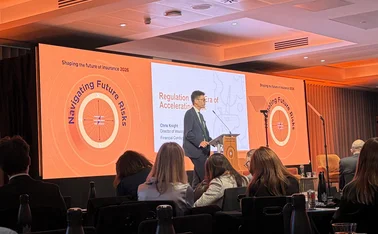
Chris Knight, director of insurance at the FCA, has updated on the progress of its report into the take up of cyber insurance, and how the regulator has to keep pace with technological advancements.
Growing FCA attestation appetite a warning for brokers
The Financial Conduct Authority has increased the level of attestation requests dished out to insurance firms in recent years, and the serious regulatory tool is one brokers need to keep a keen eye on according to compliance specialists.
Why insurer oversight cannot become another regulatory box-ticking exercise
With regulatory workloads continuing to grow and the FCA maintaining its focus on customer outcomes, Insurance DataLab co-founder Matt Scott explains why brokers need a practical, evidence-led approach to insurer oversight.

FCA cancels insurance distribution business’ permissions
The Financial Conduct Authority cancelled Professional Liability Network’s permission to carry out regulated activities on 11 September 2026.