

John Parker - Lobbying for industry change
John Parker prides himself on the Association of British Insurers' good relationships with the government and the Financial Services Authority, and says the organisation uses its status to reflect the insurance industry's opinion. Nicolle Farthing reports
John Parker was appointed head of general insurance at the Association of British Insurers in 1994. The organisation represents around 400 insurance companies worldwide but Parker says a large proportion of his time is spent monitoring UK regulatory changes and lobbying the government.
He says: "Well over 60% of the ABI's time is spent lobbying. We seek to influence the government and the media, while adding value for our members."
Lobbying is an effective tool, he says, pointing out that the government and the Financial Services Authority listen to considered argument. For example, he believes the ABI can take much of the credit for the government's decision to boost flood defences by £200m during the next three years.
He also points out that the ABI helped persuade the government to update the Pool Re terrorism fund after 11 September.
Parker says that building good working relationships with the government, the FSA and other international insurance bodies has contributed to the ABI's success.
He explains: "You can't just turn up and talk to a government department you have never met before. You have to build good long-term relationships with stakeholders, have factual evidence to back up what you are asking for, and make sure it is sensible."
Effective lobbying
Parker says the FSA's decision not to go ahead with its early proposal in CP 160 - treating small businesses in the same way as private customers - is another example of effective lobbying.
He says: "We pointed out this was not the way insurers dealt with business and so to give small business the same level of protection as private customers would significantly add to insurers costs. We proposed some alternatives and the FSA listened - in CP 187 it has proposed a split between private customers and commercial customers. It has also accepted the arguments about higher risk health products."
Parker is disappointed with the FSA's decision not to regulate travel insurance sold by travel agents, however, believing that the new regime should include everyone. "It will only confuse the customer," he explains.
However, he thinks regulation will be a positive move both for insurers and brokers. He says: "It was interesting to see that virtually all the delegates at the British Insurance Brokers' Association conference said regulation is an opportunity, not a threat."
Parker says that one of his main concerns beyond regulation is employers' liability. Recent reports into EL conducted by the Department of Work and Pensions and the Office of Fair Trading fell short of imposing any clear-cut solutions but made several short-term and long-term recommendations, which the ABI is addressing.
Good practice
In the short term, the reports recommended insurers give firms adequate notice of renewal terms. In response, the ABI and BIBA have just agreed a statement of good practice, encouraging insurers to give 21 days notice of renewal. The ABI is also looking at ways to check whether businesses have EL, and is discussing the possibility of setting up a register with the government.
In the long-term, the government has promised to look at legal costs.
The ABI believes the government will need to take radical steps to address the huge amounts paid to lawyers in EL claims, as the average cost of the claims has increased by more than 100% during the past five years.
Parker says changes to personal injury law during the past three years - in particular the introduction of no win, no fee agreements - are partly to blame for the increases, with around 40% of the total claim going on legal costs.
Parker is hopeful the new Department for Constitutional Affairs, which has replaced the former Lord Chancellor's Department, will provide the impetus for change. He says: "The Lord Chancellor's department has been wound up and this makes change easier as there is no legacy. Also, the fact that a regulation task force has said it is going to look at legal costs bodes well."
The ABI is putting a number of ideas to the government and is awaiting the second stage of the review, due in September. Parker says ideas include restricting access to litigation for cases that are disputed and cannot be resolved by mediation, creating a small claims process for less serious cases, and establishing a personal injuries assessment board similar to the Irish model.
The EL reviews indicate that the government wants to make rehabilitation more central, says Parker. "The UK has a poor record on rehabilitation. This is mainly due to the fault-based legal process," he says. "When you have to claim from the defendant it gets in the way of rehabilitation."
No fault or not no fault?
However, the ABI is not in favour of no-fault-based claims, following recent discussions with an external consultancy. The research revealed that legal costs tend to be higher where there is no fault because more claimants come forward.
It has also found that improved access to return to work schemes for victims of workplace accidents or diseases could cut the cost of compensation paid through EL insurance by up to 40%. However, this could only be achieved if the schemes were widely used and claimants obliged to participate.
Parker says: "The challenge is to come up with a more co-ordinated approach and break down some of the barriers. We are conducting further research, which we hope will show the benefits of having a rehabilitation process. We want to get all stakeholders together and come up with a national action plan."
A crucial step, according to Parker, is to have different systems for dealing with the long-tail and short-tail claims. "The real problem for EL insurance is long-tail diseases," he says. "Insurers can't plan for something that will occur 40 years later. We have suggested that there could be a fund financed by industry and commerce for these claims.
"The government understands our argument but is yet to be convinced and wants to know what economic impact it would have on the interested parties," he continues.
The ABI has commissioned a major study to consider the economic implications, looking at whether separation would enable insurers to price the risks more accurately, lead to more competition in the EL market and reduce the amount of capital insurers need to support the business.
The ABI is also currently raising government awareness of the pressure on unlimited liability for personal injury for third parties in motor claims. Parker says: "Some reinsurers strongly feel that if you are a limited liability company you cannot have unlimited exposures on your balance sheet. They are signalling that they want to see an end to these exposures."
He continues: "The government accepts that unlimited liability is anachronistic - the UK is one of only a few countries that has it. But to change the Road Traffic Act would require primary legislation, which is unlikely to be contemplated unless there are a significant number of insurers withdrawing from the market."
Parker says the UK can learn from the approach of other countries. The ABI is a member of CET, the European insurance association, based in Paris, and meets to discuss concerns on an issue-by-issue basis.
He says this is important as commercial insurance and reinsurance is a global business. Retail insurers are still very localised, though the ABI backs a more liberal, single market across the EU.
Retail therapy
Parker says: "With retail there are some barriers to trade. You might be able to produce legislation to remove these but often people want to buy locally and there may also be cultural or linguistic factors to take into consideration. We will probably see more companies having subsidiaries across Europe rather than people buying across border."
The government intends to move towards a culture of periodical payments for personal injury claims, which would replace the current practice to award lump sums. The Courts Bill revises the law on damages to allow courts to order periodical payments in personal injury cases.
To find out what impact this could have on insurers, the ABI visited Denmark to look at the system of reviewable settlements for personal injury awards in place there. He says the information provided was extremely useful.
"Danish insurers argue that reviewable payments are a good thing but then Denmark has the social insurance and tax benefits to provide for them. We gained some figures that we passed on to the government and which have helped our cause."
Parker believes what could have been a major proposal has turned into a manageable one. He says the government has narrowed down the potential reopening of the limitation of professional indemnity claims so it will be similar to the existing system of provisional damages.
"Sometimes you have a small injury that puts you at risk of a bigger injury further down the line," he explains. "For example, if you have had a knock on the head in a road traffic accident you might develop epilepsy 10 years later. Under the proposals, you would get paid for the knock on the head but there would be a clause in your award that said if you develop epilepsy you can come back and have your claim valued again."
Future definitions
There is concern, however, that this clause could widen in the future leading to reviewability being applied in more loosely defined circumstances.
"We need to see more detail," says Parker. "It is difficult to say at this stage what it would mean for insurers."
He says: "In principle, it should mean that when the courts make a damages award they will be able to make an assessment as to whether things are likely to get better or worse. And they can provide to look at the case again. We believe they will only do this for quite significant PI. There would have to be some kind of control otherwise there will be lots of secondary claims."
The change could have wide implications for insurers. At the moment, even in a severe personal injury case it might take three years for the claimant's condition to stabilise and their final award to be paid. Under periodical payments, the injured party could come back five or 10 years later to reopen the claim. Insurers would have to make reserves to deal with this, which, Parker says, could prove difficult.
He explains: "It might mean insurers would have to keep track of medical conditions on a case-by-case basis, because nobody will come back and declare that their condition has improved."
However, Parker believes the government will be cautious and avoid placing a heavy burden on insurers. "There is a recognition in government that if the law is widened, there will be more claims, which only leads to higher liability premiums," he points out.
All in all, Parker has his work cut out. The ABI has proved itself to be an influential body with both the government and the FSA. But it remains to be seen whether it can bring down legal costs and put an emphasis on rehabilitation in EL and personal injury claims in an increasingly litigious society.
Only users who have a paid subscription or are part of a corporate subscription are able to print or copy content.
To access these options, along with all other subscription benefits, please contact info@insuranceage.co.uk or view our subscription options here: https://subscriptions.insuranceage.co.uk/subscribe
You are currently unable to print this content. Please contact info@insuranceage.co.uk to find out more.
You are currently unable to copy this content. Please contact info@insuranceage.co.uk to find out more.
Copyright Infopro Digital Limited. All rights reserved.
As outlined in our terms and conditions, https://www.infopro-digital.com/terms-and-conditions/subscriptions/ (point 2.4), printing is limited to a single copy.
If you would like to purchase additional rights please email info@insuranceage.co.uk
Copyright Infopro Digital Limited. All rights reserved.
You may share this content using our article tools. As outlined in our terms and conditions, https://www.infopro-digital.com/terms-and-conditions/subscriptions/ (clause 2.4), an Authorised User may only make one copy of the materials for their own personal use. You must also comply with the restrictions in clause 2.5.
If you would like to purchase additional rights please email info@insuranceage.co.uk
More on Regulation

Which? demands ban on brokers charging high motor APRs
Which? has named and shamed motor insurance brokers charging high interest rates on monthly policies and called for a ban on the practice.

No ‘particular targets’ for insurance regulation simplification, says FCA
Consumer Duty will be a building block for any future work on the simplification of insurance regulations that affect brokers, according to David Geale, executive director of consumers, payments and competition at the Financial Conduct Authority.

FCA kicked off financial year with improved authorisation service bar one outlier
The Financial Conduct Authority has upped its game on authorisation service levels in categories affecting brokers, with improvements in four areas, but one notable outlier where the performance dipped.

FCA alerts of Kent-based broker clone
Quotemetoday.co.uk has made clear it has no affiliation with Quote Me Go as the Financial Conduct Authority has reported fraudsters have been impersonating the Kent-headquartered broker.
FCA’s Knight updates on cyber insurance report
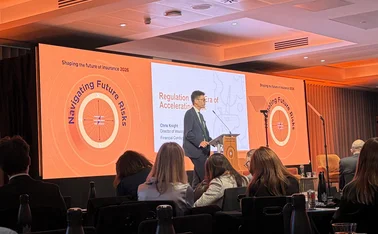
Chris Knight, director of insurance at the FCA, has updated on the progress of its report into the take up of cyber insurance, and how the regulator has to keep pace with technological advancements.

Growing FCA attestation appetite a warning for brokers
The Financial Conduct Authority has increased the level of attestation requests dished out to insurance firms in recent years, and the serious regulatory tool is one brokers need to keep a keen eye on according to compliance specialists.

Why insurer oversight cannot become another regulatory box-ticking exercise
With regulatory workloads continuing to grow and the FCA maintaining its focus on customer outcomes, Insurance DataLab co-founder Matt Scott explains why brokers need a practical, evidence-led approach to insurer oversight.

FCA cancels insurance distribution business’ permissions
The Financial Conduct Authority cancelled Professional Liability Network’s permission to carry out regulated activities on 11 September 2026.