

Regulation - Following the paper trail

Although I'm happy that the advice we give to customers is appropriate, I'm not confident that it would be obvious to anyone looking at a file. What would you suggest?
This is a timely question, with the first of this year's Financial Services Authority Treating Customers Fairly deadlines upon us at the end of March. Matching a product to the client, and the quality of advice given is the subject of two of the six TCF consumer outcomes, and one which the FSA has said will be the subject of further thematic work.
The regulatory requirements come from a background of independent financial adviser business, which incorporate a holistic customer fact-find, detailed Know-Your-Customer requirements and extensive suitability reports. Much of this now forms the basis of the general insurance rules, albeit in a reduced way which the FSA view as being proportionate to the level of risk to consumers that GI products represent. However, they still expect to be able to see a distinct and discernible link between the fact-find, the summary of cover, and the demands and needs and suitability statement.
Whether you use enquiry forms which are specific to insurance types, or a single form, or even a sample proposal form, they should be completed to a standard that enables the monitor to understand what the customer's requirements were. Remember that this review could be carried out by a supervisor at your firm, your compliance consultant, or someone from the FSA. Unfortunately, all too often in the past, these details were scrawled on a piece of scrap-paper, in largely illegible handwriting, and only consisted of the minimum information necessary to get the quotation.
In effect, your fact-find should show that you asked all of the questions necessary to rate the risk and establish what cover the customer wanted, and that the cover provided under the policy selected matched the customer's needs.
The final link in the chain is the demands and needs statement, which effectively brings these two areas together by saying, "this is what you wanted, and this policy gives that cover, and that is the reason why we are recommending it".
Of course, that is over-simplifying a little, and you will also need to incorporate non-cover related "demands" into the statement, such as "a cheaper premium" and "good claims service" as well as using your expertise to point out any underlying needs. These could be areas of cover that the customer didn't necessarily raise as "demands", but which from your knowledge and experience of insurance, you know the customer may need, and which formed the basis of your decision to recommend that particular policy over another similar contract.
- Jim Dart, director, RWA Group.
Only users who have a paid subscription or are part of a corporate subscription are able to print or copy content.
To access these options, along with all other subscription benefits, please contact info@insuranceage.co.uk or view our subscription options here: https://subscriptions.insuranceage.co.uk/subscribe
You are currently unable to print this content. Please contact info@insuranceage.co.uk to find out more.
You are currently unable to copy this content. Please contact info@insuranceage.co.uk to find out more.
Copyright Infopro Digital Limited. All rights reserved.
As outlined in our terms and conditions, https://www.infopro-digital.com/terms-and-conditions/subscriptions/ (point 2.4), printing is limited to a single copy.
If you would like to purchase additional rights please email info@insuranceage.co.uk
Copyright Infopro Digital Limited. All rights reserved.
You may share this content using our article tools. As outlined in our terms and conditions, https://www.infopro-digital.com/terms-and-conditions/subscriptions/ (clause 2.4), an Authorised User may only make one copy of the materials for their own personal use. You must also comply with the restrictions in clause 2.5.
If you would like to purchase additional rights please email info@insuranceage.co.uk
More on Regulation

Which? demands ban on brokers charging high motor APRs
Which? has named and shamed motor insurance brokers charging high interest rates on monthly policies and called for a ban on the practice.

No ‘particular targets’ for insurance regulation simplification, says FCA
Consumer Duty will be a building block for any future work on the simplification of insurance regulations that affect brokers, according to David Geale, executive director of consumers, payments and competition at the Financial Conduct Authority.

FCA kicked off financial year with improved authorisation service bar one outlier
The Financial Conduct Authority has upped its game on authorisation service levels in categories affecting brokers, with improvements in four areas, but one notable outlier where the performance dipped.

FCA alerts of Kent-based broker clone
Quotemetoday.co.uk has made clear it has no affiliation with Quote Me Go as the Financial Conduct Authority has reported fraudsters have been impersonating the Kent-headquartered broker.
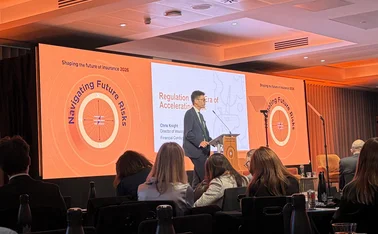
FCA’s Knight updates on cyber insurance report
Chris Knight, director of insurance at the FCA, has updated on the progress of its report into the take up of cyber insurance, and how the regulator has to keep pace with technological advancements.
Growing FCA attestation appetite a warning for brokers
The Financial Conduct Authority has increased the level of attestation requests dished out to insurance firms in recent years, and the serious regulatory tool is one brokers need to keep a keen eye on according to compliance specialists.

Why insurer oversight cannot become another regulatory box-ticking exercise
With regulatory workloads continuing to grow and the FCA maintaining its focus on customer outcomes, Insurance DataLab co-founder Matt Scott explains why brokers need a practical, evidence-led approach to insurer oversight.

FCA cancels insurance distribution business’ permissions
The Financial Conduct Authority cancelled Professional Liability Network’s permission to carry out regulated activities on 11 September 2026.