

Snooping on staff

Q. We suspect an employee on sick leave is faking illness. Can we use surveillance?
Where there is already suspicion that an employee on sick leave is not being truthful, an employer is entitled to conduct surveillance. This could be to ascertain whether an employee is sick at all, or simply the extent of an injury. The decision to take such measures should not be made lightly and a number of factors should be considered.
Covert surveillance is best as a final resort to confirm existing concerns. 'Strong suspicion' is the key phrase; surveillance should be used to gain final proof of evidence already obtained rather than as a fishing exercise. If an employee is allegedly seen taking part in a football tournament while claiming a serious back condition, then the use of surveillance may be warranted.
A tribunal is likely to accept evidence from surveillance if it shows the action was taken to protect the assets of the business, for example, to disrupt fraudulent activity. Careful consideration should be given to exactly how, where and for how long surveillance will be carried out, in order to help avoid allegations of breach of human rights and constructive dismissal claims.
Surveillance carried out in a public place is unlikely to be regarded as an infringement of privacy. Hiring an investigator to gain access to an employee's home under false pretences in order to record conversations is likely to be seen as a step too far. A tribunal will set the right to privacy against the seriousness of the alleged offence to determine if the intrusion was necessary to counter any wrongdoing by an employee.
The Human Rights Act provides somebody the right to respect for their private and family life. The right to privacy does not apply in a situation where the measures taken were necessary for the prevention of disorder and crime. The onus here would appear to be the ability for the evidence to prove the necessity for the surveillance. If surveillance does indeed prove the fraud, then, it will be seen as an acceptable method. However, if the surveillance is inconclusive, would the method, once tested, be seen as obstructive and unacceptable although in both circumstances, the initial aim was the same?
Obligations under the Act are limited to public authorities. Tribunals have demonstrated they will take the provisions of the Act into account when interpreting other legislation. Recent case law underlines the importance of following the correct disciplinary procedure in such cases. Failure has damaged the defence of the respondent company even if the surveillance appears to provide incriminating evidence. If a disciplinary hearing is to be held, make sure the employee is aware of all allegations and is able to avail themselves of proper representation. It is also advisable to seek medical advice to corroborate the 'proof' on video.
Only users who have a paid subscription or are part of a corporate subscription are able to print or copy content.
To access these options, along with all other subscription benefits, please contact info@insuranceage.co.uk or view our subscription options here: https://subscriptions.insuranceage.co.uk/subscribe
You are currently unable to print this content. Please contact info@insuranceage.co.uk to find out more.
You are currently unable to copy this content. Please contact info@insuranceage.co.uk to find out more.
Copyright Infopro Digital Limited. All rights reserved.
As outlined in our terms and conditions, https://www.infopro-digital.com/terms-and-conditions/subscriptions/ (point 2.4), printing is limited to a single copy.
If you would like to purchase additional rights please email info@insuranceage.co.uk
Copyright Infopro Digital Limited. All rights reserved.
You may share this content using our article tools. As outlined in our terms and conditions, https://www.infopro-digital.com/terms-and-conditions/subscriptions/ (clause 2.4), an Authorised User may only make one copy of the materials for their own personal use. You must also comply with the restrictions in clause 2.5.
If you would like to purchase additional rights please email info@insuranceage.co.uk
More on Regulation

Which? demands ban on brokers charging high motor APRs
Which? has named and shamed motor insurance brokers charging high interest rates on monthly policies and called for a ban on the practice.

No ‘particular targets’ for insurance regulation simplification, says FCA
Consumer Duty will be a building block for any future work on the simplification of insurance regulations that affect brokers, according to David Geale, executive director of consumers, payments and competition at the Financial Conduct Authority.

FCA kicked off financial year with improved authorisation service bar one outlier
The Financial Conduct Authority has upped its game on authorisation service levels in categories affecting brokers, with improvements in four areas, but one notable outlier where the performance dipped.

FCA alerts of Kent-based broker clone
Quotemetoday.co.uk has made clear it has no affiliation with Quote Me Go as the Financial Conduct Authority has reported fraudsters have been impersonating the Kent-headquartered broker.
FCA’s Knight updates on cyber insurance report
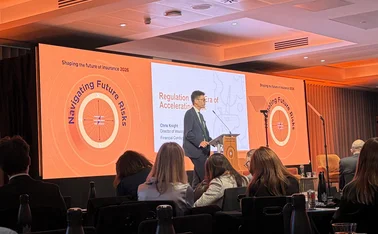
Chris Knight, director of insurance at the FCA, has updated on the progress of its report into the take up of cyber insurance, and how the regulator has to keep pace with technological advancements.
Growing FCA attestation appetite a warning for brokers
The Financial Conduct Authority has increased the level of attestation requests dished out to insurance firms in recent years, and the serious regulatory tool is one brokers need to keep a keen eye on according to compliance specialists.

Why insurer oversight cannot become another regulatory box-ticking exercise
With regulatory workloads continuing to grow and the FCA maintaining its focus on customer outcomes, Insurance DataLab co-founder Matt Scott explains why brokers need a practical, evidence-led approach to insurer oversight.

FCA cancels insurance distribution business’ permissions
The Financial Conduct Authority cancelled Professional Liability Network’s permission to carry out regulated activities on 11 September 2026.