

Back in the ring
Being short-listed for Commercial Broker of the Year at the recent British Insurance Awards says something about where Kevin Young, chairman and founder of Argyll is taking his firm. And, after a temporary absence from the acquisition arena, he is now back with the intention of doubling Argyll's size. Richard Adams reports
While many brokers lament the lack of local underwriter contact, Argyll Insurance Brokers has two underwriters from Norwich Union based at its Worthing head office; a legacy from General Accident. While this is not unique to Argyll or NU, it is one of the commercial advantages peculiar to Argyll, which caters for the top end of the standard commercial SME market, with an average premium spend of between £25,000 and £30,000.
The company's chairman and founder, Kevin Young, probably came to the attention of most in the period following the collapse of Independent Insurance as the chairman of the creditors of Independent. Despite Young's best efforts, he was unable to rescue some affected clients but he still strongly believes the industry needs champions.
Like many brokers, Young has strong views on the Financial Services Authority and the way it has gone about devising and implementing the governing guidelines for brokers. One bugbear is risk transfer and the handling of client money.
"The market needs to make more noise about this - and will do as we get into the first six monthly period. Brokers will realise how complicated it is and this is one of the primary reasons why I hope the FSA will review the situation," he exclaims, adding: "If you have a customer with five policies with a total bill, including brokerage, of £50,000, with four of the policies in the company market - there is therefore no issue under client money under the FSA.
The risk transfer debate
However, if the fifth policy is with a wholesaler - at Lloyd's for fleet, for example - a broker needs to treat this differently and commingle. But, because there is no agency with the final underwriter, as there was in the past, there is no risk transfer. The wholesaler will have risk transfer under a separate arrangement for themselves, but surely risk transfer must give better protection for the customer. I do not understand why the FSA did not make it statutory. If risk transfer applies, they have paid the insurer, if not, the client has only paid the agent and, if they go bust, the client is not protected. I am not saying it was an easy decision but brokers should have been given this."
While Young is not volunteering to champion this cause, he says, while the British Insurance Brokers' Association 'sort of is', there needs to be someone credible and with the stature to press the issue on behalf of the broking community.
The other concern he raises about regulation is the fact that brokers with up to a £1m turnover are not required to formulate a business plan. He continues: "This is potentially a big problem as there are holes in the accounts at the lower end of the scale, many of which have taken an almost tick-box approach but that have been allowed into the regime and granted authorisation anyway. All brokers should compile a business plan, as this is partly how a business proves its solvency. If this was the case, from the outset, more firms that did not make the grade would have been weeded out at the application stage. As time goes on, the FSA will uncover a lot of things it does not like. All the brokers I know are generally very professional and operate their firms to a high standard but it seems strange to allow firms in that will not, on closer inspection, make the grade.
"Another area of concern is financial stability, which adds further to the risk-transfer debate. If risk transfer is not made compulsory, can the FSA honestly vouch for a broker and assure the customer that this is a safe place to put their business?"
Regarding the European Union's plans for a Spitzer-style investigation and what it may mean for the UK, Young says: "Spitzer was about bid-rigging, which in the US, was big news. In the UK there are relationships in which there are profit shares and retention rewards and they are legitimate commercial incentives. A broker's first responsibility is to its client and, if they are placing their clients' business in a reputable market that best suits their needs, I cannot see how they can be vilified for that. It does of course depend on what the EU did. If they came in 'all guns blazing', we would have to jump, but it would not be an issue if brokers were found to be operating in ways that did not present a conflict of interest."
Like many, Young is waiting with bated breath to see how the regulatory regime under the FSA will shape up and, simultaneously, the unpredictable influence of the EU on the insurance sector. One other increasingly aired sentiment he is concerned about is the impact on the market during the first wave of reporting.
"This is more difficult than people realise and there could be a wave of consolidation as brokers realise just what is involved." As a firm that has not embarked on a great deal of acquisition activity itself, Young says Argyll - which has not acquired another firm since 2004 - is on the trail with a couple of prospects in play. And he is bullish about the outcome: "We will acquire in the next six months. We had one target that did not come to fruition recently, but we are looking to bolt firms onto our existing operation."
Consolidation strategy
And the strategy? "It is very difficult to open up in new geographical areas and a lot of careful planning and putting the correct management structure in place has to be done before this can be attempted. Argyll was built in this way, by making sure we had a good financial director, human resources, IT and other infrastructure in place and now has operations in Kent and Sussex. So now the main focus of acquisition activity will add to these existing bases."
Although, with Argyll's nearest prospect, things are still at the pre-due-diligence stage, Young is still confident that he will complete it by the autumn. "I anticipate that, by the end of September, this will be complete and the deal should take our gross written premium close to £30m."
In terms of Young's overall plans for Argyll and beyond, he says: "In terms of where we go next, I would like to double the size of Argyll in the next five years. Beyond that, it is difficult to say. I may want to double it again or I may be satisfied with my accomplishments and look at passing the business on.
"We have had some good suitors that have offered generous packages in the not-too-distant past, but it is not the right stage yet. The problem is that you can become too big to buy; the same applies in the housing market, but there is a lot of potential in Argyll and that is something for the future. My preferred route would be a management buyout and to pass the company onto those that currently manage it."
In the meantime, Argyll is back on the acquisition trail. "Venture capital is great if the market is hard," Young explains, adding: "Two years ago, brokers could grow by 15% just by standing still but, if they stand still now, they will slide back by 5% so now they have to grow by 20% to keep growing at the same pace."
Young agrees that often venture-capital pressure is not always the healthiest option for a broker. He continues: "A broker needs to be sure they have a venture capitalist that will listen and understand the business. BP Marsh was an option for us in the past and it may be an option in the future. At the moment we fund all of our acquisitions with debt as banks offer more flexible arrangements. Five years ago, banks did not treat goodwill as valid but now there has been a change in attitude - certainly with Lloyds TSB."
Starting out
Young comments that the process of starting up Argyll in 1991 would be far more difficult to achieve now. "I think start-ups in future will use existing companies as a platform for entrepreneurial endeavour in future. Starting with a greenfield site now is difficult, as the FSA would look at it more closely because it would have no history," he says.
"The greatest problem when buying a business is helping the people you are buying with it over the culture shock. If a broker has built up a business of 25 to 30 years, they will undoubtedly have issues when it comes to accepting a new role. It is like telling someone you are going to 'buy their life'. That is why cultural compatibility is crucial as these issues will present themselves even with well-made matches."
In response to the question whether he thinks the banks and building societies will finish off the work Direct Line started, as some are predicting, Young says: "Non-connected personal lines business will always be under threat. We write a lot of personal lines off the back of commercial and even have our own Argyll-branded household product. Because of the demographic of this area (Worthing), a lot of people who come here to retire want to use a broker. A lot of them are not enamoured with the internet revolution and this is something peculiar to this area, which we are in a position to capitalise on.
"Banks and building societies will come in at the price-sensitive end of the market and, therefore, the small end of SME is susceptible. However, if I was an SME going down the direct route, I would be concerned that I had all the facts right because I would not be educated enough about insurance to know everything I might need to. For example, I might not understand the reasons for non-disclosure. We have a large number of SME clients and understand the product and act on their behalf and, in the event of a claim, we can argue their case from an informed position."
Championing the clients' cause has occupied Young's time of late, having recently settled Argyll's largest-ever claim with an insurer. A sum of £2.8m has been agreed for a client that suffered a major fire. "Without our involvement the insurer may not have agreed this. It is a totally unfair situation for the client without a broker and without any professional experience."
Some of the argument, unsurprisingly, came down to the business interruption claim. Young continues: "The insurer was Fusion - and they did a brilliant job. The fire occurred in February and a settlement was agreed in mid July, which is great; it's very refreshing to me. There was no need for any legal wranglings, so credit where it is due."
Clearly, advising clients and advocating on their behalf is close to the heart of what makes Young tick as a broker and business manager. So, has there been an outstanding or defining moment in his career? "I think the best thing I ever did was to be honest about what I wanted to do."
Honesty and clarity
Young cites how writing a business plan for the regulator's benefit has become an invaluable document as it is 'spin-free', substantiated by quantifiable and provable facts, and honest. However, being honest and clear about where senior managers want to take the business is a tenet Young came to revere prior to setting up Argyll. He explains: "When I came out of Citicorp - which was divesting itself of its insurance involvement in 1991 - I went to chief executive David Woodward and said I wanted to take a chunk of its clients and set up on my own. To that, he shook my hand and said: "Because you have told me, I will let you do it." And, not only did he let me do it but he supported us. Poaching teams and clients happens - and there were those that tried to - but we really didn't need Citiorp's lawyers hounding us. Instead we had a free run as a result."
In an era of greater transparency Young's philosophy is one the regulator would probably wholeheartedly endorse, and is clearly one that has stood him in good stead and is set to continue to do so for the future.
CV
1991: founded Argyll Insurance Brokers
1987: associate director, Citicorp Insurance Brokers
1979: various management roles in insurance management
1974: commenced his insurance career at The National Transit Company, part of Sun Alliance.
Only users who have a paid subscription or are part of a corporate subscription are able to print or copy content.
To access these options, along with all other subscription benefits, please contact info@insuranceage.co.uk or view our subscription options here: https://subscriptions.insuranceage.co.uk/subscribe
You are currently unable to print this content. Please contact info@insuranceage.co.uk to find out more.
You are currently unable to copy this content. Please contact info@insuranceage.co.uk to find out more.
Copyright Infopro Digital Limited. All rights reserved.
As outlined in our terms and conditions, https://www.infopro-digital.com/terms-and-conditions/subscriptions/ (point 2.4), printing is limited to a single copy.
If you would like to purchase additional rights please email info@insuranceage.co.uk
Copyright Infopro Digital Limited. All rights reserved.
You may share this content using our article tools. As outlined in our terms and conditions, https://www.infopro-digital.com/terms-and-conditions/subscriptions/ (clause 2.4), an Authorised User may only make one copy of the materials for their own personal use. You must also comply with the restrictions in clause 2.5.
If you would like to purchase additional rights please email info@insuranceage.co.uk
More on Regulation

Which? demands ban on brokers charging high motor APRs
Which? has named and shamed motor insurance brokers charging high interest rates on monthly policies and called for a ban on the practice.

No ‘particular targets’ for insurance regulation simplification, says FCA
Consumer Duty will be a building block for any future work on the simplification of insurance regulations that affect brokers, according to David Geale, executive director of consumers, payments and competition at the Financial Conduct Authority.

FCA kicked off financial year with improved authorisation service bar one outlier
The Financial Conduct Authority has upped its game on authorisation service levels in categories affecting brokers, with improvements in four areas, but one notable outlier where the performance dipped.

FCA alerts of Kent-based broker clone
Quotemetoday.co.uk has made clear it has no affiliation with Quote Me Go as the Financial Conduct Authority has reported fraudsters have been impersonating the Kent-headquartered broker.
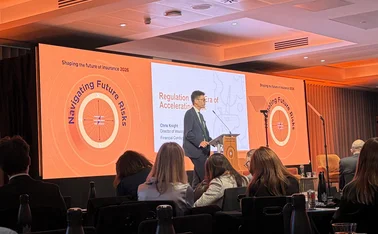
FCA’s Knight updates on cyber insurance report
Chris Knight, director of insurance at the FCA, has updated on the progress of its report into the take up of cyber insurance, and how the regulator has to keep pace with technological advancements.

Growing FCA attestation appetite a warning for brokers
The Financial Conduct Authority has increased the level of attestation requests dished out to insurance firms in recent years, and the serious regulatory tool is one brokers need to keep a keen eye on according to compliance specialists.

Why insurer oversight cannot become another regulatory box-ticking exercise
With regulatory workloads continuing to grow and the FCA maintaining its focus on customer outcomes, Insurance DataLab co-founder Matt Scott explains why brokers need a practical, evidence-led approach to insurer oversight.

FCA cancels insurance distribution business’ permissions
The Financial Conduct Authority cancelled Professional Liability Network’s permission to carry out regulated activities on 11 September 2026.