

Approaching the apex
On the eve of making an acquisition - while in the process of he and his firm being acquired - Ian Richens, chairman of FM Green, emerges from an administrative nightmare to find himself in an enviable position. He talks to Richard Adams about this, why regulation has unlevelled the playing field and brokers' need for a scapegoat
Despite Ian Richens' choice of neckwear, he is no Mickey Mouse operator. Indeed the timing of this interview finds Richens approaching the climax of his 33-year career, amid a head-spinning bout of acquisition activity - being the acquirer and the acquired all at once.
Fortunately, the army of lawyers and accountants involved in this multifariously complex process were held at bay long enough to allow him time to shed some light on this fairly unique situation before signing FM Green over to its new parent.
However, despite the deal being all but signed and sealed as Professional Broking went to press, the absence of the regulator's final seal of approval meant mention of the acquirer's name became impossible.
Simultaneously, Richens' company is readying itself to absorb another broker, which he estimates will expand its turnover by 30% to a gross premium income of £25m.
Although Richens could not disclose the final consideration, it seems the price that FM Green's new owners will pay reflects the fact that it has been innovative, particularly with specialist schemes rather than a sum based on the usual multiple-of-income basis. In fact, at the time of writing, a final figure had not yet been thrashed out but, says Richens, the greatest change for him will be answering to someone else after many years of being his own boss. "This really will be one of my main challenges - I've not had a boss since I was in my late 20s."
While Richens will not sit on the board of FM Green's new parent, it will be making good use of his established talents. He explains: "I will join the management team and my first job will be spending time with insurers and putting together packages in niche markets. I will remain as chairman of FM Green, but this will be more of a figurehead role - my main energy will be going into its parent, which is still looking to expand and acquire."
The deal puts Richens in a position coveted by many brokers, having released the cash value of his (working) life's work while gaining a new challenge that will be the finale of his career. And this is something about which Richens is understandably enthusiastic. "Instead of a premium income of £17m to play with, I will have in excess of £100m."
He continues: "There is no fixed time frame for my exit; it is a case of 'suck it and see'. But, nearing the eve of being acquired, I see it as a challenge for the next few years that will make the most of my experience."
Commenting on his choice of new parent for his firm, Richens says: "This firm best fitted the existing culture at FM Green and we were also attracted by the fact that its money is not venture capital."
Richens agrees that the venture capital route can sometimes place pressure on a firm to grow at a pace that suits the lender better than the business to which it is lending.
He continues: "I also have members of staff that have worked for FM Green for 18 years and so, obviously, I felt it my duty to get the best deal for them as well. We found the firm we eventually chose very professional to deal with and, once we had decided to go ahead, they moved very quickly."
Entrants and exits
In terms of Richens' exit in 'the next few years' and who may be in the frame to succeed him and his team, he says: "This is not fixed but we have an idea of what may happen and who would fit, having identified people as succession management material, but there are other things in play. For example, the firm we are acquiring at present may have rising stars that have management material written all over them. Equally, FM Green's new owner may have individuals in mind that they may think would be good to install at some point."
While the steady flow of acquisitions continues in the UK, many brokers watch their counterparts go through the process of selling with a view to making their own leap off the broking merry-go-round. On this note, Richens says: "If there is one thing that stands out, having almost completed this process, I would say we were not prepared for the sheer amount of time due diligence takes out of a working day. We receive complex queries and questions from two sets of lawyers and two sets of accountants and they are always trying to score points against each other." A fact that is substantuated by the five calls he received during the process of this interview.
When it comes to regulation, Richens jokes that his publicly aired views on the Financial Services Authority are likely to land FM Green with an Arrow visit sooner rather than later. However, on a more serious note, he says he is not a dissenter in the same league as Andrew Paddick, director general of the Institute of Insurance Brokers. "I am critical of the level of detail the regulator has felt it necessary to go into. They have turned an eight-page document into a 3000-page handbook, but I think this is a cultural thing in the UK."
He adds: "Whether it is health and safety rules or whatever, the British seem to go over the top with legislation and I worry that this makes us less competitive in Europe. Take, for example, a French market in which chicken meat is sold alongside live chickens - it would not be allowed here. Or ice-cream sellers must have a washbasin in their vans and, this is no joke, even those on their bikes. I am not saying this is wrong - these rules are necessary - but it is just frustrating to see other EU countries do not seem to have grasped the idea of best practice as well as we have, which inevitably equates to a productivity advantage."
Like many brokers, Richens is also frustrated by the regulator's reluctance to provide definitive answers when advising them about specific problems. "The FSA is doing some much-needed work, illustrated recently by clamping down on the likes of BPS and highlighting some of the areas that need tackling. However, because the rules are so complex, they are sometimes not prepared to give straight answers. One example was a caravan-warranty seller and the question arose: does he needed to be authorised because this is connected with the motor trade? No one at the FSA was prepared to advise us and provide us with an opinion. The FSA's response basically was to consult a lawyer as its position is to police it, not interpret in detail."
Commenting on the fact that the UK regulator has stated its desire to simplify matters, which is at odds with the likelihood that future legislation originating from Brussels will increase, Richens says: "This is an ironic situation because now Brussels seems to be looking to the UK as something of a role model."
At 57, Richens is in many ways typical of his peer group, but he warns that some will find the current situation facing brokers simply too difficult. "While there was no mass exodus prior to 14 January as predicted by many, there has been a steady trickle of mergers and acquisitions instead, but once the cost of regulation really starts to show, things could start to escalate. When the complexity of mandatory electronic half-yearly reporting hits brokers, many will have to face the hard fact that it will be more difficult in future for them to maintain bottom-line net profits."
Although a self-professed supporter of regulation, the more Richens gives air to his views, the more he seems to agree that regulation is a good thing in principle. He continues: "The FSA, by being over-interpretive in the way it applies the rules, has in turn become so complex itself that regulation is self-generating. Regulation is not a bad thing, but everyone is embroiled in red tape and I do not think the regulator has learned the lessons from the life market, i.e. that it has produced a lot more paper and has not stopped high-profile fraud, and I am not sure that customers have benefited.
"Trading for a broker is more onerous nowadays in that there are more reasons for customers to be able to come back against the broker if they do not comply with the full audit trail of the FSA. Adding to this difficulty is the soft market, which, in some areas, is positively flaccid, and I think we will see a softish market until renewals in mid 2006 when reinsurers will start putting a bit more premium on the bone."
Imarket
As one of the brokers consulted in the creation of imarket, Richens is also concerned about the future of the broking market in terms of its handle on IT. "I am apprehensive about the fact that some of the software that is available - and being used by brokers - is not compliant. Another problem is compatibility, as with some systems there is no direct link between a nominal ledger and insurers' ledgers. They are more often than not totally different and there needs to be greater integration. I think one day imarket will be the great leader but it has taken a decade just to come up with a common claims form.
"I attended a banking seminar recently where the insurance industry was held up as an example of how not to embrace IT - with disparate firms spending millions of pounds in silos. While banks had the advantage of being forced to act more homogeneously because of pressure from clearing houses, insurance has missed the opportunity; but it's better late than never and imarket has come on in leaps and bounds in the last year."
One of Richens' more bizarre ideas to create an additional source of income is a world away from broking and at one stage threatened to lure him away from his day job. After visiting the Royal Show in 1996, he and his wife fell in love with alpacas, a close relative of the llama, and are described by Richens as "like sheep with long necks".
With 52 animals on a 33-acre 'smallholding', and with each animal fetching between £3000 and £14,000 apiece, Richens has sold them to hotels in the West Country, a Noah's Ark theme park and to schools for autistic children, who apparently respond extremely well to their friendly disposition. "I wouldn't recommend alpacas as an alternative revenue generator to brokers," Richens exclaims, adding: "But, as a stress reliever, I would definitely recommend them. They are incredibly affectionate animals and, no matter how bad a day you have had, you can't help smiling when you go down into the paddock and they gather round to shove their heads under your arm." Richens' stress-relieving creatures are, in this sense, literally scapegoats. But the great business venture backfired somewhat when Mr and Mrs Richens became too attached to their alpacas, which were increasingly viewed less as stock and more as field-dwelling furry friends.
So has his flock been seeing a lot of him during the last year while new regulation under the FSA was being installed? "Yes, they have, but not just because of the FSA. The last 12 months have been the most stressful in my 33-year career because insurance has become so over-complicated.
Increasing global events
"In disaster classes such as fire and flood, nowadays it is often the misfortune of the many that is paid for by the many as opposed to the misfortune of the few being paid for by the many as there seem to be more 'one-offs'. This is illustrated by events in Boscastle and Carlisle, the like of which are seen with increasing frequency and that, while I'm no expert, could be part of a case for global warming. Also, as I said, regulation gives the consumer more reason to be able to come back at the broker if they do not comply with every jot and tittle the FSA has published."
Richens' view that insurance is essentially simple but has become more over-complicated is certainly a sentiment shared by other interviewees that have appeared on these pages; with Duncan Boyle, outgoing chief executive of Royal & SunAlliance, and Stuart Reid, chief executive of Stuart Alexander, being notably animated about this point.
However, despite the bureaucracy and lack of commonality between different insurers' policy wordings gumming up the processes of broking on a daily basis, Richens is by no means disenfranchised about insurance. In fact, when enthusing in great detail about the challenge of educating underwriters about sleep apnoea - how many are affected and how easily it can be remedied - Richens runs perilously close to missing his meeting following this interview.
With his enthusiasm firmly intact and a fresh challenge ahead of him, it looks likely that Richens' alpacas will not be seeing him hanging around the paddock during weekdays for some time yet.
CV
1997 - made FM Green a public limited company
1993 - merged FM Green with Andrew Rodgers
1972 - purchased FM Green
1970 - inspector, Royal
1967 - joined the Royal.
Only users who have a paid subscription or are part of a corporate subscription are able to print or copy content.
To access these options, along with all other subscription benefits, please contact info@insuranceage.co.uk or view our subscription options here: https://subscriptions.insuranceage.co.uk/subscribe
You are currently unable to print this content. Please contact info@insuranceage.co.uk to find out more.
You are currently unable to copy this content. Please contact info@insuranceage.co.uk to find out more.
Copyright Infopro Digital Limited. All rights reserved.
As outlined in our terms and conditions, https://www.infopro-digital.com/terms-and-conditions/subscriptions/ (point 2.4), printing is limited to a single copy.
If you would like to purchase additional rights please email info@insuranceage.co.uk
Copyright Infopro Digital Limited. All rights reserved.
You may share this content using our article tools. As outlined in our terms and conditions, https://www.infopro-digital.com/terms-and-conditions/subscriptions/ (clause 2.4), an Authorised User may only make one copy of the materials for their own personal use. You must also comply with the restrictions in clause 2.5.
If you would like to purchase additional rights please email info@insuranceage.co.uk
More on Regulation

Lords Committee demands FCA goes further and faster on home, travel insurance
The cross-party House of Lords Financial Services Regulation Committee has urged the Financial Conduct Authority to go “further and faster in implementing and enforcing its rules on home and travel insurance” as it warned the Consumer Duty has not yet led to improvements.

FSCS opens for claims from customers of failed broker Anthony Jones
The Financial Services Compensation Scheme has opened to claims from customers who paid for insurance through collapsed broker Anthony Jones (U.K.) but find themselves without the relevant cover and unable to recover the premiums by other means.

Which? demands ban on brokers charging high motor APRs
Which? has named and shamed motor insurance brokers charging high interest rates on monthly policies and called for a ban on the practice.

No ‘particular targets’ for insurance regulation simplification, says FCA
Consumer Duty will be a building block for any future work on the simplification of insurance regulations that affect brokers, according to David Geale, executive director of consumers, payments and competition at the Financial Conduct Authority.

FCA kicked off financial year with improved authorisation service bar one outlier
The Financial Conduct Authority has upped its game on authorisation service levels in categories affecting brokers, with improvements in four areas, but one notable outlier where the performance dipped.

FCA alerts of Kent-based broker clone
Quotemetoday.co.uk has made clear it has no affiliation with Quote Me Go as the Financial Conduct Authority has reported fraudsters have been impersonating the Kent-headquartered broker.
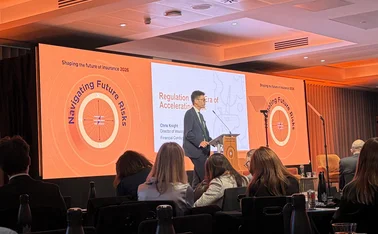
FCA’s Knight updates on cyber insurance report
Chris Knight, director of insurance at the FCA, has updated on the progress of its report into the take up of cyber insurance, and how the regulator has to keep pace with technological advancements.

Growing FCA attestation appetite a warning for brokers
The Financial Conduct Authority has increased the level of attestation requests dished out to insurance firms in recent years, and the serious regulatory tool is one brokers need to keep a keen eye on according to compliance specialists.