

The brave face of a broker-only insurer
After masterminding some sizeable deals in the last 12 months, Barry Smith, chief executive of Fortis, is certainly making his mark on the company. But, after taking a hit from the onslaught of direct motor insurers earlier this year, he talks to Richard Adams about his response and the battle to help brokers deliver quality in a volume-driven world
First impressions of Barry Smith communicate a lot about the way he runs Fortis' UK arm of the Benelux insurer. The tie-shunning chief executive's relaxed manner sets the tone from the top down at 'family Fortis'. Even in the face of the most adamant scepticism, Smith would be found to be inescapably personable. But behind the affable, easy-going exterior, Smith is absolutely on a mission to build greatly on his company's steady heritage as a broker-only motor insurer - a fact illustrated partly by some of the sizeable businesses Fortis UK has picked up in the last 12 months.
About the latest purchase of personal lines affinity specialist OutRight, Smith calmly talks about its strategic alignment with Fortis' aims and how it adds affinity market opportunities to the insurer's armoury. But, reading between the lines, it is not difficult to detect - beneath this very laudable yet understated reasoning - the thing that Smith really relishes is that, with OutRight under Fortis' wing, it is in a position to punch above its weight and have a crack at the larger corporates.
Broadening horizons
Clearly, an appetite for acquisition exists within the insurer - the view being that now is the time to broaden its offering to brokers while keeping a watchful eye on its tried and trusted reputation. Smith explains: "Acquisitions are a definite part of Fortis' desire to increase net profits from 15% to 30%. In the UK it has already outgrown the market in terms of scale change but, while acquiring the right businesses is important, organic growth is the central plank of our strategy."
Fortis, Smith adds, is centred largely on the development of products, and how it gets them to market. And Fortis, under Smith's leadership, is obviously a company intent on gaining a wider influence than it has had historically.
While Smith, as the main driver behind this, has the kind of ambition that no doubt gains nodding approval from the board of Fortis International, he claims the company's direction is driven by brokers, beyond the obvious need to increase profits for its ultimate parent. "From community brokers to retail brokers we are constantly asked the same thing - to provide a fuller range of products," he says, adding: "But it is critical that we do this maintaining the values we are known for and totally underpin everything with high-quality service.
Sentiment Surveys
The fact that Fortis has crept onto the radar of Professional Broking's Sentiment Surveys - as one of the insurers that brokers consider offer the best service - would tend to support Smith's vision that an insurer can provide quantity and quality. The fact that the majority of PB's readers are predominantly commercial lines could also indicate Fortis' efforts in the commercial area. Smith adds: "Obviously, the launch of a commercial vehicle will not be the biggest income line for us this year, but we need to offer a wider range."
Smith certainly talks the talk when it comes to servicing brokers: "Providing access to underwriters and key decision-makers and getting those decisions made quickly," are certainly all things that brokers want to hear. But, the fact that a company of Fortis' size is nudging into territory occupied by much larger players - when brokers are asked to anonymously rate providers on service - shows the wishes of this chief executive are filtering through in the right parts of the business.
Smith continues: "It is undoubtedly an advantage that there are no legacy issues at Fortis. The reverse is true - we have a positive legacy and this is also underpinned by a superb team, which obviously is fundamental to the success we create as a business. Everyone here understands the common purpose and there are excellent levels of engagement and alignment between the staff and customers."
Family Fortis
Certainly, the atmosphere at Fortis' Eastleigh offices is conducive with that of a financially strong, growing company and Smith is a keen exponent of senior staff setting the tone for the company's culture. He explains: "Obviously, we invest in the skills and development of our staff but they are also people and how they feel about what they do is central to how well they do it. We had some feedback from some managers that had undergone training and they came up with the phrase 'family Fortis', which had a huge impact. They were not obliged to come up with a slogan but it just surfaced as a phrase that encapsulated the culture that marries a high degree of informality with a great focus on what we want to collectively achieve. This is born out in our attrition rates, which are reducing year on year."
While Fortis may well be doing a good deal to position itself as the next David to the more established insurers' Goliath, it did receive a blow on home turf earlier this year when it suffered a 5% reduction of its gross written motor premiums. Smith dismisses the suggestion that this was because Fortis was preoccupied with its expansion in other lines. Instead, he is stoic about what he regards as the real cause of the slippage and the seemingly relentless onslaught from direct motor players old and new: "Motor pricing has been squeezed and squeezed in the last 12 to 18 months, but insurers have to underwrite for profit - which everyone says they are doing - right? But it will be very interesting to look at the end-of-year results of some insurers."
While Smith will not be drawn into talking about the specific culprits he suspects, he is of course alluding to the time-honoured tradition of insurers playing for market share in a soft market.
He continues: "Some companies will get a return on capital, but there will be market erosion because of claims inflation. The proof of the pudding is in the numbers and they may show that, for some insurers, it has been about market share." He adds: "But we insure 1.3 million cars in the UK and we absolutely intend to stay in this market and compete aggressively."
Smith's own perspective and longer-term thinking is certainly what brokers would hope and expect the chief executive of a broker-only insurer to be. He sees a direct link between the ability to produce consistent results and service quality and asks the rhetorical question: "Why would a company like Fortis invest so much in product development and not ensure the service is there to sustain it?"
Growth strategy
Although Fortis is growing its product range and, as previously stated, wants to balance the split of its personal/commercial portfolio, Smith will not be drawn on specific targets for commercial growth and seems to suggest that there are none. "There are no absolute levels of growth we want to achieve in commercial, i.e. in commercial motor. But there is an ongoing research programme into identifying potential areas for growth and product improvement."
Despite the setback in motor, other areas of the business certainly are motoring. "Growth in household has been electric," he says. Growth in travel too shows willing take-up from brokers of Fortis' efforts to offer them a wider product range. So far, the strategy of offering more to its existing agency base, as opposed to the emphasis being on growing the number of brokers it uses, to the mutual benefit of Fortis and its brokers seems to be well gauged.
But, is Smith, as a provider of small commercial packages, concerned about the commoditisation happening at the SME end of commercial and its effect on brokers? "The market will adapt to volume macro and economic changes - it has done in the past when there have been predictions that the end is nigh for brokers, why would it not adapt again? Independent brokers will decide where it is best to compete; in personal lines there are brokers enjoying a roaring success, partly by clever use of technology such as automating the process."
When asked what he thinks of the common assumption that larger, more complex risks are safe in the hands of brokers - particularly now the second generation of automated underwriting is being introduced - he says: "The more complex commercial risks are where brokers are able to add huge value." And again he casts doubt over the efforts of some insurers to be able to show financial justification for their direct commercial efforts. He adds: "Some competitors may not see financial returns and again the proof of this will be shown in their end-of-year results."
He continues: "Brokers have a special place in the value chain when it comes to complex risks and those that do it well have shown exemplary adaptability and resilience and I see no reason why brokers will not continue to do this and survive well in future."
While initially reluctant to talk about another great challenge to brokers, namely regulation, on the basis that much has already been written on the subject, he is concerned about the regulator's communication with the market. Having just received an Arrow visit on the morning that this interview took place, he is understandably reluctant to talk about it, although he did not appear to be too scarred by the experience.
"It is early days in terms of what the Financial Services Authority is seeing when it visits firms but I hope that early feedback is forthcoming before too long. The subject has been well reported on but regulation has added costs to the process and many are also asking the question: does more documentation really help customer understanding? I think such matters will require significant review and, to reiterate, I think emerging themes from Arrow visits and their translation into best-practice guidelines should be issued as quickly as possible."
The regulatory regime
Smith also alludes to the need for the industry, while assimilating what regulation means for individuals and their firms, to maintain the pressure on the regulator to ensure it goes about regulating it properly. However, he does say that, as far as he can see, the regulator is monitoring how it can continue to improve the regime and the better achieve its targets.
Concerning how the broker market may change in future, Smith says: "Distribution is a central pillar of insurance and how customers' buying habits change - with take-up of internet sales, strategic alliances with brokers and customer buying groups - shows the ongoing challenge of keeping abreast to be able to meet the customers' needs. I am sure there will be more mergers and acquisitions and the emergence of a large number of stronger players in future as a result of the increasing pressure on distribution."
It is clear that Smith's ethos is - to use of one his favourite phrases - closely aligned with brokers in the UK. He completely waives the question about what he aspires to do after his present role and is clearly content to push Fortis to deliver its stated aims and is thriving on being at the helm of a firm that is snapping at the heels of insurers many times its size.
Only users who have a paid subscription or are part of a corporate subscription are able to print or copy content.
To access these options, along with all other subscription benefits, please contact info@insuranceage.co.uk or view our subscription options here: https://subscriptions.insuranceage.co.uk/subscribe
You are currently unable to print this content. Please contact info@insuranceage.co.uk to find out more.
You are currently unable to copy this content. Please contact info@insuranceage.co.uk to find out more.
Copyright Infopro Digital Limited. All rights reserved.
As outlined in our terms and conditions, https://www.infopro-digital.com/terms-and-conditions/subscriptions/ (point 2.4), printing is limited to a single copy.
If you would like to purchase additional rights please email info@insuranceage.co.uk
Copyright Infopro Digital Limited. All rights reserved.
You may share this content using our article tools. As outlined in our terms and conditions, https://www.infopro-digital.com/terms-and-conditions/subscriptions/ (clause 2.4), an Authorised User may only make one copy of the materials for their own personal use. You must also comply with the restrictions in clause 2.5.
If you would like to purchase additional rights please email info@insuranceage.co.uk
More on Regulation

Which? demands ban on brokers charging high motor APRs
Which? has named and shamed motor insurance brokers charging high interest rates on monthly policies and called for a ban on the practice.

No ‘particular targets’ for insurance regulation simplification, says FCA
Consumer Duty will be a building block for any future work on the simplification of insurance regulations that affect brokers, according to David Geale, executive director of consumers, payments and competition at the Financial Conduct Authority.

FCA kicked off financial year with improved authorisation service bar one outlier
The Financial Conduct Authority has upped its game on authorisation service levels in categories affecting brokers, with improvements in four areas, but one notable outlier where the performance dipped.

FCA alerts of Kent-based broker clone
Quotemetoday.co.uk has made clear it has no affiliation with Quote Me Go as the Financial Conduct Authority has reported fraudsters have been impersonating the Kent-headquartered broker.
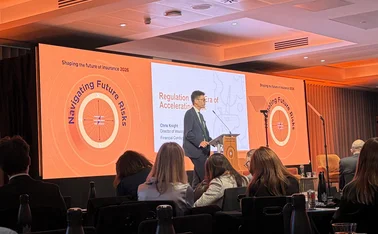
FCA’s Knight updates on cyber insurance report
Chris Knight, director of insurance at the FCA, has updated on the progress of its report into the take up of cyber insurance, and how the regulator has to keep pace with technological advancements.

Growing FCA attestation appetite a warning for brokers
The Financial Conduct Authority has increased the level of attestation requests dished out to insurance firms in recent years, and the serious regulatory tool is one brokers need to keep a keen eye on according to compliance specialists.

Why insurer oversight cannot become another regulatory box-ticking exercise
With regulatory workloads continuing to grow and the FCA maintaining its focus on customer outcomes, Insurance DataLab co-founder Matt Scott explains why brokers need a practical, evidence-led approach to insurer oversight.

FCA cancels insurance distribution business’ permissions
The Financial Conduct Authority cancelled Professional Liability Network’s permission to carry out regulated activities on 11 September 2026.