

ATE: Group Litigation: Collective danger ahead


Ever since the Woolf reforms removed legal aid for civil claims in 1999, a fearsome uprising has threatened, looming as a storm cloud over the insurance industry, writes Ralph Savage.
It seems that nothing strikes fear into the hearts of insurers more than the prospect of a united group of claimants seeking redress; all for one in the hope of generating compensation to match their injuries or financial losses.
If a poll were carried out asking the general public what they knew of their right of recourse in the event of accident or injury, it is pretty easy to believe that, through consistent advertising reminding us every day of how to make a claim, we are all pretty well informed. Yet the fact that a mechanism already exists for collective action is less well known and, according to many experts in the field, it is increasingly likely to be implemented as a means of redress.
Known as the Group Litigation Order, the mechanism has been in existence in some form or other for more than 10 years; a list of more than 70 currently in action is available on Her Majesty's Court Service website. Werner Schaad, managing director in casualty underwriting at Swiss Re, says there is a clear trend towards the creation of collective redress schemes throughout the European Union, with Poland and Italy having recently introduced them and Belgium drafting similar legislation.
"Court-based schemes place a premium on the role of the judge, who decides whether or not to group individual claims. Courts therefore act as a gatekeeper and safeguard against abuse of the system," says Schaad. "The scheme is used in England and Wales, Spain, Germany and the Netherlands. The systems vary but they empower qualified associations such as consumers' rights groups to represent the interests of individuals. Public authorities in the UK, Ireland, Nordic countries and the Netherlands have the power to bring collective actions."
The right case
As the HMCS list points out, in the UK we have already seen some striking examples of the GLO in action. Two cases of note have recently hinted at a trend: the Linkwise 'sofa litigation' and more recently a GLO involving almost 2000 claimants who have brought a personal injury claim against baby buggy manufacturer Maclaren.
Richard Langton, a partner with Russell Jones & Walker, is acting on behalf of the Maclaren claimants. "The case is a classic multi-party action," he says. "In isolation, none of those people would have thought of doing anything, yet they were alerted to the issue by coverage of an enormous product recall in the US and it prompted them to contact us."
Jim Bryant, partner at defendant law firm Halliwells, says that group litigation should not necessarily be compared directly with its US counterpart, the class action law suit, because the UK's opt-in system creates a cost-benefit challenge for the claimant side. "They must calculate this carefully before pursuing a GLO," he says. "Why would they want to drum up publicity to a potential cohort of many thousands, only to find that 98% of them haven't got a claim? The processing costs alone would swallow up the profit margin immediately, while claimants who joined the group register only to drop off later would create costs headaches for their side."
As Bryant's comment suggests, predicting whether or not GLO will become the liability claims trend of the 2010s is no simple task. For legal expenses insurers, opportunities to profit are available: it is just about picking the right case. Tony Buss, managing director at Arag, believes the number of GLOs being brought is on the increase, with a consequent need for funding in terms of after-the-event insurance. He says: "The area of law we are seeing the interest in is Competition Act cases. For example, a company might be acting unlawfully in terms of a breach of Competition Act rules and is perhaps accused of price fixing or running a cartel. The Act has been beefed up in the last few years and damages can be fairly large."
Buss explains that Arag is reviewing a group action with hundreds of claimant businesses potentially against a similar number of defendants: "In this instance, we are considering our options of whether to underwrite ATE insurance for a single GLO or choosing a number of test cases; I expect the latter. If they are successful then we can extend outwards from there."
Richard Myrtle, managing director at legal expenses insurance broker Universal Legal Protection, adds that there is an appetite among insurers, though the question about what area of law or what cases might be best to underwrite depends on what the insurer finds most palatable. He says: "With personal injury, there is a risk that some claimants will have a less strong case than others and this results in issues about when the policy is expected to respond."
Myrtle's hunch is that GLOs will provide the mechanism for shareholder actions as claimants gather together to take on financial institutions. He says: "These are being formed as we speak. It may be that they are fought as test cases or pilots, though ultimately they will be GLO cases. ATE insurers may be attracted to this potential market but the problem then is how much capacity will they need? Significant actions may have to be syndicated among a number of insurers."
Risk and reward
Writing high-value deferred ATE policies, those for which the premium is paid only upon receipt of costs from the losing side, is a high-stakes game and Richard Langton is less convinced that there is an appetite from legal expenses insurers to become involved. He points to a recent case involving Zurich, in which 300 claimants, who were part of a 4,000-strong GLO, had their claims rejected, saying this may have put some legal expenses insurance providers off.
Known affectionately as 'the sofa litigation', a group of retailers that had sold furniture containing a substance that causes rashes and skin burns - manufactured by the company Linkwise - were sued under a GLO. Liability was admitted and compensation of £20m is now due, yet the 300 or so of these claimants who had purchased their furniture from Land of Leather (others were customers of Argos and other retailers) ultimately lost out when it emerged that Zurich could avoid indemnifying the Land of Leather claimants because this retailer had already received compensation from Linkwise of $900,000 before going into administration itself. Justice Teare ruled in March 2010 that these claimants were not entitled to any money (this could still be challenged in the Court of Appeal): what this means for an ATE insurer assessing a personal injury GLO, says Langton, is that budgeting to recover costs to pay a deferred ATE premium from 4,000 claims and then losing 10% of that revenue could be the difference between profit and loss.
"The facts of the Maclaren case are therefore an absolutely classic reason why ATE insurers hate it," says Langton. "We have an admission of liability, reasonable value cases; we are going to recover the costs aren't we? What if 10% of the cases suddenly disappear because the indemnity insurer says 'oh didn't we tell you? We reserved our position regarding indemnity' and suddenly the ATE insurer loses that 10%?"
With complaints as vehement as these, it seems reasonable to assume that the Maclaren case must have failed to secure ATE cover. "It opted to write each policy for this GLO on an individual basis, creating a lot of administration and policies that were less than £1,000 each," confirms a relieved Langton. "We hope our ATE insurers will get back 1200-1500 premiums in the Maclaren case, though this is bound to be challenged by the defendant for being excessive."
From the point of view of the insurance industry, which covers all and sundry, collective redress systems offer some significant advantages, not least that large numbers of consumers can be dealt with in the most cost-effective and timely manner possible. Yet in this high-stakes game, as long as the house does not change its rules and remove recoverability of ATE premiums, all bets will remain firmly on the table.
Source: PB – May 2010
Only users who have a paid subscription or are part of a corporate subscription are able to print or copy content.
To access these options, along with all other subscription benefits, please contact info@insuranceage.co.uk or view our subscription options here: https://subscriptions.insuranceage.co.uk/subscribe
You are currently unable to print this content. Please contact info@insuranceage.co.uk to find out more.
You are currently unable to copy this content. Please contact info@insuranceage.co.uk to find out more.
Copyright Infopro Digital Limited. All rights reserved.
As outlined in our terms and conditions, https://www.infopro-digital.com/terms-and-conditions/subscriptions/ (point 2.4), printing is limited to a single copy.
If you would like to purchase additional rights please email info@insuranceage.co.uk
Copyright Infopro Digital Limited. All rights reserved.
You may share this content using our article tools. As outlined in our terms and conditions, https://www.infopro-digital.com/terms-and-conditions/subscriptions/ (clause 2.4), an Authorised User may only make one copy of the materials for their own personal use. You must also comply with the restrictions in clause 2.5.
If you would like to purchase additional rights please email info@insuranceage.co.uk
More on Insurer

rrelentless and Zurich team up on specialist haulage
Managing general agent rrelentless has expanded into haulage fleet motor insurance backed by Zurich capacity.

Moody’s keeps stable outlook for UK P&C insurers
Ratings agency Moody’s has maintained a stable outlook for property and casualty insurers in the UK, with economic growth expected to balance pricing pressures.

Insurance fraud hits £1.34bn as criminals target bigger payouts
The value of insurance fraud detected by insurers jumped 14% to £1.34bn in 2025, despite the number of fraudulent claims falling, according to the Association of British Insurers.
Broker Expo 2026 Countdown Q&A: Pen Underwriting’s Nick Milton
Nick Milton, head of UK and European distribution at Pen Underwriting, advises the next generation of insurance professionals to “get out and meet people”, as the MGA looks forward to talking to brokers about its mid-market PI and cyber propositions at Broker Expo.
Arch’s Ian Grundy on bringing specialist expertise closer to brokers
As Broker Expo returns to the NEC, Arch Insurance is once again ready to engage with their brokers. Ian Grundy, regional manager for the Midlands and South West, shares what’s changed at the insurer over the past year and why he thinks it’s worth setting aside 15 minutes to stop by at Stand 17.

Aviva calls on Ofcom to assist in fight against ghost broking
Aviva has urged Ofcom to use its consultation on Fraudulent Advertising Codes of Practice as an opportunity to strengthen online advertising rules, as the insurer has supported its proposals for tougher action to deter the threat posed by online insurance fraud.

Zurich completes £8bn Beazley deal as CEO Cox exits
Zurich Insurance Group has completed the acquisition of Beazley, to create what it claims to be the world's largest specialty insurance business.
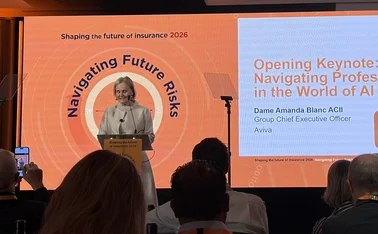
Blanc urges CII to keep pace with AI developments
Amanda Blanc, group CEO of Aviva, has urged the Chartered Insurance Institute to “stay relevant” as she called on the CII to keep its qualifications up with the speed of artificial intelligence developments.