

Read the warning signs
Brokers need to pay more attention to the effects of the introduction of legislation such as the Corporate Manslaughter and Corporate Homicide Act (2007). Doing so will help to keep clients on the right side of the law and could also improve value-add business, argues Edward Murray.
This May saw the first case brought against a firm under the Corporate Manslaughter and Corporate Homicide Act (2007). The legislation came into force in April 2008 and, while it has enjoyed a high profile, this is the first time that it has been called upon.
Unexpectedly, Cotswold Geotechnical Holdings, the firm facing trial, is a relatively small operation with a turnover of £330,000. It had been thought that the legislation would apply in cases where multiple deaths had occurred and much larger corporations were involved but this has not proved to be the case. As such, the lesson for brokers is that it is not only their top-end clients that need to be wary about their responsibilities under the Act. Where smaller firms are involved, it is often easier to show where breakdowns in safety procedures occurred and whether or not this amounted to a gross breach in the firm's duty of care.
In dealing with the extra liability created by the new Act, there has not been a uniform response from insurers and this is something that brokers will want to examine in some detail.
Natasha Agius, underwriting director at Towergate Commercial Underwriting, explains: "A lot of companies have taken a different stance on it. We have issued bulletins to all our agents advising them of how our cover would respond; our standard cover would cover them in terms of court fees and we have reacted quickly."
Agius says that some insurers have added endorsements to their policies or have introduced an inner limit, which suggests that this is something brokers may want to keep an eye on. As Agius says: "The industry is responding in different ways and brokers need to be aware of this."
Individual responsibility
While the Act is aimed at organisations, new health and safety regulations have shone a spotlight on individual company directors and managers.
The Health and Safety Offences Act (2008) came into force on 16 January 2009 and has bolstered the sentencing powers of the courts to take action against those that break health and safety laws.
In the Magistrates' Court, possible fines have been pushed from £5,000 for each offence to £20,000, giving these courts much greater power. In the past, there has often been an unwillingness from Magistrates' Courts to handle certain health and saftey cases because they believed their sentencing powers to be inadequate, however we are likely to see more trials come to court with the new legislatory changes.
In the Crown Court, the fines remain unlimited but individuals can now be imprisoned if found guilty - even in non-fatal cases.
Given the pressure on resources at the Health and Safety Executive, Chris Green, partner at law firm Weightmans, feels that a rash of smaller cases brought against firms and their managers is unlikely; he believes that the focus will remain on larger offences in which the most serious breaches occurred. Patricia Baxter, head of the London Safety, Health and Environment Group at law firm Beachcroft, comments: "It is likely to affect smaller companies where one person can easily be identified as being at fault."
However, the new sentencing powers of the court work out in practice, firms need to be aware of their corporate and personal liabilities and protect against them effectively.
Unfortunately, both Green and Baxter say knowledge of the new sentencing regime is mixed, on which Green comments: "A lot of boards are still a bit surprised about this legislation."
Agius says that the lack of understanding in parts of the broking and business communities about the Health and Safety Offences Act (2008) is 'quite scary and surprising'.
Towergate Commercial Underwriting is working closely with brokers to offer support and information on changing legislation. Agius says brokers that have an agency with the firm have access to information and resources through its Business Law Gateway.
Peter Staddon, head of technical services at the British Insurance Brokers' Association, says that whether through working with insurers or setting up links with local lawyers, it is imperative that brokers gain some understanding of the changing legislative environment and the implications for their clients.
If brokers are unable to advise clients on these issues then they will end up losing them and Staddon highlights: "If they do not know about it then another broker will." When the role of the broker is increasingly one of offering added value to clients, being able to talk them through these changing liabilities and providing protection against new risks has to be a major focus.
Another area of potential concern for businesses is the Environmental Liability Directive 2004/35/EC. Initially, it was due to be implemented by member states no later than 30 April 2007. However, many states - including the UK - missed this deadline and it was only at the beginning of March that regulations were brought into force in England. Scotland, Northern Ireland and Wales are in the process of finalising their own sets of rules and they are expected to come into force later this year.
Rather than provide access to compensation for injured third parties, the legislation seeks to enforce the need for firms that have caused environmental damage to repair or replace the habitat that they have ruined.
Firms polluting a lake, for example, would have to restore it to its former state and, should this prove impossible, they would be tasked with creating a replica environment in an alternative location. Depending on the size and scale of any damage, putting the appropriate remedy in place could be hugely expensive.
Scant choice
At the moment, there is little on offer from insurers to cover this risk and Agius says: "Not many people have responded with a product offering for clients. We are researching and looking at putting together a product and we are looking at it as a separate policy, one outside our general commercial offering."
To date, there are no relative cases or examples of how the legislation has been used against firms and so designing and pricing the cover appropriately is a difficult task.
How quickly this niche area develops remains to be seen and a large part of that will depend on the reaction of the broking community, as Agius explains: "We will have to wait to see how much focus this garners from brokers and how much they feel their clients need it." There are already some covers available and Biba has introduced an online quoting system - underwritten by Ace Europe - which seeks to provide insurance against the new range of liabilities now in place.
It will be interesting to watch how the market reacts and if a wide spectrum of covers becomes available over the coming months. For brokers, the challenge remains accessing up-to-date technical information regarding the legislation and then working through the practical implications for their clients.
If brokers have clients operating across UK, taking the time to see how the environmental legislation that is introduced in Scotland, Wales and Northern Ireland differs from that now in place in England will prevent any unwelcome surprises.
There are often differences in the laws applied in each of the home nations and this is particularly true between Scotland and England.
Perhaps the best example of this recently was the decision in March by the Scottish government to pass The Damages (Asbestos-related conditions) (Scotland) Act and overturn the House of Lords judgment that said people with pleural plaques could not raise an action for damages.
It will take time to assess how many cases are actually brought in Scotland but, for brokers, the point must be that clients operating throughout the UK could be liable to very different actions depending on where their activities are based.
At a time when the covers in place are coming under intense pressure and firms are looking to reduce their insurance spend where possible, the irony is that these same businesses face more liabilities than ever before and must protect themselves appropriately to safeguard their operations.
Helping businesses to keep on top of their liabilities, mitigate them where possible and place suitable levels of insurance remains the focus of the broking market, though it is not a job that is becoming any easier in the face of the evolving statute books.
Only users who have a paid subscription or are part of a corporate subscription are able to print or copy content.
To access these options, along with all other subscription benefits, please contact info@insuranceage.co.uk or view our subscription options here: https://subscriptions.insuranceage.co.uk/subscribe
You are currently unable to print this content. Please contact info@insuranceage.co.uk to find out more.
You are currently unable to copy this content. Please contact info@insuranceage.co.uk to find out more.
Copyright Infopro Digital Limited. All rights reserved.
As outlined in our terms and conditions, https://www.infopro-digital.com/terms-and-conditions/subscriptions/ (point 2.4), printing is limited to a single copy.
If you would like to purchase additional rights please email info@insuranceage.co.uk
Copyright Infopro Digital Limited. All rights reserved.
You may share this content using our article tools. As outlined in our terms and conditions, https://www.infopro-digital.com/terms-and-conditions/subscriptions/ (clause 2.4), an Authorised User may only make one copy of the materials for their own personal use. You must also comply with the restrictions in clause 2.5.
If you would like to purchase additional rights please email info@insuranceage.co.uk
More on Regulation

Which? demands ban on brokers charging high motor APRs
Which? has named and shamed motor insurance brokers charging high interest rates on monthly policies and called for a ban on the practice.

No ‘particular targets’ for insurance regulation simplification, says FCA
Consumer Duty will be a building block for any future work on the simplification of insurance regulations that affect brokers, according to David Geale, executive director of consumers, payments and competition at the Financial Conduct Authority.

FCA kicked off financial year with improved authorisation service bar one outlier
The Financial Conduct Authority has upped its game on authorisation service levels in categories affecting brokers, with improvements in four areas, but one notable outlier where the performance dipped.

FCA alerts of Kent-based broker clone
Quotemetoday.co.uk has made clear it has no affiliation with Quote Me Go as the Financial Conduct Authority has reported fraudsters have been impersonating the Kent-headquartered broker.
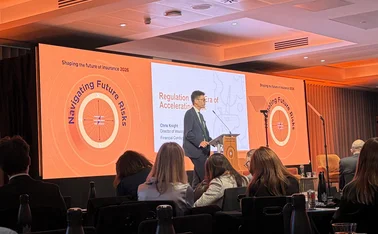
FCA’s Knight updates on cyber insurance report
Chris Knight, director of insurance at the FCA, has updated on the progress of its report into the take up of cyber insurance, and how the regulator has to keep pace with technological advancements.

Growing FCA attestation appetite a warning for brokers
The Financial Conduct Authority has increased the level of attestation requests dished out to insurance firms in recent years, and the serious regulatory tool is one brokers need to keep a keen eye on according to compliance specialists.

Why insurer oversight cannot become another regulatory box-ticking exercise
With regulatory workloads continuing to grow and the FCA maintaining its focus on customer outcomes, Insurance DataLab co-founder Matt Scott explains why brokers need a practical, evidence-led approach to insurer oversight.

FCA cancels insurance distribution business’ permissions
The Financial Conduct Authority cancelled Professional Liability Network’s permission to carry out regulated activities on 11 September 2026.