

Thrills, spills and market pressures
2004 looks to be more stable than 2003, with worldwide economic growth leading to fewer ups and downs. Andrew Clare looks forward to a smoother ride
Last year certainly proved eventful for financial markets, from the Iraq conflict precipitating a collapse in equity market valuations to multi-year lows in March, followed by widespread fears of deflation propelling government bond prices to multi-year highs in June. All in all, the financial markets gave investors a tough ride last year. However, Legal & General believes the year ahead should prove less alarming.
Though the spur to the equity market recovery in late March was the realisation that the economic implications of the conflict in Iraq would be fairly limited, the rebound continued as equity investors began to sense that a broad economic recovery was under way. This was led by the US, aided by Asian economies, and then more recently by economies in Europe and Japan.
Profits and productivity
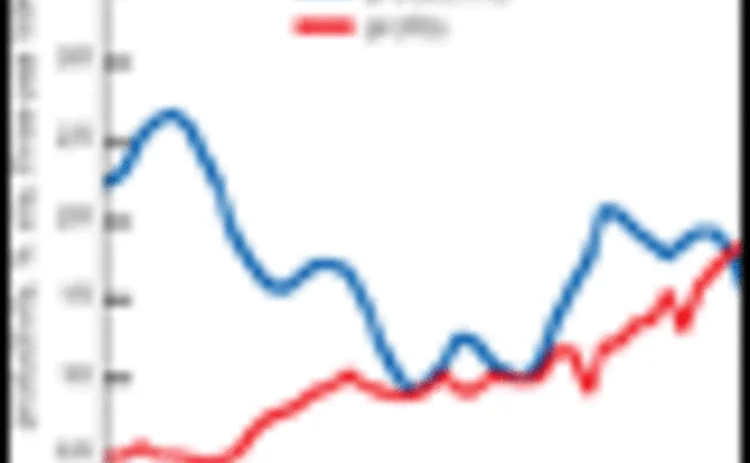
One of the main features of this economic upturn was the recovery in US corporate profits (represented by the red line in Figure 1). However, much of the improvement in profitability has come about as US companies have squeezed out higher output from a smaller workforce. In other words, productivity growth (shown as the blue line in Figure 1) has been even more impressive than the profits recovery.
Similar trends emerged outside the US as corporations continued to repair their balance sheets. This concentration on balance sheet improvement and rising corporate cash flows also benefited corporate bond investors. Corporate bond spreads narrowed during the year as evidenced by out performance of sterling corporate bonds over gilts during 2003.
The themes established during the past six months will probably continue into 2004. With respect to the global economy some of the forward-looking confidence indicators have been spectacularly positive. This renewed confidence has been particularly marked in the manufacturing sector. For example, the Institute for Supply Management survey of the US manufacturing sector is currently at a 20-year high and the index implies US economic growth is likely to remain relatively strong into the first half of this year.
Other data points towards a broadening of the recovery, beyond the US. Consensus Economics, which surveys economists around the world, reports that economic growth in the US, Japan, Europe and Asia (excluding Japan) is expected to be 4%, 1.2%, 2.1% and 6%, respectively, in 2004.
On the whole, if the survey evidence and other leading indicators of activity in the US and elsewhere translate into real activity during the course of 2004, this year could turn out to be the best year for global trade since 1999. This sort of reflationary environment, where activity accelerates and profits continue to improve, is normally very positive for equities.
However, there are several caveats. Firstly, most of the positive news about the global economy was released during the past three months of 2003. The fact that equities performed rather poorly at the end of last year suggests the markets had already anticipated much of this positive news. If such strong profit growth had been expected, just how strong does profit growth have to be in 2004 to push the market higher? There remains a risk that both the economy and profits could disappoint in the year ahead because expectations are so high.
Risk appetite
Secondly, the financial markets' appetite for risk at the end of last year had rarely been so high. Investors' confidence could be seen in the prices of those financial assets normally considered to be most risky. The last time emerging market debt and high yield bonds were this highly priced was at the height of the last equity bull market.
In short, global investors are so confident that they know what the future holds that they are willing to pay relatively high prices for relatively risky assets. While confidence is good, overconfidence is a risk.
Thirdly, since much of the strong profits growth in 2003 has been based on cost-cutting, corporations now need to prove to investors that they can generate profits by expanding revenues. Should it prove difficult to generate profits by increasing sales in 2004, global equities may fail to make significant headway this year.
So where does all this leave UK equities? In local currency terms the UK market will advance along with other global markets and will respond to global developments in much the same way as these markets. However, there are at least two UK-specific phenomena that will affect the performance of UK equities next year.
The UK's residential property market remains a threat to the UK's economy and equity market. Though year-on-year house price inflation fell by more than 10% last year it still has further to go. The Bank of England's Monetary Policy Committee is aware that a slowdown in house price inflation could damage the economy if it results in widespread falls in house prices. Thus the housing market represents a key downside risk next year.
Also, the UK market continues to face weak institutional demand for equities. Pension funds, in particular, are reducing their equity weightings in favour of fixed income investments. Though a strong performance from global equities may convince some trustees to postpone, soften or even cancel this switch, many will continue to reduce the weightings. On balance, despite the difficulties for UK equities, the UK market will continue to make progress during 2004. By the end of this year, Legal & General expects the FTSE-100 to be trading around the 4700 mark.
As this environment is good for equities, surely it follows that bonds, and government bonds in particular, should perform poorly. The interest rate cycle has definitely turned. Rates have been raised once by the MPC and twice by the Australian central bank. Money markets expect central banks to raise rates progressively during the course of 2004. Figure 2 shows the predicted path of short-term interest rates during the next 12 months for the UK, Europe and the US. Rates are expected to rise by around 100bps in the UK, by around 75bps in Europe, and by around 100bps in the US. These projections represent the top end of the range for policy rates during the next year.
In the US, the Fed is only likely to begin to raise rates after three or four months of strong employment growth. In Europe, if the European Central Bank pays any attention to growth prospects next year interest rates are unlikely to rise for some time either. In the UK, the MPC has made it clear it will take a cautious approach to rate increases as it gauges the results of its handiwork on consumer sentiment, borrowing and the housing market.
Inflation switches
In the UK, the switch from an RPI-X (Retail Prices Index minus mortgage interest payments) to an HICP (Harmonised Index of Consumer Prices) means that inflation is now well below target. Before this change the UK's inflation measure was 0.2% above target. We cannot be sure yet, but it seems likely that interest rate rises will be less aggressive now than those the MPC would have implemented had the old RPI-X stayed in place.
Despite this, Legal & General believes rates will rise next year. In the UK, the MPC's policy rate of 3.75% will rise to 4.5%.
A background of rising interest rates is not normally a healthy environment for government bond investors, neither is high government bond issuance. With the US committed to rebuilding Iraq, the Federal deficit will expand still further during 2004. Meanwhile, the effective collapse of the Stability and Growth Pact in the Eurozone might also be seen by Continental governments as a green light to expand their fiscal deficits. In the UK, the Chancellor has announced that he will be a further £10bn short of cash by the end of the fiscal year in April 2004 and may announce further borrowing if the economy underperforms his optimistic growth scenario.
These events are almost certain to result in the high issuance of Western economy government bonds this year. With rising short rates and continuing high government bond issuance, should government bond investors just throw in the towel while they can still afford to? The global economy still has an excess of productive capacity, particularly in the US, Europe and Japan. It is possible, therefore, that the global economy could put in a strong performance next year without bringing about the sort of significant inflationary pressures that bond investors loathe.
Bond rally
And even though the bond markets reacted to the global recovery two to three months after the response in the equity market, 10-year Gilt, US Treasury, German Bund and Japenese Government Bond yields have risen significantly since the height of the bond rally on 16 June. While the outlook may not look as rosy as it did two to three years ago, much of the bad news for bonds has already been discounted.
Overall, government bond yields will be more prone to rise than to fall during the course of the year. But if global (and especially US) economic growth disappoints, government bonds will find some support.
With respect to UK government bonds, 10-year gilt yields will be closer to 5.25% by the end of the year, compared with the 4.75% yield available at the end of 2003.
As we enter the new year there is optimism about the outlook for equities, though slightly less so for fixed income markets. While the financial market roller coaster never truly comes to a halt, it will probably be less nerve-wracking this year - compared with 2003 it may seem positively tame.
| Forecast for 2004 | |
| Market Interest rate FTSE 100 £(UK) buys $(US) £(UK) buys Euro | Year end forecast 4.25% to 4.75% 4600 to 4800 1.80 to 1.85 1.40 to 1.47 |
Only users who have a paid subscription or are part of a corporate subscription are able to print or copy content.
To access these options, along with all other subscription benefits, please contact info@insuranceage.co.uk or view our subscription options here: https://subscriptions.insuranceage.co.uk/subscribe
You are currently unable to print this content. Please contact info@insuranceage.co.uk to find out more.
You are currently unable to copy this content. Please contact info@insuranceage.co.uk to find out more.
Copyright Infopro Digital Limited. All rights reserved.
As outlined in our terms and conditions, https://www.infopro-digital.com/terms-and-conditions/subscriptions/ (point 2.4), printing is limited to a single copy.
If you would like to purchase additional rights please email info@insuranceage.co.uk
Copyright Infopro Digital Limited. All rights reserved.
You may share this content using our article tools. As outlined in our terms and conditions, https://www.infopro-digital.com/terms-and-conditions/subscriptions/ (clause 2.4), an Authorised User may only make one copy of the materials for their own personal use. You must also comply with the restrictions in clause 2.5.
If you would like to purchase additional rights please email info@insuranceage.co.uk
More on Regulation

Which? demands ban on brokers charging high motor APRs
Which? has named and shamed motor insurance brokers charging high interest rates on monthly policies and called for a ban on the practice.

No ‘particular targets’ for insurance regulation simplification, says FCA
Consumer Duty will be a building block for any future work on the simplification of insurance regulations that affect brokers, according to David Geale, executive director of consumers, payments and competition at the Financial Conduct Authority.

FCA kicked off financial year with improved authorisation service bar one outlier
The Financial Conduct Authority has upped its game on authorisation service levels in categories affecting brokers, with improvements in four areas, but one notable outlier where the performance dipped.

FCA alerts of Kent-based broker clone
Quotemetoday.co.uk has made clear it has no affiliation with Quote Me Go as the Financial Conduct Authority has reported fraudsters have been impersonating the Kent-headquartered broker.

FCA’s Knight updates on cyber insurance report
Chris Knight, director of insurance at the FCA, has updated on the progress of its report into the take up of cyber insurance, and how the regulator has to keep pace with technological advancements.

Growing FCA attestation appetite a warning for brokers
The Financial Conduct Authority has increased the level of attestation requests dished out to insurance firms in recent years, and the serious regulatory tool is one brokers need to keep a keen eye on according to compliance specialists.

Why insurer oversight cannot become another regulatory box-ticking exercise
With regulatory workloads continuing to grow and the FCA maintaining its focus on customer outcomes, Insurance DataLab co-founder Matt Scott explains why brokers need a practical, evidence-led approach to insurer oversight.

FCA cancels insurance distribution business’ permissions
The Financial Conduct Authority cancelled Professional Liability Network’s permission to carry out regulated activities on 11 September 2026.