

The industry's election efforts - a review
As PB went to press, David Worsfold rounds up the industry's political hopefuls and looks at their attempts to push insurance up the political agenda
All three main parties featured candidates from the insurance industry among their ranks.
As Professional Broking went to press, Margaret Mullane (Labour) was attempting to overturn a 6000 Conservative majority in Romford, Essex.
She has worked for 1st Quote Insurance Brokers for over 20 years. Not surprisingly, she highlighted regulation as one of the key issues facing the industry: "We cannot ignore the Financial Services Authority and its impact on the industry. Regulation is new to many firms and some of it is difficult to get to grips with but, from the customer point of view, it is positive. There are a lot of issues that need ironing out but it has put insurance on a more professional footing"
Among those trying to get elected to the House of Commons was Marie-Louise Rossi, former chief executive of the International Underwriting Association of London, who attempted to overturn a Conservative majority of 4499 in London and Westminster from third place for the Liberal Democrats. Rossi was previously a Conservative member of Westminster Council.
In with a better chance of electoral success is Tim Butcher, who is a member of Lloyd's and a director of liability giant DA Constable Syndicate 386. He is fighting marginal Gillingham for the Conservatives for the second time, with a Labour majority of just 2272 in his sights. He made it clear that he intends to speak for the industry if elected:
"I want to continue standing up for the industry. I think we are much misunderstood and we need champions in parliament to put across just how valuable the insurance industry is."
Key among his objectives is to cut the burden of regulation and make the FSA more accountable: "I am very concerned for smaller high-street brokers who are being stifled by heavy-handed regulation. A lot of it seems to be regulation for the sake of it. It should be about retaining choice for consumers."
Butcher was also concerned about improving the accountability of the FSA to parliament: "It seems to be able to create regulation for the sake of regulation without ever being called to account. That has got to change".
Several MPs who have taken a keen interest in insurance stood down at the election, some through choice, others under duress.
The most prominent was Howard Flight, was forced out of his safe Arundel and South Downs seat by Conservative leader Michael Howard after speaking out of turn on public expenditure cuts. As well as being opposition City Spokesman, Flight was a keen supporter of the Post-Magazine-sponsored All Party Parliamentary Group on Insurance and Financial Services.
Also on his way out under a cloud went one of the group's deputy chairmen, Tory Nick Hawkins, who fell out with his local party in Surrey Heath and was de-selected. Hawkins had been a member of the group since his election in 1992, prior to which he was group legal adviser to Lloyds Abbey Life.
Among the Labour members of the group who stood down was Ivor Caplin (Hove) who worked for Legal & General prior to his election in 1997.
KEY LABOUR POLICY POINTS
- Reduce the number of regulatory bodies through merger and rationalisation
- Rationalise business inspections by combining them
- Ensure EU-sponsored legislation is proportionate
- Expand return-to-work programmes by offering rehabilitation
- Make the Environmental Agency a statutory planning consultee to reduce building on flood plains
KEY LIBERAL DEMOCRAT POLICY POINTS
- Abolish the Department of Trade and Industry
- Set regulatory budgets and implement cost/benefit analyses and 'sunset clauses'
- Ensure EU-sponsored legislation is proportionate
- Curb misleading advertising by promoters of insurance for mortgages, loans and credit cards
- Planning policies to be overhauled to take account of the implications of climate change
KEY CONSERATIVE POLICY POINTS
- Reform Financial Services Authority remit with emphasis on competition and competitiveness
- Appoint independent directors for the FSA and Financial Services Ombudsman
- Make THE FSA more accountable to parliament
- Test all new regulations against cost/benefit criteria and introduce 'sunset clauses'
- End the 'gold plating' of EU directives
- Pay half the cost of operations when people opt for private health treatment.
Only users who have a paid subscription or are part of a corporate subscription are able to print or copy content.
To access these options, along with all other subscription benefits, please contact info@insuranceage.co.uk or view our subscription options here: https://subscriptions.insuranceage.co.uk/subscribe
You are currently unable to print this content. Please contact info@insuranceage.co.uk to find out more.
You are currently unable to copy this content. Please contact info@insuranceage.co.uk to find out more.
Copyright Infopro Digital Limited. All rights reserved.
As outlined in our terms and conditions, https://www.infopro-digital.com/terms-and-conditions/subscriptions/ (point 2.4), printing is limited to a single copy.
If you would like to purchase additional rights please email info@insuranceage.co.uk
Copyright Infopro Digital Limited. All rights reserved.
You may share this content using our article tools. As outlined in our terms and conditions, https://www.infopro-digital.com/terms-and-conditions/subscriptions/ (clause 2.4), an Authorised User may only make one copy of the materials for their own personal use. You must also comply with the restrictions in clause 2.5.
If you would like to purchase additional rights please email info@insuranceage.co.uk
More on Regulation

Which? demands ban on brokers charging high motor APRs
Which? has named and shamed motor insurance brokers charging high interest rates on monthly policies and called for a ban on the practice.

No ‘particular targets’ for insurance regulation simplification, says FCA
Consumer Duty will be a building block for any future work on the simplification of insurance regulations that affect brokers, according to David Geale, executive director of consumers, payments and competition at the Financial Conduct Authority.

FCA kicked off financial year with improved authorisation service bar one outlier
The Financial Conduct Authority has upped its game on authorisation service levels in categories affecting brokers, with improvements in four areas, but one notable outlier where the performance dipped.

FCA alerts of Kent-based broker clone
Quotemetoday.co.uk has made clear it has no affiliation with Quote Me Go as the Financial Conduct Authority has reported fraudsters have been impersonating the Kent-headquartered broker.
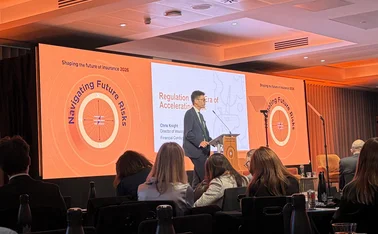
FCA’s Knight updates on cyber insurance report
Chris Knight, director of insurance at the FCA, has updated on the progress of its report into the take up of cyber insurance, and how the regulator has to keep pace with technological advancements.

Growing FCA attestation appetite a warning for brokers
The Financial Conduct Authority has increased the level of attestation requests dished out to insurance firms in recent years, and the serious regulatory tool is one brokers need to keep a keen eye on according to compliance specialists.

Why insurer oversight cannot become another regulatory box-ticking exercise
With regulatory workloads continuing to grow and the FCA maintaining its focus on customer outcomes, Insurance DataLab co-founder Matt Scott explains why brokers need a practical, evidence-led approach to insurer oversight.

FCA cancels insurance distribution business’ permissions
The Financial Conduct Authority cancelled Professional Liability Network’s permission to carry out regulated activities on 11 September 2026.