

A year of living dangerously
There is no doubt that 2005 proved a particularly hectic year for brokers across the UK. Jane Bernstein examines how brokers managed to meet these challenges, and asks whether the work carried out over the last 12 months will mean that 2006 should be a calmer year all round
Financial Services Authority regulation became a fact of life right at the beginning of 2005 and few would disagree that it was a defining event for the year. However, there is also general consensus that - one year on - it is still difficult to measure the effect it has had on brokers. As Kevin Pallett, executive director of Fusion, comments: "I think people are only just starting to realise what is involved."
"The impact will take some time to filter through," concurs Grant Ellis, chief executive of The Broker Network, adding: "The greatest impact of regulation is probably 18 months away as people start to realise what they need to do. I think there is still a huge amount of misunderstanding and an awful lot of complacency."
What most brokers have come to realise is that there is a certain amount of work involved in being part of the new regime. "There has been a lot more paperwork, and at a cost to business," observes Stuart Reid, chief executive of Stuart Alexander. Despite this, Reid believes that regulation has been a positive move: "It is very good for the industry that there is now a level playing field."
Steve White, head of regulation and compliance for the British Insurance Brokers' Association, believes that: "As time goes by and the benefits of implementing appropriate processes and procedures become apparent, intermediaries are likely to consider regulation to be a good thing, albeit expensive."
One area in which regulation has had a significant impact is consolidation, although the nature of merger and acquisition activity has been something of a surprise. While many predicted that the smaller brokers would be swallowed up by larger firms, it has been very much the medium and larger brokers that have been acquired over the last 12 months.
As Amanda Blanc, distribution and customer services director for Groupama, explains: "Merger and acquisition activity was a fundamental part of 2005. We always knew it would be, but it has been the consolidation of bigger rather than smaller brokers, and that has been a very interesting move. In many respects, the consolidators have looked to grow more quickly and have not set their sights on the smaller brokers."
If this trend continues in 2006, some are predicting that the next step will be for the consolidators to start buying each other. "I think we will see some consolidation of the consolidators themselves," says Pallett. "That may be one of the drivers for 2006 - for commercial business, we will be looking at a lesser number of larger brokers."
Difficult times ahead
So, will the smaller brokers that have so far escaped consolidation look forward to a thriving business in 2006? Pallett does not believe it will be easy: "It is very difficult for the smaller commercial broker now because you have a double whammy - the cost of the regulatory environment and also from the insurer side; the insurers are demanding more and more business to maintain agencies."
However, as Blanc points out, the smaller broker is nothing if not resilient. She adds: "They have lived through a lot and I think they will continue to survive."
Mark Cliff, distribution director, Axa, comments: "I think we will see a number of the smaller firms really finding it tough in 2006. I think they are more resilient than we think they are but we will start to see a shift where people start looking to sell books of business and perhaps thinking about exiting. I still think they have all the tools needed to survive - it is a question of whether they want to. Post-regulation, there are so many other things for the smaller broker to think about."
There is a sense among both larger and smaller brokers that there has been little change in insurer service standards over the past 12 months. As Gary Chandler, executive director with the Jelf Group, comments: "I do not think there has been any noticeable improvement in the service standards of insurance companies. There is certainly still work to be done on the claims side."
Peter Staddon, BIBA's head of technical services, observes: "Although many of the major insurers have been active in addressing poor service standards, brokers have still found pockets in which either the standard is not up to scratch or that the particular discipline has not been handled with sufficient expertise."
The trend of offshoring continued apace in 2005, but opinion remains divided as to whether it will prove beneficial in terms of service. Reid declares himself a fan of offshoring, having travelled to India to view one insurer's operation there. He comments: "The enthusiasm, the professionalism and eagerness of the staff to do the work they are doing, as well as the quality of the work they are doing, is outstanding. From my business point of view, I have no problem with seeing more business go over there."
Ellis says the offshoring issue has come to the fore over the last year and is a practice that is likely to continue. "My view is that this will just become the norm, but you will have one or two carriers that will perhaps use the fact that they do not do that as a service differentiator."
Spitzer fallout
Opinion is also varied on the fallout from the Spitzer inquiry into contingent commissions. Eric Galbraith, BIBA's chief executive, comments: "With regard to the Spitzer effect, I think we have to remind ourselves that we have had no similar issues in the UK and that we have a regulatory environment that allows brokers and intermediaries to operate in what is a very diverse market with a variety of different remuneration methods. This has worked well for the UK market for many years but, as we are now in a statutory, regulated environment, every broker and intermediary must manage any perceived or actual conflicts of interest within this environment. If the market does not do this, the FSA has indicated it will revisit the question of remuneration."
Reid claims that Spitzer has done 'tremendous harm' to the industry as a whole. He refers in particular to the problem of public perception, believing that the public will not differentiate from one broker to another.
Cliff comments: "Unfortunately, as ever, the publicity does not do the industry proud. It does have a knock-on effect." Cliff adds that the industry will have to address the issue of reputation in 2006: "And that is not purely on the back of Spitzer. Where the press is concerned, it is the negatives that come up rather than the positives."
Following Spitzer, the European Commission announced it was launching sector inquiries into business insurance and retail banking in the UK and other European countries. Is this something brokers should lose sleep over? "I do not believe there is an issue that they or others will have with the provincial broking market place," asserts Reid, "We transact on a relatively straightforward level and everything is transparent to a client if he asks."
The soft market
The soft market also had an impact on brokers across the board and few see any end to it in 2006. "There are no signs that it is going to change in the foreseeable future," comments Chandler.
Cliff points to the difference between commission and fee models in a soft market: "Anything where rates are going down or plateauing clearly has an effect on income where it is tied to a commission model."
In addition to major events such as regulation and the Spitzer report, 2005 will also be remembered as the year that climate-change issues came to the fore, and when the heightened global flood and hurricane activity grabbed the headlines. As far as brokers are concerned, has this had any impact on their role?
Pallett observes: "There is a role for the broker in that, when underwriting individual risks, you need good-quality information about that risk. That requires local knowledge. Brokers have a role in presenting risks."
However, Pallett adds that this does not essentially represent a change to accepted practice: "It is no different to the role they have always had in that a good broker will help an underwriter understand the exposures they are being asked to consider - both adverse and favourable."
Staddon asserts that brokers are at the front line with individuals and firms on the question of obtaining cover and ensuring claims are handled correctly, explaining: "They must therefore be aware of the issues around flood risks, what is available in the market, risk management and advice on claims."
Innovation
Cliff believes one of the 'unsung' success stories of 2005 was innovation. "I think we are seeing innovation really starting to emerge. In terms of really starting to think about customer needs and also in terms of technology - in terms of changing some archaic processes. We probably have more online products now than there have ever been. As an industry, we are becoming more innovative."
The past 12 months have seen significant change and a raft of new challenges that will occupy brokers not just throughout 2006 but for many years to come. This year looks set to be as busy as 2005, with the continuing ramifications of FSA regulation as well as further activity on the part of the consolidators.
There are many areas in which it is difficult to foresee the impact over the next year - from climate change to the market cycle. However, as Blanc concludes: "I think it is going to be a very exciting year."
UNAUTHORISED GENERAL INSURANCE BUSINESS
In November, The Financial Services Authority reported a positive outcome to a nationwide investigation into the level of unauthorised general insurance business being conducted following the inception of general insurance regulation in January 2005.
The FSA visited more than 1700 firms around the country that were potentially conducting insurance mediation activities illegally and found that only two primary intermediaries and 14 secondary intermediaries were wilfully acting illegally. Where breaches were inadvertent or resulted from genuine misunderstanding, the FSA says it worked with the firms to ensure they stopped doing the business, became authorised or restructured their business so that they did not need to be authorised. In the other cases, the FSA took steps to stop them doing any further insurance business. The FSA says it will continue to monitor both the mortgage and general insurance markets and will follow up leads, where appropriate, to prevent firms operating illegally.
Only users who have a paid subscription or are part of a corporate subscription are able to print or copy content.
To access these options, along with all other subscription benefits, please contact info@insuranceage.co.uk or view our subscription options here: https://subscriptions.insuranceage.co.uk/subscribe
You are currently unable to print this content. Please contact info@insuranceage.co.uk to find out more.
You are currently unable to copy this content. Please contact info@insuranceage.co.uk to find out more.
Copyright Infopro Digital Limited. All rights reserved.
As outlined in our terms and conditions, https://www.infopro-digital.com/terms-and-conditions/subscriptions/ (point 2.4), printing is limited to a single copy.
If you would like to purchase additional rights please email info@insuranceage.co.uk
Copyright Infopro Digital Limited. All rights reserved.
You may share this content using our article tools. As outlined in our terms and conditions, https://www.infopro-digital.com/terms-and-conditions/subscriptions/ (clause 2.4), an Authorised User may only make one copy of the materials for their own personal use. You must also comply with the restrictions in clause 2.5.
If you would like to purchase additional rights please email info@insuranceage.co.uk
More on Regulation

Which? demands ban on brokers charging high motor APRs
Which? has named and shamed motor insurance brokers charging high interest rates on monthly policies and called for a ban on the practice.

No ‘particular targets’ for insurance regulation simplification, says FCA
Consumer Duty will be a building block for any future work on the simplification of insurance regulations that affect brokers, according to David Geale, executive director of consumers, payments and competition at the Financial Conduct Authority.

FCA kicked off financial year with improved authorisation service bar one outlier
The Financial Conduct Authority has upped its game on authorisation service levels in categories affecting brokers, with improvements in four areas, but one notable outlier where the performance dipped.

FCA alerts of Kent-based broker clone
Quotemetoday.co.uk has made clear it has no affiliation with Quote Me Go as the Financial Conduct Authority has reported fraudsters have been impersonating the Kent-headquartered broker.
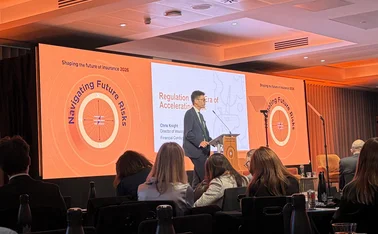
FCA’s Knight updates on cyber insurance report
Chris Knight, director of insurance at the FCA, has updated on the progress of its report into the take up of cyber insurance, and how the regulator has to keep pace with technological advancements.

Growing FCA attestation appetite a warning for brokers
The Financial Conduct Authority has increased the level of attestation requests dished out to insurance firms in recent years, and the serious regulatory tool is one brokers need to keep a keen eye on according to compliance specialists.

Why insurer oversight cannot become another regulatory box-ticking exercise
With regulatory workloads continuing to grow and the FCA maintaining its focus on customer outcomes, Insurance DataLab co-founder Matt Scott explains why brokers need a practical, evidence-led approach to insurer oversight.

FCA cancels insurance distribution business’ permissions
The Financial Conduct Authority cancelled Professional Liability Network’s permission to carry out regulated activities on 11 September 2026.