

A dash of European colour
The European influence on some insurance companies is plain to see but how much effect this is having on the rest of the market is unclear. Nicolle Farthing explains
Many of the UK's top-10 insurers are Continentally owned but, though Europe is having a big influence on UK insurers, a single European insurance market is still a long way off.
Paul Picknett, corporate services director of French-owned Groupama's UK operation, believes there are still major differences between UK insurers and those on the Continent.
He says: "UK insurers have been and, to some extent continue to be, poorly disciplined, chasing volume rather than profit. This explains poor results and deep market cycles. For example, motor insurers have announced rate cuts to drive volume. As a result, motor has only seen profit for two of the past 20 years, which would not be acceptable in any other sector. On the Continent, insurers want results and are more disciplined."
According to Picknett, France and Germany do not suffer from the big cycles of the UK. He argues that insurers on the Continent sell on the value of the product and service proposition rather than price alone, adding that the UK arm of Groupama is trying to do the same.
Steve Tidd, managing director of Link, says Groupama UK's move is indicative of a wider shift. He explains: "In the past, UK companies largely operated independent of influence from Continental owners, reflecting UK trading conditions as they perceived them. However, the Continental influence and control has increased substantially following heavy losses in recent years, merger and consolidation in the market, and the need to focus on underwriting return above investment return."
Dieter Wemmer, chief operating officer of Zurich Continental Europe, a division of Swiss insurer Zurich Financial Services Group, believes the country of the owner is not a big factor. He argues it is more important to be international and serve customers internationally.
Wemmer says: "It is particularly important for large corporate clients to be international. It does not matter whether the client is domiciled in London or elsewhere. We are one of the few large insurers that has a network to serve customers around the globe."
He adds: "Being global makes it easier for us to manage our exposures, especially in a volatile market. Our core markets are the UK, Continental Europe and the US. Europe is an attractive market for us because of our market position, and history has shown that large businesses have a better chance to manage the future."
However, Oliver Laughton-Scott, principal of IMAS Corporate Advisors, argues Continental insurers will have less influence on the UK market because the trend towards Continental ownership has been reversed with RBS' purchase of Churchill and NIG.
There is no doubt the insurance world is becoming smaller. Picknett believes there will be four to five leading brands in the next 10 years, spread across Europe.
Wemmer agrees. He says: "Industry consolidation will continue. Compared with other industries insurance is still fragmented. The euro was a milestone and, with time, local differences will be less relevant."
There is also a greater degree of harmonisation throughout the European Union in terms of regulation and accounting procedures, according to Picknett.
However, despite the implementation of EU directives in the UK the Financial Services Authority still has its own quirks. Picknett says this means one uniform market is unlikely.
Tidd believes a key benefit to a wider European insurance market is the ability to manage assets internationally. He says this means insurers could apply capital to the most profitable markets at the right time.
He says: "Spreading risk across territories brings balance and stability to an international portfolio. The management's ability to share experiences in different territories can also improve underwriting techniques and results."
Geoff Mayhew, group marketing and communications manager at Allianz Cornhill, agrees that one of the benefits is access to the international insurance market. Since 1986, German insurer Allianz AG has owned Allianz Cornhill.
Mayhew says: "Ownership by a large international group provides credibility, especially in the commercial insurance market. Coverage by the major players is largely consistent although the strength of their presence in each territory varies significantly."
Allianz AG allows its companies to manage locally, according to Mayhew.
He says cross-border trading in the insurance sector is mainly confined to the large commercial/ reinsurance sector and has not penetrated small and medium-sized enterprises or the personal lines market.
Tidd believes companies must have a detailed knowledge of each market in which they operate, despite greater harmonisation.
He says: "While globalisation might imply greater consistency, each market has its own unique features and they must trade successfully. Insurers with a multi-national presence take a distinct approach in each of their territories due to the different distribution models and underwriting methods."
Tidd adds: "Countries on the Continent tend to distribute insurance via branch networks of main insurers or tied agents to specific insurers, while in the UK independent brokers work with a range of insurers."
UK opportunities
Laughton-Scott believes the distribution methods are slowly changing, however, and says there is a big opportunity for UK insurers to work with the emerging broker market in EU countries.
He says: "Many of the established European players will be inhibited from supporting the emerging broking market as they are constrained by support for their traditional distribution channels. There is little evidence that the Continental model is making any progress in the commercial market. There are real opportunities for UK insurers, and the question remains as to whether they have the vision and patience to become a real force on the Continent."
Picknett says there is a higher calibre of staff on the Continent and claims his company has benefited from access to actuaries through its French owner. He says UK and French insurers share experiences, product knowledge and actuarial skills.
Picknett argues that there is also a fundamental difference between UK consumers and those in the EU. He says: "In the UK, people are much more price driven, there is a greater claims culture and more fraudulent claims. This all hits insurers' profit margins."
Although Picknett has not seen any cross-border consumerism, Groupama's operation in Spain has a website section for English-speaking clients.
The insurer also puts its clients in contact with operations in other territories when there are overseas interests. The exchange of information and referrals has been facilitated by advances in technology, but Picknett believes we are not likely to see a single EU platform due to different distribution models.
Wemmer says: "Having few technology systems as our backbone is important and we are trying to rationalise our systems as much as possible. We have been consolidating our large data centres throughout the group."
He adds: "Our administration systems have been built over decades following mergers and acquisitions. As a result, rationalisation is a long and expensive process and is mainly being done on an opportunistic basis to keep costs down."
Although the exchange of information is much faster and easier to manage, customers still prefer to do business locally and in their own language, Tidd points out. Seeking the right partners to facilitate effective, low-cost distribution is key to an operation's success.
Wemmer says: "Our approach across individual territories depends on the business area - with corporate clients we have global standards. There are still a lot of local specialisms for private customers and insurance policies have to comply with local rules."
Tidd predicts that as the domiciled country becomes less relevant more insurers, particularly new start-ups, will take advantage of low-tax domiciles such as Gibraltar.
All EU law relating to insurance is in place in Gibraltar and is moving towards a similar tax regime. Tidd says it is currently attractive as it has lower taxes and levies, modern communications and improved travel facilities, combined with an approachable and efficient regulatory body.
UK companies that have recently redomiciled to Gibraltar include Markerstudy, Zenith and Admiral.
Link is aiming to expand in Europe and is currently waiting for approval by the Financial Services Commission in Gibraltar. It hopes to begin trading at the beginning of next year and also has a presence in the UK to manage broker relationships.
Tidd says: "We will use Gibraltar as our base. The licence to underwrite from Gibraltar will give us the ability to write within new EU territories, in addition to the UK."
While insurance companies are looking to exploit opportunities in the EU, brokers are much more UK-focused. They usually operate in a particular region, increasingly in niche markets. With FSA compliance high on the list of broker priorities, there is not likely to be much movement outside the UK.
Picknett says: "A few large brokerages have a presence in the principle EU countries but it is more important for regional brokers to be part of a network in the UK."
Mayhew believes European broker networks will replace regional and national groupings, although he adds that this trend is likely to be confined to the likes of Aon and Marsh.
With concern about UK losses and deep market cycles, Continental owners are taking more interest in UK operations. Further consolidation and the harmonisation of rules and regulations across the EU and improved technology systems will also contribute to a more uniform approach but, with so many different languages and cultures, a single European insurance market may prove unrealistic. Certainly it currently only exists for large commercial clients.
However, in the long term many commentators believe the industry will consolidate to only a handful of global insurers. And brokers will follow in the footsteps of solicitors and accountancy firms with global ties and brand names - with the EU being the obvious starting point.
Only users who have a paid subscription or are part of a corporate subscription are able to print or copy content.
To access these options, along with all other subscription benefits, please contact info@insuranceage.co.uk or view our subscription options here: https://subscriptions.insuranceage.co.uk/subscribe
You are currently unable to print this content. Please contact info@insuranceage.co.uk to find out more.
You are currently unable to copy this content. Please contact info@insuranceage.co.uk to find out more.
Copyright Infopro Digital Limited. All rights reserved.
As outlined in our terms and conditions, https://www.infopro-digital.com/terms-and-conditions/subscriptions/ (point 2.4), printing is limited to a single copy.
If you would like to purchase additional rights please email info@insuranceage.co.uk
Copyright Infopro Digital Limited. All rights reserved.
You may share this content using our article tools. As outlined in our terms and conditions, https://www.infopro-digital.com/terms-and-conditions/subscriptions/ (clause 2.4), an Authorised User may only make one copy of the materials for their own personal use. You must also comply with the restrictions in clause 2.5.
If you would like to purchase additional rights please email info@insuranceage.co.uk
More on Regulation

Which? demands ban on brokers charging high motor APRs
Which? has named and shamed motor insurance brokers charging high interest rates on monthly policies and called for a ban on the practice.

No ‘particular targets’ for insurance regulation simplification, says FCA
Consumer Duty will be a building block for any future work on the simplification of insurance regulations that affect brokers, according to David Geale, executive director of consumers, payments and competition at the Financial Conduct Authority.

FCA kicked off financial year with improved authorisation service bar one outlier
The Financial Conduct Authority has upped its game on authorisation service levels in categories affecting brokers, with improvements in four areas, but one notable outlier where the performance dipped.

FCA alerts of Kent-based broker clone
Quotemetoday.co.uk has made clear it has no affiliation with Quote Me Go as the Financial Conduct Authority has reported fraudsters have been impersonating the Kent-headquartered broker.
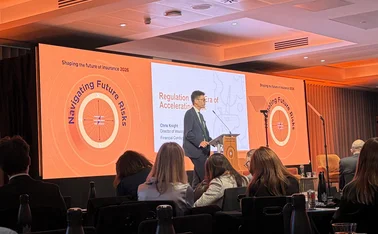
FCA’s Knight updates on cyber insurance report
Chris Knight, director of insurance at the FCA, has updated on the progress of its report into the take up of cyber insurance, and how the regulator has to keep pace with technological advancements.

Growing FCA attestation appetite a warning for brokers
The Financial Conduct Authority has increased the level of attestation requests dished out to insurance firms in recent years, and the serious regulatory tool is one brokers need to keep a keen eye on according to compliance specialists.

Why insurer oversight cannot become another regulatory box-ticking exercise
With regulatory workloads continuing to grow and the FCA maintaining its focus on customer outcomes, Insurance DataLab co-founder Matt Scott explains why brokers need a practical, evidence-led approach to insurer oversight.

FCA cancels insurance distribution business’ permissions
The Financial Conduct Authority cancelled Professional Liability Network’s permission to carry out regulated activities on 11 September 2026.