

Avoiding the elephant traps
After months of research into the issues around brokers professional indemnity - and the common 'get out' clauses used by insurers - Graham Trudgill examines the pitfalls ahead.
No matter how professional a broker is, or how stringent its systems and controls are, mistakes happen. It is at times like these when a broker relies on its professional indemnity cover to support it. To add to the stress of an unhappy customer, the burden of proof is on the broker to demonstrate that the claim falls within an insuring clause.
Understandably, many brokers make their buying decision purely on the price of cover. Unfortunately, at BIBA House we regularly see examples of cases where brokers have insufficient cover or there is an effective 'escape clause' in the PI policy enabling the insurer to avoid paying the claim.
It is not just the cost of the claim that the broker has to worry about either. The broker also has the cost of fighting a claim to contend with, not to mention the potential damage to their reputation, the impact on their PI premium going forward plus the time and effort involved with mounting a defence.
Biba is about to launch a guide to PI policy wordings to help its members better understand this vital form of protection for their business. This document sets out the guiding principles behind policy wordings in general, and suggests a series of benchmarks to ensure that members are buying the most appropriate cover for their needs.
BIBA has tapped into the resources of three of the leading PI brokers - Locktons, FirstCity and Towergate - which undertook to study the market and between them raise the standards for brokers' PI protection. Each has been accredited by BIBA and was selected for their proven expertise, knowledge, skill and the great service and competitive edge they can offer brokers in terms of both price and cover.
Educating members
The Biba initiative aims to help educate its members about the things most likely to go wrong between them and their client, and create a better understanding among members, how to recognise common problems, how to avoid them, what do when a claim happens and how to best make sure their PI policy will respond.
Biba has studied the interpretation of policy wordings as part of the initiative and is trying to raise awareness of three important areas: the necessity to ensure the PI policy meets the firm's demand and needs; obligations on the policyholder; and issues that can cause the policy to fail.
PI insurance is complicated and contains strict obligations for the policyholder that can result in a loss of cover if these are not met. This is a risk a broker cannot afford to take.
After spending many months looking into the intricacies of each clause and its findings will be published shortly. However, several 'elephant traps' have been uncovered that brokers commonly fall into, which offer insurers that sought after 'escape clause'.
Claims conditions are the largest trap of all. Clients regularly find themselves without cover because insurers claim they have failed to comply with claims notifications conditions. There is a very good reason why the insured is caught by this particular snare. It is well known that when a claim or circumstance is notified to a PI insurer it is automatically assumed that there will be an increased premium or excess at the next renewal. This is a considerable disincentive for insureds to notify circumstances or claims unless they are fairly sure that they absolutely have to do so.
In fact the assumption is erroneous. Very often the insurers will not increase terms unless there is a good reason to do so. This is a very good reason for the broker not to place the cover itself but rather engage a professional PI broker to do it on its behalf. Another broker can make a better representation to the insurer and by doing so avoid unreasonable and premature premium increases, it can also explain the implications of the most important policy terms and conditions to its client.
Biba's three accredited PI brokers are happy to help and offer very high standards of advice and cover.
Understanding the scope and power of claims notification conditions is essential not only to whoever buys the policy on behalf of the firm but also to all those within the organisation who may be in a position to recognise and, therefore, be responsible for notifying, a circumstance that may give rise to a claim.
Strict requirements
Notification conditions are a major concern, with strict requirements from some insurers. Prospective PI purchasers should look for a policy that contains clear and practical notification conditions. Brokers should also ensure that they fully understand the time constraints that these notification conditions place upon them and the manner in which potential claims should be reported to the insurer. Every PI policy will require you to notify 'circumstances' but the terms used by different insurers regarding notification can vary greatly, this is a strict obligation and insurers can deny liability if their requirements are not met.
Proposal forms are not always what they seem. Some insurers provide extensive proposals and then, when claims arise, Biba has seen the insurer use the proposal as a 'get-out-of-jail-free' card. Brokers should make sure that they carefully complete the proposal form, and if a question is not included about a certain aspect of their business then they should make reference to this in an addendum to the form. Nearly all PI policies have a clause that incorporates the proposal form into the policy and by doing so this declaration becomes a warranty.
A check list for a PI buyer would include:
Insuring clause: does the insuring clause clearly describe what is insured; and does the cover you bought really meet your demand and needs?
Definitions: do any of the definitions change the meaning of the words or expressions in the insuring clauses; and do any of the definitions relate to the claims notification clause?
Conditions: are there any extensions of the insurer's rights under the contract; are there any procedures that you must follow; and are there any conditions that appear to change the cover from your demands and needs?
Exclusions: do any of the exclusions remove cover for any activities necessary to the conduct of your core business; and do any of the exclusions remove cover for any activities necessary to conduct your non-core business?
Excess and related clauses: do you understand how the self insured excess operates in practice; do insurers pay the costs and expenses incurred in defence of the claim (or do these fall within the excess; and does the excess apply to each and every claimant?
Claims conditions: what are the time limits regarding notification; what obligations do the claims limits impose on you; and does your business run in a way that can accommodate the obligations of prompt notification and the requirements to comply with the claims conditions?
Identifying pitfalls
In identifying the pitfalls of typical brokers' PI insurance policies three core issues came to the fore: the importance of buying a policy based on value and not just on price; the effect of key expressions in typical policy wordings and how they differ in interpretation and in practice; and the importance of understanding the obligations concerning conditions precedent to liability and the notification of circumstances and claims.
PI insurance has always been seen as a necessary evil by brokers and they have, in many cases, paid less attention to buying it for themselves than they would for buying it for their clients. Consequently, the policy is often bought on price alone and the brokers will sometimes try to negotiate their own claims difficulties rather than notify them, believing that, as brokers, they are qualified to do so. They sometimes fail; and are vexed. Unsurprisingly, problems arise that are then referred to Biba for help, such as claims being denied, underwriters rights being reserved and a host of other difficulties that the broker had not expected to encounter.
Policy conditions are often the least interesting clauses in the policy and are often skipped over in an initial reading of the associated documentation. However, they have considerable power, and lawyers acting on behalf of insurers are skilled in understanding and applying the conditions that can come as a surprise to a broker.
If a condition is difficult to understand or to see how it will work in practice it is best to seek clarification of its intention and how it will operate. If a condition is beyond comprehension then it is probably unclear or ambiguous; in which case the broker is advised to get clarity and certainty before they buy the PI policy.
Delving into the detail of a PI policy can be a minefield of interpretation and confusion, as this article has shown. For more information on the Biba PI initiative or the new wording guide, please contact us on 0844 77 00 266 or go to our website at www.biba.org.uk.
- Graeme Trudgill, Manager, technical services, Biba
The British Insurance Brokers' Association has been raising the profile of the issues surrounding the placement of brokers' professional indemnity insurance cover for nearly two years now. A broker's PI protection is massively important as it forms their last defence in the event of disgruntled client - if this fails the broker is left vulnerable and their business could be place in jeopardy.
This month, the BIBA conference and exhibition sees James Dingeman QC, leading counsel to the Hutton inquiry, sharing his considerable experience and insight into some of the problems that can beset brokers when purchasing professional indemnity insurance or when a claim materialises. Members would be unwise to miss this incisive session, which takes place at 2.10pm on 24 May at London's ExCel centre.
FREQUENTLY ENCOUNTERED DIFFICULTIES WITH CLAIMS
- Late notification or non-disclosure of circumstance or claims
- Non-disclosure of material information
- Non-acceptance of a notification of circumstances
- Reservation of rights and acting as a "prudent uninsured"
- Inadvertent breach of policy conditions
- The insurer's solicitor seems to be representing them, rather than the insured
THE MOST TYPICAL LOSSES AND CLAIMS AGAINST BROKERS
- Failure to effect insurance cover
- Failure to effect appropriate insurance cover
- Failure to execute client's instructions
- Documentation drafting errors
- Failure to disclose material information
- Missed time limits
- Failure to advise clients of the consequences of non-compliance with terms and conditions
- Failure to clarify ambiguities in policy terms and conditions.
Only users who have a paid subscription or are part of a corporate subscription are able to print or copy content.
To access these options, along with all other subscription benefits, please contact info@insuranceage.co.uk or view our subscription options here: https://subscriptions.insuranceage.co.uk/subscribe
You are currently unable to print this content. Please contact info@insuranceage.co.uk to find out more.
You are currently unable to copy this content. Please contact info@insuranceage.co.uk to find out more.
Copyright Infopro Digital Limited. All rights reserved.
As outlined in our terms and conditions, https://www.infopro-digital.com/terms-and-conditions/subscriptions/ (point 2.4), printing is limited to a single copy.
If you would like to purchase additional rights please email info@insuranceage.co.uk
Copyright Infopro Digital Limited. All rights reserved.
You may share this content using our article tools. As outlined in our terms and conditions, https://www.infopro-digital.com/terms-and-conditions/subscriptions/ (clause 2.4), an Authorised User may only make one copy of the materials for their own personal use. You must also comply with the restrictions in clause 2.5.
If you would like to purchase additional rights please email info@insuranceage.co.uk
More on Regulation

No ‘particular targets’ for insurance regulation simplification, says FCA
Consumer Duty will be a building block for any future work on the simplification of insurance regulations that affect brokers, according to David Geale, executive director of consumers, payments and competition at the Financial Conduct Authority.

FCA kicked off financial year with improved authorisation service bar one outlier
The Financial Conduct Authority has upped its game on authorisation service levels in categories affecting brokers, with improvements in four areas, but one notable outlier where the performance dipped.

FCA alerts of Kent-based broker clone
Quotemetoday.co.uk has made clear it has no affiliation with Quote Me Go as the Financial Conduct Authority has reported fraudsters have been impersonating the Kent-headquartered broker.
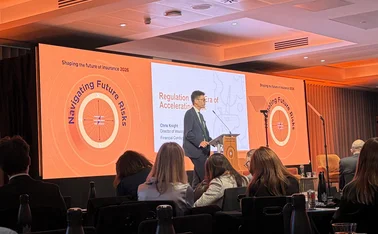
FCA’s Knight updates on cyber insurance report
Chris Knight, director of insurance at the FCA, has updated on the progress of its report into the take up of cyber insurance, and how the regulator has to keep pace with technological advancements.
Growing FCA attestation appetite a warning for brokers
The Financial Conduct Authority has increased the level of attestation requests dished out to insurance firms in recent years, and the serious regulatory tool is one brokers need to keep a keen eye on according to compliance specialists.

Why insurer oversight cannot become another regulatory box-ticking exercise
With regulatory workloads continuing to grow and the FCA maintaining its focus on customer outcomes, Insurance DataLab co-founder Matt Scott explains why brokers need a practical, evidence-led approach to insurer oversight.

FCA cancels insurance distribution business’ permissions
The Financial Conduct Authority cancelled Professional Liability Network’s permission to carry out regulated activities on 11 September 2026.

FCA opens GI consultation to reduce reporting burden
The Financial Conduct Authority has opened a consultation on minor changes to reduce the reporting burden on general insurance firms.