

Right to apply

In the run-up to Financial Services Authority regulation in January 2005, the actual number of general insurance brokers that will apply for authorisation is presenting a significant challenge. Nicolle Farthing examines the facts
Although the exact constitution of the broker market is uncertain, the initial signs are that its demographics are not going to shift significantly in the run-up to regulation by the Financial Services Authority.
From 14 January 2005, the FSA will regulate the sale of general insurance products. However, despite researching the broker market, the FSA has only an estimate of how many firms it expects to apply for authorisation.
Kate Bristowe, spokeswoman at the FSA, says: "The huge challenge is trying to estimate how many general insurance (GI) brokers there are and how many will apply. We estimate that we will receive around 12 900 applications from GI brokers and 4000 variations of permission."
So far, approximately 10,000 firms have registered to apply to the FSA.
More than 4000 of these are GI brokers and around 2700 are both mortgage and GI brokers. It has received around 800 completed applications from mortgage and general insurance brokers.
Comprehensive coverage
The Insurance Directory 2004, published by Incisive Media this month, will provide comprehensive coverage of the insurance market. It will feature the contact details of insurance companies and underwriters, brokers and intermediaries, loss adjusters and assessors; legal and specialist service suppliers; associations and institutions. It contains a total of 6581 GI brokers.
The broking industry's self-regulating body, the General Insurance Standards Council, has 4618 GI broker members. It classifies banks, building societies, independent financial advisers and mortgage brokers as secondary intermediaries of which it has a total of 1274 members. It also has 142 insurer members.
The Institute of Insurance Brokers, which also self-regulates, has more than 1000 members, which are typically medium-sized provincial brokers.
The British Insurance Brokers' Association has approximately 2200 members.
However, Graeme Trudgill, technical services officer at BIBA, estimates that there are approximately 8000 GI brokers in the UK. He predicts: "The catalyst of FSA regulation will cause a reduction of less than one-third in intermediary levels through mergers and brokers selling up."
The geographical spread of brokers has a southern bias, with the majority of brokers located in the south of England. The Insurance Directory 2004 records England as having the lion's share, with 5805 brokers; second is Scotland with 376; Wales has 226; there are 168 in Northern Ireland; and five in the Republic of Ireland.
Lloyd's currently has 166 brokers, of which 21 are based overseas, nine are regional and 136 are in London.
Allianz Cornhill deals with around 3500 brokers. Of its 12 branches, nine are located in the Midlands and in the south of England. Zurich has approximately 5000 agencies with the majority in the south. Axa has 5600 agencies with the majority located in the south of England and in the UK's major cities.
Groupama works with about 3500 brokers across the country. Its brokers also tend to be concentrated around the major towns and cities. Royal & SunAlliance has 12 900 agencies spread evenly across the UK and Norwich Union has 13,000 agencies.
Most GI insurance brokers offer both personal lines and commercial insurances.
The Insurance Directory 2004 lists 266 commercial-only brokers and 1495 specialising in personal lines, whereas there are 4293 that offer both.
Broker emphasis
Colin Calder, head of broker development at Axa, says: "There are very few personal lines or commercial lines only specialists and most brokers offer a combination of both. Nowadays, the larger, more profitable brokers tend to be commercial-lines oriented."
Historically, Groupama's agency base was biased towards personal lines brokers. However, it recently changed the emphasis of its commercial business to target small and medium-sized enterprises rather than large commercial risks.
Amanda Blanc, distribution and customer services director at Groupama, says: "This will help to establish the future trading patterns and methodologies to ensure profitable growth."
Insurers have started asking agencies what their plans are with regard to authorisation.
Sarah Wilson, director of high street firms at the FSA, says: "Insurers need to satisfy themselves that all the links in their supply chain affected by regulation become authorised or are appointed representatives. Insurers will not be able to continue doing business with unauthorised intermediaries."
Phillip Bell, chief executive of Misys General Insurance, believes that insurers are looking very closely at the long-term future of brokers.
He says: "Several insurers are concerned that those who do not make early applications will not be authorised in time and are contemplating restrictions such as the cancellation of agency agreements."
Bell adds: "Insurers appear to be taking comfort from the brokers that have invested in their IT systems. It is a clear indicator that these are the ones who understand the implications of compliance and who are in the process of making their application. We have already taken a high volume of orders for our FSA Regulation Module."
The Misys Countrywide network has achieved just short of 100% retention of members with almost all of its 900 members renewing their membership this year. As part of Countrywide's renewal process, brokers are asked to confirm whether they are preparing for regulation.
AC recently began contacting its brokers to find out their intentions and, so far, the majority have said they intend to become directly authorised according to Chris Garrett, sales support manager at AC.
He says: "If we don't hear from brokers shortly we will visit them. We are handling this actively and don't want any surprises. We will keep a close eye on those that apply through our sales team."
Lloyd's is working with the London Market Brokers Committee and the Lloyd's Market Association to obtain FSA authorisation of Lloyd's brokers.
Caroline Howe, press officer at Lloyd's, says: "Our accreditation process will require authorisation by the FSA. At present, following discussions with LMBC and through our own enquiries, we are unaware of any UK-based Lloyd's broker who does not intend to apply for FSA authorisation."
NU's account managers are tracking the progress of its agencies according to Simon Bloomfield, distribution manager at NU.
Bloomfield says: "For brokers that don't intend to comply with the FSA our options include assisted exit from the market, where NU will purchase their book of business. Ultimately, if we or the broker have not found an alternative broker to handle the business by January 2005, we will need to deal directly with the customers from brokers who are not authorised, as we are expected to do by the FSA."
Axa is communicating with its agencies on an ongoing basis. So far, the vast majority of its brokers have indicated that they will apply to become authorised, according to Calder. Those that do not intend to apply are being introduced to brokers that are looking to acquire.
Around 90% of RSA's brokers have also already confirmed that they intend to apply for authorisation, according to Blythe Morris, director at RSA.
He says: "We expect to know about any possible cases that are not going to comply by the end of the month. If they don't intend to comply we will take steps early in the process to ensure the end-consumer is protected. We are comfortable about the fact that most are getting their heads around authorisation."
Groupama also believes that the majority of its agents are taking serious steps towards authorisation. "It has a detailed communication plan in place to manage the transition to a regulated industry", says Blanc.
Secondary intermediary compliance
Insurers must also be satisfied that secondary intermediaries selling insurance in addition to their main business comply with regulation. The FSA is concerned about the lack of registrations from secondary intermediaries such as motor dealers, retailers and vets. So far it has received only 1200 registrations.
Branko Bjelobaba, regulation and compliance consultant at BIBA, warns: "The extremely low number of registrations from secondary intermediaries is alarming. Brokers and insurers must examine their distribution chains carefully as they will not be able to work with firms if they are not authorised or appointed as representatives.
"A lot of secondary intermediaries don't know that they need to be regulated and, if they go out of business, it would mean a significant change within the distribution chain and will affect consumer choice."
It appears that insurers have been rationalising agencies in order to deal primarily with professional intermediaries that intend to become authorised. Few are offering to act as principals for agencies.
Morris says: "The vast majority of our agencies are with primary intermediaries selling general insurance on a full-time basis. We deal with some large affinity groups, all of which plan to become authorised.
"The secondary market does not concern us directly. It is up to brokers to consider whether they want to act as principals for those not intending to become authorised. We will offer to act as principals for the occasional client, such as a building society, but this will not be offered to GI brokers."
Zurich, however, is prepared to act as a principal to a handful of its brokers on a single-tie basis.
Bloomfield says: "We expect the vast majority of intermediaries will wish to be directly authorised with the FSA and we will not be offering an appointed representative solution to the market. The end-result will be that the market will be much more focused around full-time professional intermediaries."
Industry pundits agree that the broker market will change shape in the next few years, although initial predictions that numbers would significantly fall appear to have been exaggerated and it is now widely believed that there will be gradual change continuing well after January 2005.
Morris says: "At the end of the day, regulation will lead to a more professional broker market. The scaremongers who have been predicting that 50% of the broker market will disappear are talking rubbish."
The broker market is undergoing significant change, according to Blanc, with regulation just one of the dynamics driving this. The acquisitive nature of larger brokers, changes in customer buying patterns, technology, the growing impact of networks and the limited availability of capacity, will all contribute to ongoing consolidation in the broker sector.
Blanc says: "In simple terms, the big are likely to get bigger, and small and medium-sized intermediaries will either be acquired, merge, join a network or cease trading altogether. However, we do not expect the level of consolidation to be as dramatic and far reaching as some industry commentators suggest."
While the number of GI brokers will remain unclear for some time, insurers are confident that the majority will apply to be authorised. The big question is: what will happen with secondary intermediaries? Insurers are taking steps to ensure that their supply chains are compliant and it is now vital that brokers do the same.
Only users who have a paid subscription or are part of a corporate subscription are able to print or copy content.
To access these options, along with all other subscription benefits, please contact info@insuranceage.co.uk or view our subscription options here: https://subscriptions.insuranceage.co.uk/subscribe
You are currently unable to print this content. Please contact info@insuranceage.co.uk to find out more.
You are currently unable to copy this content. Please contact info@insuranceage.co.uk to find out more.
Copyright Infopro Digital Limited. All rights reserved.
As outlined in our terms and conditions, https://www.infopro-digital.com/terms-and-conditions/subscriptions/ (point 2.4), printing is limited to a single copy.
If you would like to purchase additional rights please email info@insuranceage.co.uk
Copyright Infopro Digital Limited. All rights reserved.
You may share this content using our article tools. As outlined in our terms and conditions, https://www.infopro-digital.com/terms-and-conditions/subscriptions/ (clause 2.4), an Authorised User may only make one copy of the materials for their own personal use. You must also comply with the restrictions in clause 2.5.
If you would like to purchase additional rights please email info@insuranceage.co.uk
More on Regulation

Which? demands ban on brokers charging high motor APRs
Which? has named and shamed motor insurance brokers charging high interest rates on monthly policies and called for a ban on the practice.

No ‘particular targets’ for insurance regulation simplification, says FCA
Consumer Duty will be a building block for any future work on the simplification of insurance regulations that affect brokers, according to David Geale, executive director of consumers, payments and competition at the Financial Conduct Authority.

FCA kicked off financial year with improved authorisation service bar one outlier
The Financial Conduct Authority has upped its game on authorisation service levels in categories affecting brokers, with improvements in four areas, but one notable outlier where the performance dipped.

FCA alerts of Kent-based broker clone
Quotemetoday.co.uk has made clear it has no affiliation with Quote Me Go as the Financial Conduct Authority has reported fraudsters have been impersonating the Kent-headquartered broker.
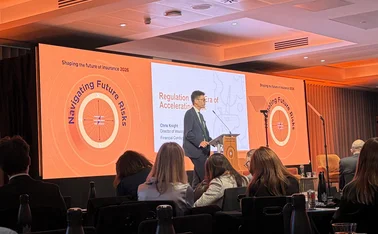
FCA’s Knight updates on cyber insurance report
Chris Knight, director of insurance at the FCA, has updated on the progress of its report into the take up of cyber insurance, and how the regulator has to keep pace with technological advancements.

Growing FCA attestation appetite a warning for brokers
The Financial Conduct Authority has increased the level of attestation requests dished out to insurance firms in recent years, and the serious regulatory tool is one brokers need to keep a keen eye on according to compliance specialists.

Why insurer oversight cannot become another regulatory box-ticking exercise
With regulatory workloads continuing to grow and the FCA maintaining its focus on customer outcomes, Insurance DataLab co-founder Matt Scott explains why brokers need a practical, evidence-led approach to insurer oversight.

FCA cancels insurance distribution business’ permissions
The Financial Conduct Authority cancelled Professional Liability Network’s permission to carry out regulated activities on 11 September 2026.