

Three sides to the story
Earlier this year, the Financial Services Authority reported that the insurance industry had met its initial target for contract certainty compliance. David Hall outlines how clients, brokers and insurers must commit to tripartite relationships if progress is to be sustained and the benefits realised
The Financial Services Authority was appointed as the regulator for the general insurance industry at the end of 2004. Achieving contract certainty across all insurance lines by January 2007 was one of the first challenges it set the industry, and a timetable for voluntary compliance was agreed.
The Code of Practice from the London Market Principles defines contract certainty as having the complete and final agreement of all terms, including signed lines, between insurers and insured before inception of the policy. From the nature of the words chosen, it clear that the FSA is determined to bring an end to the industry's prevalent "deal now, detail later" culture.
The initial response from the insurance industry has been positive. The FSA's mid-term stock-take report was published just over one year into the programme. The report confirmed that the interim target of 65% contract certainty had been met, and all the early indications are that the industry will meet or exceed the next significant yardstick of 85% delivery by January 2007. However, in order to gain a more accurate measure of the industry's progress it is important to look beyond the headline rate and examine the figures in more detail.
A consistent rate
A recent survey conducted by the Association of Insurance and Risk Managers showed that the rate of contract certainty for some lines of business, such as property and employers' liability, were as low as 35%. If a consistent rate of contract certainty across all lines of business is to be achieved, it is clear that some areas of the market have a great deal of work to do. Even lines of business that performed well above the average cannot afford to sit on their laurels. There is the feeling that much of the progress to date has been achieved through the picking of low-hanging fruit, meaning it is going to become incrementally more difficult to achieve future targets.
The decision to progress with contract certainty on a voluntary basis has worked well, with the benefits to the industry far out-weighing the time and effort spent on compliance. The industry is well aware that the FSA has the option to switch to a mandatory compliance regime should the voluntary programme cease to be effective. Question marks still remain over how the next 20% and 15% will be delivered but progress to date augers well enough for the all parties to keep the voluntary momentum going.
Elevating matters beyond mere procedural compliance so that they become culturally adopted will signal real development within the industry. This is a significant change that requires a cohesive tripartite approach from clients, brokers and insurers alike. A contract certainty partnership, based upon full disclosure and open dialogue between all three parties, has to become central to the way the industry operates.
True tripartite relationships have the long-term understanding of a client's risks at their heart. This is important to deliver mechanical compliance with the FSA's requirements and will also ensure that the advantages lying behind the concept can be accrued by all parties involved.
Adopting a tripartite approach leads to more informed underwriting and, therefore, certainty of insurance transactions. Clients will be clearer on precisely what cover they have purchased and will experience a more straightforward claims process. At the same time, insurers will fully understand a client's risk exposure, enabling capital to be efficiently allocated to risk profile. This will allow for better control of costs and thereby help to avoid mis-pricing.
Significant benefits
While the focus of the regulator is primarily on the insurer and the insured, contact certainty will also deliver significant benefits to brokers. Contract certainty provides a model for best practice, which can be articulated to cover the entire transaction from cradle to grave. By driving the industry to look at the way it works, previously ad-hoc practices have been replaced by detailed and streamlined processes, increasing the transactional efficiency and reducing the associated costs.
Policy wordings are available at an earlier point in the process, making it easier to compare quotes on a like-for-like basis. As everything is a lot more black and white, especially in relation to claims, brokers can be clearer in their service and proposition to clients from the outset. By reducing the time spent resolving disputes, brokers are able to divert resources to the more profitable areas of their business.
Operating efficiency can be further increased as contract certainty has allowed processes to be monitored with a greater degree of accuracy. This allows potential issues to be identified at an earlier stage, and the workload to spread more effectively.
A broker's operational risk can also be minimised by embracing tripartite relationships to deliver contract certainty. Dialogue between all parties needs to be an ongoing process, and not just take place at renewal or after a claim. With client, broker and insurer working together to keep the risk profile as accurate as possible throughout the period of cover, the potential for gaps in cover is minimised. This provides brokers with further cost savings, as the likelihood of professional indemnity claims is reduced, meaning less capital has to be set aside to cover any errors and omissions in the policy.
The ultimate goal for any insurance transaction is that the policy issued best reflects the needs of the client. Creating a stronger tripartite alignment will help make this a reality, as the more insurers and brokers know about the client, the more equitable and certain the business link becomes.
This will lead to policies becoming better defined and more accurately priced. It is important to put the issue of pricing in its proper context, which requires clients to think in terms of value and not price. Clients need to look beyond the figure at the bottom of the contract and ask themselves what is the true value to the business of good risk management and adequate risk transfer? Is a nominal reduction in premium really worth as much as the ability of the business to quickly get back on its feet at a time of crisis?
Commercial advantages
The UK market is seen as one of pioneers of contract certainty and there is a great deal of international support for the concept. By offering overseas buyers reduced risks combined with a greater level of control, the UK is an ideal position to realise the significant commercial advantages of a contact certain market. Provided that interpretation issues are tackled effectively, the UK will become a more attractive place to conduct business.
Contract certainty is not an end goal for the insurance industry but is instead the foundation for its future. It will ultimately be tied up with the creation of effective tripartite disclosure via open dialogue and listening based relationships. The successful completion of a documentary process will only answer the FSA's concerns if it involves the accurate understanding and full articulation of a client's risks. Far from being the FSA's final challenge, achieving contract certainty is more likely to be the first step.
- David Hall, Director, client management and broker relations, Allianz Global Corporate and Specialty.
Only users who have a paid subscription or are part of a corporate subscription are able to print or copy content.
To access these options, along with all other subscription benefits, please contact info@insuranceage.co.uk or view our subscription options here: https://subscriptions.insuranceage.co.uk/subscribe
You are currently unable to print this content. Please contact info@insuranceage.co.uk to find out more.
You are currently unable to copy this content. Please contact info@insuranceage.co.uk to find out more.
Copyright Infopro Digital Limited. All rights reserved.
As outlined in our terms and conditions, https://www.infopro-digital.com/terms-and-conditions/subscriptions/ (point 2.4), printing is limited to a single copy.
If you would like to purchase additional rights please email info@insuranceage.co.uk
Copyright Infopro Digital Limited. All rights reserved.
You may share this content using our article tools. As outlined in our terms and conditions, https://www.infopro-digital.com/terms-and-conditions/subscriptions/ (clause 2.4), an Authorised User may only make one copy of the materials for their own personal use. You must also comply with the restrictions in clause 2.5.
If you would like to purchase additional rights please email info@insuranceage.co.uk
More on Regulation

Which? demands ban on brokers charging high motor APRs
Which? has named and shamed motor insurance brokers charging high interest rates on monthly policies and called for a ban on the practice.

No ‘particular targets’ for insurance regulation simplification, says FCA
Consumer Duty will be a building block for any future work on the simplification of insurance regulations that affect brokers, according to David Geale, executive director of consumers, payments and competition at the Financial Conduct Authority.

FCA kicked off financial year with improved authorisation service bar one outlier
The Financial Conduct Authority has upped its game on authorisation service levels in categories affecting brokers, with improvements in four areas, but one notable outlier where the performance dipped.

FCA alerts of Kent-based broker clone
Quotemetoday.co.uk has made clear it has no affiliation with Quote Me Go as the Financial Conduct Authority has reported fraudsters have been impersonating the Kent-headquartered broker.
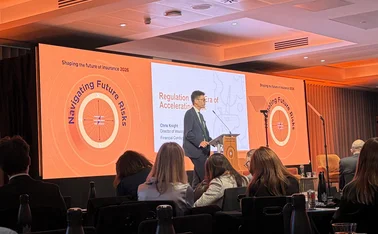
FCA’s Knight updates on cyber insurance report
Chris Knight, director of insurance at the FCA, has updated on the progress of its report into the take up of cyber insurance, and how the regulator has to keep pace with technological advancements.

Growing FCA attestation appetite a warning for brokers
The Financial Conduct Authority has increased the level of attestation requests dished out to insurance firms in recent years, and the serious regulatory tool is one brokers need to keep a keen eye on according to compliance specialists.

Why insurer oversight cannot become another regulatory box-ticking exercise
With regulatory workloads continuing to grow and the FCA maintaining its focus on customer outcomes, Insurance DataLab co-founder Matt Scott explains why brokers need a practical, evidence-led approach to insurer oversight.

FCA cancels insurance distribution business’ permissions
The Financial Conduct Authority cancelled Professional Liability Network’s permission to carry out regulated activities on 11 September 2026.