

A second chance
The unpreparedness of secondary intermediaries for 'GI day' forced the regulator to offer a period of grace to allow them to catch up. With half of this time gone, Andrew Tjaardstra looks at the sector's efforts to comply
Filling out forms from the Financial Services Authority is not only a task for brokers and insurance companies; veterinary practices, removal firms, motor traders, furniture stores and jewellery firms offering insurance policies are also adapting to regulation. Indeed, any company that offers insurance, however small, needs to address compliance.
However, six months into regulation, there are ongoing concerns that the secondary market has not yet taken all the necessary steps to keep the authorities at Canary Wharf satisfied.
There are three alternatives for secondary intermediaries in order to comply with regulation. And, for the last year and a half, these firms have been prompted by trade associations, product providers and the FSA to comply.
First, businesses can apply directly to the FSA for authorisation. To date, 5351 secondary firms have been directly authorised, according to the FSA.
Secondary intermediaries can also become indirectly authorised to sell general insurance by becoming an appointed representative of a directly authorised firm. Around 10,000 secondary intermediaries have become appointed representatives so far, according to an FSA spokesperson.
The third option for secondary intermediaries is to have the choice of dropping insurance from their list of services, with the option of being an introducer and, essentially, leaving the market.
Secondary intermediaries also need to have professional indemnity insurance cover of at least £1.1m. Despite the outcry of the insurance industry over the exemption of warranty sellers and travel agents, the FSA has refused to reconsider this until 2007.
A list of registered firms - including secondary intermediaries and appointed representatives - that are FSA-compliant can be found at the FSA Register website (www.fsa.gov.uk/register/), where there are also details of designated 'approved persons'.
Statistics
Problematically for the FSA, there are no official statistics for the number of secondary intermediaries, although there have been suggestions of between 20,000 and 25,000. The FSA says around 15,000 firms are regulated.
Steve White, regulation and compliance manager at the British Insurance Brokers' Association, says: "I find 25,000 an odd number. There are no statistics that tally regarding the number of secondary intermediaries, certainly prior to the introduction of regulation." However, Gary Head, Hiscox UK underwriting director, says: "There could be 100,000 secondary intermediaries in the UK."
There is certainly a wide variety of secondary intermediaries. Tony Boorman, principal ombudsman and decisions director at the Financial Ombudsman Service, said at the BIBA Conference: "Insurance day, 14 January, brought into our jurisdiction over 750 car dealers, a significant number of double-glazing and conservatory installers, nearly 900 veterinary practices and at least one gunsmith. Authorised representatives also include schools, parent-teacher associations, kennels, catteries and more than 400 caravan parks."
A single direct application could cover a chain of intermediaries. Steve Carter, director of compliance and operations, at DaimlerChrysler UK Insurance Solutions, was put in charge of organising compliance issues for DaimlerChrysler's retail group in the UK. It owns 48 sites selling Mercedes-Benz and Smart cars - selling between 40,000 and 50,000 policies - with premiums in excess of £25m.
He says, "We took a strategic decision in January 2004 to act as group and have a single direct-authorisation process and, therefore, a single relationship with the regulator. Many of our staff had not been exposed to general insurance and training was one of our priorities, including product training.
"DaimlerChrysler offers a range of products, including a motor insurance programme with Norwich Union; guaranteed asset protection and credit protection with Pinnacle and mechanical breakdown with Mondial. We sell our products as a broker-type model, taking commissions."
Consultants are also helpful. Carter says: "We hired a consultant from Alliance Consultancy for three months and we also use Branko, a compliance consultancy. Branko helped us gauge what our competitors were doing." Carter also says there was discussion with "like-minded people within the industry and open forums with the FSA."
DaimlerChrysler also had to negotiate a new PI contract for all parts of the business. Carter says they are due an Arrow visit from the FSA, presently.
Carter considers that any costs incurred could be made up by increased transparency in the sales process, although he says his firm will not be able to gauge the real cost of regulation until after one year. He adds: "I would hope that our sales go up because we give the customer a fairer opportunity to understand the products than before."
Direct authorisation may also be recommended by the insurance company. Jonathon Heap, head of marketing at Car Care Plan, which offers GAP insurance, says that 97% of its clients were directly authorised with the FSA by 14 January. GAP insurance covers the 'gap' between an insurer's valuation of a car and what it will cost to either buy an equivalent replacement or pay off the finance, depending on the level of cover chosen.
Heap says: "Car Care Plan could not provide the audit requirements for 3000 dealers, and asked dealers to apply direct." He said the majority of policies offered remained the same, though they are now being presented differently. He adds: "At the secondary intermediaries, workload has increased, literature has changed and staff have had additional training." Despite the cost of regulation, estimated at £2.80 per policy, profit margins may not have changed, Heap continues: "Many motor companies have increased sales of policies, because it is a more structured culture." This will be music to the ears of the FSA, though whether secondary intermediaries are fully complying with the rules remains to be seen.
Appointed representatives
"It might be easier for a firm to monitor and control an appointed representative for whom insurance activities are secondary if the appointed representative was only handling one product class," adds White.
Building an appointed representative network can be attractive to both brokers and insurance companies as it guarantees business that may have been placed elsewhere prior to the introduction of regulation. Also, secondary intermediaries can benefit from the resources and expertise that brokers and insurance companies can offer.
Broker Stuart Alexander has granted around 50 property managing agents appointed representative status after starting a network in light of regulation. Network members are charged an annual fee and benefit from Stuart Alexander handling regulatory requirements.
Dick Tucker, compliance manager at Stuart Alexander, says: "We have provided training, audits and consultancy; we also handle FSA requirements such as conduct of business and state of business. We have PI cover for all the agents, and they also have their own. However, we do need to sit down and clarify whose PI cover is used in certain situations."
According to Tucker, regulation has not impeded business for the broker. Rather, it has provided it with more guaranteed income as the appointed representatives begin to deal with a single broker.
Allianz Cornhill's Pet Plan scheme has 700 vets as appointed representatives. John Bower, who works at The Veterinary Hospital Plymouth and is an adviser to the Pet Plan scheme, says: "Pet Plan trains people in the practice and will take the blame if anything goes wrong. As an appointed representative we can only recommend Pet Plan, but, if we weren't an appointed representative, then we could not talk about any insurance plans at all. I would be surprised if many other vets offered any rivals to Pet Plan, which offers insurance for dogs, cats, rabbits and horses, though we would not hesitate in offering cover for insurance that Pet Plan does not cover."
Bower says, "In most cases, when a client comes in with a new pet, we will thoroughly recommend pet insurance. We can issue a temporary cover through Pet Plan for four weeks, and then Pet Plan rewards the staff with gift vouchers that are allotted each Christmas for each policy sold."
Six months after regulation by the FSA and some are worried that some secondary intermediaries have not done enough or are confused by the number of forms.
Andrew Paddick, director general of the Institute of Insurance Brokers, cites confusion over client money, statutory trusts, non-statutory trusts and risk transfer. He says: "People who have problems do not realise they have problems until we find them." Alarmingly, he says: "Directly authorised secondary intermediaries are not taking compliance seriously, and are not accountable to anybody except the FSA." He adds: "Whereas the primary market has been prepared by General Insurance Standards Council regulation, the secondary market has not had the same experience."
While some secondary intermediaries have given up on insurance, there is evidence that some have simply not become compliant. David Harvey, a director at PI Direct, which offers secondary intermediary PI cover sold by PI Brokerlink and underwritten by Hiscox, says: "We are still receiving calls from secondary intermediaries that have not yet realised they need PI cover to sell insurance." Tucker says he believes there are a lot of property agents that have not become authorised and some are still selling insurance.
Customer concerns
There are also concerns for customers. Vets, for example, have had to become more circumspect when offering advice. Bower says: "These new arrangements have not helped the consumer at all. Those who do not have appointed representative status cannot begin to discuss any policies. Ideally, FSA regulation would not have come in at all.
"Before FSA regulation, vets in our 4000 practices were able to put forward insurance companies based on our experience. Since regulation, we can no longer do that - we can only say we think it is a good idea or a bad idea, and also that there are three different types."
Stephen Bland, acting director, small firms division at the FSA, in addressing the BIBA Conference, said: "The rapid expansion of networks, together with evidence gained from the authorisation process, suggests there may be significant systems and controls issues in firms that have appointed representatives. We are worried that principals and appointed representatives may not have implemented the control adequately in a small number of larger networks to ensure that they are compliant with the responsibilities they take on when accepting appointed representatives."
The second half of this year will be a litmus test for how well compliance is doing on a practical basis. Encouragingly, a spokesperson at the Financial Ombudsman Services says the number of investigated cases of complaints against FSA-authorised secondary intermediaries has been around 150 and at the bottom end of expectations.
The FSA also says it is now concentrating more on the insurance sector. At the BIBA Conference in April, Bland issued a warning to firms that are not complying: "We will continue rigorously to enforce the perimeter where firms are either unauthorised or acting outside their permissions. We have been concentrating on detecting unauthorised mortgage firms. The focus of that work is now changing to the general insurance sector."
A picture of how regulation is being received will be clearer following the submission of retail mediation activities returns to the regulator.
The FSA will be conducting audits, examining issues such as client money, training and competence, the conduct of business issues and making on-site visits, and only then will it be clear how companies are coping, and how many are not.
Only users who have a paid subscription or are part of a corporate subscription are able to print or copy content.
To access these options, along with all other subscription benefits, please contact info@insuranceage.co.uk or view our subscription options here: https://subscriptions.insuranceage.co.uk/subscribe
You are currently unable to print this content. Please contact info@insuranceage.co.uk to find out more.
You are currently unable to copy this content. Please contact info@insuranceage.co.uk to find out more.
Copyright Infopro Digital Limited. All rights reserved.
As outlined in our terms and conditions, https://www.infopro-digital.com/terms-and-conditions/subscriptions/ (point 2.4), printing is limited to a single copy.
If you would like to purchase additional rights please email info@insuranceage.co.uk
Copyright Infopro Digital Limited. All rights reserved.
You may share this content using our article tools. As outlined in our terms and conditions, https://www.infopro-digital.com/terms-and-conditions/subscriptions/ (clause 2.4), an Authorised User may only make one copy of the materials for their own personal use. You must also comply with the restrictions in clause 2.5.
If you would like to purchase additional rights please email info@insuranceage.co.uk
More on Regulation

Which? demands ban on brokers charging high motor APRs
Which? has named and shamed motor insurance brokers charging high interest rates on monthly policies and called for a ban on the practice.

No ‘particular targets’ for insurance regulation simplification, says FCA
Consumer Duty will be a building block for any future work on the simplification of insurance regulations that affect brokers, according to David Geale, executive director of consumers, payments and competition at the Financial Conduct Authority.

FCA kicked off financial year with improved authorisation service bar one outlier
The Financial Conduct Authority has upped its game on authorisation service levels in categories affecting brokers, with improvements in four areas, but one notable outlier where the performance dipped.

FCA alerts of Kent-based broker clone
Quotemetoday.co.uk has made clear it has no affiliation with Quote Me Go as the Financial Conduct Authority has reported fraudsters have been impersonating the Kent-headquartered broker.
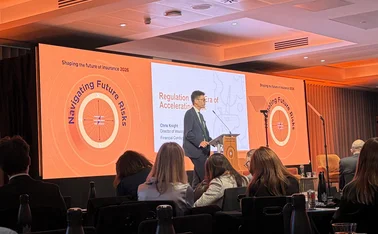
FCA’s Knight updates on cyber insurance report
Chris Knight, director of insurance at the FCA, has updated on the progress of its report into the take up of cyber insurance, and how the regulator has to keep pace with technological advancements.

Growing FCA attestation appetite a warning for brokers
The Financial Conduct Authority has increased the level of attestation requests dished out to insurance firms in recent years, and the serious regulatory tool is one brokers need to keep a keen eye on according to compliance specialists.

Why insurer oversight cannot become another regulatory box-ticking exercise
With regulatory workloads continuing to grow and the FCA maintaining its focus on customer outcomes, Insurance DataLab co-founder Matt Scott explains why brokers need a practical, evidence-led approach to insurer oversight.

FCA cancels insurance distribution business’ permissions
The Financial Conduct Authority cancelled Professional Liability Network’s permission to carry out regulated activities on 11 September 2026.