

The rating game
Brokers owe a duty of care to place their clients' business with insurers that show financial strength. Nicolle Farthing discusses whether brokers can be confident that they are doing enough to protect their clients
One of the best ways of measuring insurer security is to use a rating from a rating agency, argues Chris Waterman, senior director of Fitch.
These can be accessed via rating-agency websites free of charge. In addition to Fitch ratings, brokers can pay a fee for more detailed reports that detail the types of business an insurer underwrites, the strength of its balance sheet, operating performance and management quality.
Waterman says: "Brokers should endeavour to place their clients' business with a financially strong insurer who will be around in a number of years in order to meet the claims on the policies they have placed.
"Fitch does not just look at the audited financial statements produced by insurers, but provides interactive ratings. We meet the management teams, review their strategy and business plans and determine whether these are achievable. We combine a qualitative approach for the management quality and the competitive positioning the insurer has, relative to its past financial performance to provide a rating that we believe is prospective in nature - the ability to meet obligations in the future rather than at this exact point in time."
Standard & Poor's uses eight key areas of analysis and a range of qualitative and quantitative methodologies to rate insurers. The eight key areas are: industry risk; competitive position; management and corporate strategy; operating performance; investments; liquidity; capital; and financial flexibility.
Peter Hughes, director at S&P, says the rating outcome relies heavily on the qualitative interpretation of each area of analysis. "For example, we rate the country in which the insurer resides and that country's banking systems; these can have an impact on our view of the insurer. When assessing financial security there are a number of important things to consider - simple capital and surplus analysis is insufficient and capital can easily be spent, the question is whether the insurer has the ability to rebuild or service its capital."
Ratings are medium-term indicators, says Hughes, and aim to look beyond market cycles - so ratings do not go up and down with the cycle. In addition to the rating, the outlook gives the probable direction the rating will take if the company continues on its current path. He says: "The outlook is particularly important for companies that are experiencing difficulties and brokers would be well advised to consider both the outlook and the detail of the rationale that accompanies the rating."
The British Insurance Brokers' Association has a scheme with AM Best in which members can purchase a disk containing information on more than 500 insurers transacting business in the UK. This can be tailored to a member's requirements.
Security checks
Peter Staddon, technical manager of BIBA, says: "BIBA feels that it is a very important business practice for members to perform security checks before they arrange insurance for their clients. With the challenging conditions faced by insurers, combined with the need to find suitable markets, brokers have to be increasingly careful about their choice of insurers."
In addition to using rating agencies, the major brokers carry out their own research on insurers' financial security, employing dedicated teams of people who are responsible for vetting the security of insurers.
Waterman says: "Major brokers assess the ratings and carry out additional reviews that may include internal fact-finding through claims departments. Information is fed back to a broker's security committee, which makes a decision on whether an insurer will be accepted on their approved panel."
Dedicated teams within major brokerages also concentrate on start-ups and those insurers that are not rated.
Alan Rees, executive director in the chairman's office at Aon, sits on the security committee, which meets monthly to vote on the relevant performance and company security issues. The committee comprises senior employees and is supported by the security department, which feeds it information on insurers and reinsurers.
According to Rees, the large brokers all have slightly different ways of measuring security but, on most occasions, will end up with the same answer.
He says: "Security is given high significance at Aon and has a large profile. We take a proactive approach, visiting clients and the markets internationally, and do not rely on the rating agencies alone. We will move companies that are well rated and continue working with an insurer that is not. We take an independent view and do not believe that hiding behind a rating fulfils our duty of care to the client."
The major brokerages hold a lot of clout. If Aon and Marsh withdraw support on a company, it is likely to go into some form of administration and becomes a self-fulfilling prophecy, Rees says. "We owe it to our clients to be very careful before withdrawing. But, where necessary, we will take that decision."
However, Hughes argues that continued surveillance of insurers is a difficult task even for large brokers. Whereas S&P's analysts carry out ongoing surveillance of their allocated companies, which includes monitoring the news wires for things that might influence the rating, and regular dialogue with the companies themselves.
The duty to assess insurer security is a huge burden for small brokerages, according to Waterman, as it likely to fall on an individual such as the finance director.
However, brokers can use external consultants to help them assess insurer security. Andrew Hubbard, partner and head of insurance at Mazars, sits on the security committees of a number of brokers. In addition to rating-agency assessments, Mazars has its own research capabilities and databases of financial information on insurers.
Hubbard says: "Brokers fall into two camps: those that rely solely on rating agencies; and those that use their own criteria to measure insurer security. Relying on ratings alone is an overly simplistic approach. The ratings do not give the whole story and brokers should establish their own criteria rather than relying blindly on the rating agencies."
According to Rees, it is more important to look at non-financial issues as opposed to financial. He says: "If you rely on financial information you will be too late, as the information is historic and incorrect. There are only two certainties in an insurer's accounts - the paid-up capital and claims paid - everything else is educated guesswork.
"A company cannot accurately assess its outstanding claims provisions. Most of the financial tests typically involve capital, premium income and reserves, which are mis-stated and thus inaccurate. Therefore, any form of financial analysis is merely a useful indicator, but that is all."
Hubbard argues that it is important to look at the reasoning behind a decision to increase reserves. He says: "If insurers have to increase reserves because they got it wrong in the past and are playing catch-up, that is indicative of something going wrong. If they are reacting to something that has happened - for example, a court case - and increase reserves it is not a problem, provided it is within their earning capabilities and does not put a huge strain on the company. Also look at what their capacity is, what it does to their solvency and their key financial performance ratios."
Rees warns that rating agencies have rarely downgraded an insurer in advance of its collapse. "Companies that are highly rated can go quickly into run-off or even insolvency," he says.
He also points out that, when a company is listed on a stock exchange, rating agencies cannot downgrade based on inside information as it is price-sensitive and would impact on the share price. This is because they have a duty of confidentiality not to disclose the information before the company has announced it through the stock exchange.
There have been numerous insolvencies where insurers have been unable to meet their liabilities. Perhaps the one that people remember most is Independent Insurance. Beth Rees, director, insurance strategy at Mazars, says: "Independent was growing through manipulation, which was not immediately apparent. It was rated pretty highly and it got great press before collapsing."
Even in today's regulated market, Rees believes it is unlikely that the Financial Services Authority would have picked up Independent. She says: "The FSA regulates more than 800 insurers and its locus is to ensure the protection of policyholders and it is difficult to catch every entity."
Alan Rees agrees: "We will never get away from failure of insurance companies. Regulation in the UK has come some way but whether it can prevent a company failure is another matter and the FSA's systems are more geared towards banking, which has a completely different risk profile."
No guarantee
According to Hughes, it is important that brokers make clear to their clients that nobody can guarantee the financial security of an insurer as this is a risk that is inherent in any business. He also states: "When it comes to using ratings, it is also important to have a basic understanding of what a rating means. Ratings simply indicate the varying degrees of probability of failure. There is a danger that even a AAA-rated company could fail - although it is a lesser danger than the failure of an A-rated company."
On average, the rating of the insurance industry is lower today than it was five years ago; reflecting a general weakening in credit strength.
Waterman says: "Over the last few years, we have seen a downward shift in the credit quality offered by insurers, with adverse reserve development and historic declines in the investment market. As a result, many ratings have lowered over the last two to three years.
"However, the larger, more sophisticated players are using more sophisticated techniques in terms of allocating capital, monitoring their business and deciding when to exit business when it is not profitable. There should be less volatility in the results we see from insurers and reinsurers."
Hughes agrees: "For the UK markets, we have had a stable outlook on the general sector for some time. This reflects our belief that there will be as many upgrades as downgrades over the next three to five years."
While the outlook is stable, brokers still have a duty to carry out security checks regardless of their size and resources. However, whether they rely on rating-agency ratings, external advisers or their own research, it is important to make clear to clients that even the most thorough checks cannot guarantee against failure.
RATING AGENCY SERVICES
AM Best
- www.ambest.com
Via BIBA's scheme with AM Best, members can purchase a disk offering the following:
- Financial strength ratings on over 170 UK insurers.
- Financial reports on over 500 UK insurers.
- An e-mail link to senior European AM Best staff to answer enquiries.
- Immediate notification by e-mail of rating actions by AM Best.
- Seamless hyperlink from each company's entry on the CD to their entry on AM Best's website (for real-time rating information or news).
Standard & Poor's
- S&P's website www.eclassicdirect.com provides a real-time delivery platform for ratings and financial information on insurers.
- S&P also offers a cut-down information service called UK Insurer.
- S&P has a new URL concentrating on the activities of the European Insurance Group - www.europeinsurance.standardandpoors.com
- S&P produces a free weekly bulletin, Inside View, which breaks its methodology down into plain English. To subscribe, e-mail open_door@standardandpoors.com Fitch ratings and reports
- www.fitchratings.com.
Only users who have a paid subscription or are part of a corporate subscription are able to print or copy content.
To access these options, along with all other subscription benefits, please contact info@insuranceage.co.uk or view our subscription options here: https://subscriptions.insuranceage.co.uk/subscribe
You are currently unable to print this content. Please contact info@insuranceage.co.uk to find out more.
You are currently unable to copy this content. Please contact info@insuranceage.co.uk to find out more.
Copyright Infopro Digital Limited. All rights reserved.
As outlined in our terms and conditions, https://www.infopro-digital.com/terms-and-conditions/subscriptions/ (point 2.4), printing is limited to a single copy.
If you would like to purchase additional rights please email info@insuranceage.co.uk
Copyright Infopro Digital Limited. All rights reserved.
You may share this content using our article tools. As outlined in our terms and conditions, https://www.infopro-digital.com/terms-and-conditions/subscriptions/ (clause 2.4), an Authorised User may only make one copy of the materials for their own personal use. You must also comply with the restrictions in clause 2.5.
If you would like to purchase additional rights please email info@insuranceage.co.uk
More on Regulation

Which? demands ban on brokers charging high motor APRs
Which? has named and shamed motor insurance brokers charging high interest rates on monthly policies and called for a ban on the practice.

No ‘particular targets’ for insurance regulation simplification, says FCA
Consumer Duty will be a building block for any future work on the simplification of insurance regulations that affect brokers, according to David Geale, executive director of consumers, payments and competition at the Financial Conduct Authority.

FCA kicked off financial year with improved authorisation service bar one outlier
The Financial Conduct Authority has upped its game on authorisation service levels in categories affecting brokers, with improvements in four areas, but one notable outlier where the performance dipped.

FCA alerts of Kent-based broker clone
Quotemetoday.co.uk has made clear it has no affiliation with Quote Me Go as the Financial Conduct Authority has reported fraudsters have been impersonating the Kent-headquartered broker.
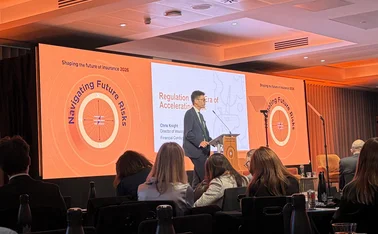
FCA’s Knight updates on cyber insurance report
Chris Knight, director of insurance at the FCA, has updated on the progress of its report into the take up of cyber insurance, and how the regulator has to keep pace with technological advancements.

Growing FCA attestation appetite a warning for brokers
The Financial Conduct Authority has increased the level of attestation requests dished out to insurance firms in recent years, and the serious regulatory tool is one brokers need to keep a keen eye on according to compliance specialists.

Why insurer oversight cannot become another regulatory box-ticking exercise
With regulatory workloads continuing to grow and the FCA maintaining its focus on customer outcomes, Insurance DataLab co-founder Matt Scott explains why brokers need a practical, evidence-led approach to insurer oversight.

FCA cancels insurance distribution business’ permissions
The Financial Conduct Authority cancelled Professional Liability Network’s permission to carry out regulated activities on 11 September 2026.