

Protection from the top - Directors' and Officers'

As scrutiny grows on individual liability, directors' and officers' cover is becoming more popular, writes Katherine Brandon
Statistics released by Marsh in September revealed that, while two years ago only 10% of FTSE 250-listed companies purchased directors' and officers' cover, today nearly 50% are buying it.
D&O policies are not just in demand with FTSE 250 companies; they are also proving important for smaller businesses. In June, a member survey carried out by the Association of Insurance and Risk Managers rated D&O among the issues that keep risk managers awake, with 17% rating it as their top concern.
"The perception that D&O insurance is only an issue for the major public companies is receding," says Nigel Tocknell, D&O underwriter at Travelers.
Nick Allen, product leader for professional and financial risks at RSA, believes that the growing popularity of D&O is due to increased awareness of directors' liabilities: "In the last 10 years, since the dotcom bubble burst, there has been more regulatory scrutiny focusing on individual liability. Speculation about the regulation of banks could perhaps see regulators reviewing the systems again with another round of regulatory scrutiny that could remind directors of their need for cover."
Expert
Allen believes that brokers have an important role to play in the sale of such policies: "As D&O policies are taken out by businesses of varying size and in so many different industry sectors, we are keen to write policies bespoke to the customer. For this, we need to know the customer and brokers can play a key role in providing access to the relevant information."
Despite the growth in volume of D&O policies and a plethora of insurers offering cover, there is a feeling that rates will rise soon. "The market is at an all-time low; it is certainly at its softest for the last 30 years. Potential exposures of insurers could be increasing with a less attractive loss ratio. Liability has heightened alongside a dip in premiums, therefore the loss ratio is not attractive. Insurers will be taking a closer look at what they are willing to offer," says Chris Hewitt, partner for financial risks at Lockton.
David Ritchie, director of D&O at Heath Lambert, agrees: "There are already fewer super-cheap deals around. Underwriters are trying to push rises through and we will see the first consistent premium increases in years."
Callum Taylor, management liability underwriting manager in the professions and speciality commercial division at Hiscox, believes that, despite underwriters looking to drive them up, premiums are very affordable - even if they are varied: "Our catchline is that all D&O policies are not the same. For smaller companies with a turnover of less than £50m, we have a set of 13 questions that our underwriters ask when putting together a policy. Premiums start from approximately £500."
On the majority of policies, there are no excesses for individuals named, yet excesses for US or company claims start at around £1,000 and typically lie between £2,500 and £5,000. Allen believes that it is important for insurance companies to continue to ensure that excesses do not apply for individuals on a D&O policy: "If you have a good claims team that becomes involved early then a customer may not need to make as large a claim. Excesses may discourage policyholders from coming to us immediately and help us to understand how we can help them."
Taylor highlights that, even where claims are made against the company rather than an individual, directors can still find themselves liable - a problem that the market needs to address. He remarks: "The problem with many D&O policies is that most claims are not made solely against one individual but rather against a company. An attack on a company can be a back-door assault on individual managers whose livelihood is dependent on the success of the business, therefore it is often important to ensure D&O policies also cover the company as an entity."
With so many insurers offering D&O policies, Taylor says that brokers need to think carefully when arranging D&O cover in order to ensure that the client is covered against all eventualities. He comments: "Brokers can make the mistake of believing all policies are much of a muchness but each insurer uses its own terms when talking about D&O policies and this can be very confusing for the broker."
Brokers with specialist D&O offerings range from big players such as Lockton, Aon and Heath Lambert to smaller outfits, such as Bordengate Insurance. Hewitt believes that new players in the D&O space should seek advice or an agency with a specialist in the area if they are not to leave themselves liable should a client have a claim refused: "The key is for brokers to be able to explain the benefits and limitations of the many policies out there.
"You can't just play at D&O. There is complicated wording, significant differences in cover and also the issues of global policies where the broker has to understand all the possible liabilities in the local areas, which can become very detailed. Inexperienced or non-specialist brokers run the risk of obtaining inferior products for the client. Underwriting criteria is becoming tougher and if you are new to the game then you will be the loser. In the current market, it is in brokers' interests to seek out expertise in this product line. There are numerous markets for D&O with different attitudes to risk, therefore you need someone with the knowledge in order to secure best terms for the client."
Ritchie agrees: "It is important for brokers to pay attention to the details of policies when dealing in complicated areas such as D&O. A broker can think their client has cover until a claim is refused. There is an intrinsic risk when not using specialists."
Side by side
Policies are often sold in conjunction with other liability or commercial insurance products. Allen comments: "D&O is a very good product for cross-selling as it fits very well across any area. There is always someone managing the business, so there is always the potential to discuss the management risk." Allen also believes that there is plenty of opportunity for selling additional services alongside D&O policies: "Some added-value services have proved popular. Legal helplines give access to professional advisers. Employment practices advisers are popular with smaller businesses."
Simon Mepham, D&O underwriter at WR Berkley, warns that selling this cover alongside other products is not always in the best interests of the customer: "D&O is different from other commercial insurances in that its principal purpose is to protect the personal assets of the directors. This creates a rational reason for keeping the D&O insurance separate from a company's other insurance products."
The financial difficulties being faced by many companies have already resulted in a number of lawsuits. In November, a lawsuit was filed in Canada with charges that AIG and many of its senior officials misled investors about the safety of some of its credit market activities for two years. Disputes at Lehman Brothers and UBS have also led to shareholder lawsuits in the recent months.
Ritchie believes that growing numbers of claims are causing hold-ups in the claims process: "In previous years, when a company had a problem then it may not have tried to access the policy, whereas now it would claim. The fundamental problem is ensuring that claims are paid efficiently because we are working through red tape constantly that is giving insurers a bad name. Trying to push claims through will continue to be an issue for as long as financial institutions continue to hoard cash."
Appreciation
As some insurers hold on to the pennies and delay the claims process, Allen believes that other insurers will have a chance to prove their worth to broker clients to develop strong, long-term relationships. He comments: "Claims are when our customers need our services the most. It is our chance to show our worth and the value of our services to both the broker and customer."
While the credit crunch takes its toll on insurers and in light of the high-profile problems at AIG - a major D&O player - brokers are seeing customers take a greater interest in which firms they place their risks with where they may previously have been more price driven. "The problems with AIG have focused the minds of buyers with regards to how much risk they place with one carrier and buyers are becoming more scrupulous when it comes to which carriers they choose. People are beginning to pay attention to security where before they were focused on price," highlights Hewitt.
John Hurrell, chief executive at Airmic, agrees: "Given that directors have a personal interest in this class of cover, inevitably risk managers are very concerned to ensure that this coverage is as secure as it can possibly be. With AIG as a market leader, risk managers have had to make difficult decisions based on the best available information."
Despite the high-profile nature of its financial issues, Andre Basile, vice-president at AIG UK, believes that the US-based giant has not seen a significant drop in the numbers of D&O policies placed with the insurer: "Levels of new trade we have seen are very heartening: we have seen great commitment from our D&O customers in renewing existing business and placing new business with us in recent weeks. We write D&O insurance for more than 50% of FTSE 250 firms and for more than 10,000 companies in the UK. We have seen many companies through difficult claims and many are showing that commitment back to us."
Judgement
Ritchie agrees that brokers might consider their options carefully before advising clients to move their risks away from AIG: "While other underwriters are taking advantage by making a play for AIG business, AIG is not the only one with problems. It is all about maintaining the options for clients and AIG is still a major D&O player."
In spite of financial problems faced by some insurers, Tocknell believes that the future is rosy for those in the D&O market and that there are plenty of opportunities for more brokers to become involved: "Uptake will continue to rise. We still see many brokers that do not sell D&O to the majority of their commercial client base, so there is still room for growth. A recession and consequent increased litigation against directors will only encourage more insureds to buy the cover."
Large organisations
For large organisations, where a limit of over £20m is required, programmes will usually be shared between carriers. The split will depend on insurer capacity and the client's attitude to risk.
"Large financial institutions are a challenging area at the moment, as it can be difficult to find enough carriers that are willing to share the risk," notes Chris Hewitt, partner for financial risks at Lockton.
The Companies and Corporate Manslaughter Acts
Dan Holloway, directors' and officers' product manager UK and Ireland, Ace
"The Companies Act has affected the D&O market. It has seen the codification of directors' duties and the ability for shareholder derivative claims to be brought. Both of these factors increase the exposures faced by directors of limited companies and emphasise the need to purchase protection.
Corporate manslaughter has been talked about at length in the D&O area. The new Act has moved the liability away from individuals to the corporation and, as such, left directors' and officers' less exposed. However, the subsequent health and safety-related investigations that may follow could increase the exposures on directors' and officers' policies. Policyholders need to ensure that they have cover for such investigations or allegations for constructive, gross negligent and involuntary manslaughter."
Only users who have a paid subscription or are part of a corporate subscription are able to print or copy content.
To access these options, along with all other subscription benefits, please contact info@insuranceage.co.uk or view our subscription options here: https://subscriptions.insuranceage.co.uk/subscribe
You are currently unable to print this content. Please contact info@insuranceage.co.uk to find out more.
You are currently unable to copy this content. Please contact info@insuranceage.co.uk to find out more.
Copyright Infopro Digital Limited. All rights reserved.
As outlined in our terms and conditions, https://www.infopro-digital.com/terms-and-conditions/subscriptions/ (point 2.4), printing is limited to a single copy.
If you would like to purchase additional rights please email info@insuranceage.co.uk
Copyright Infopro Digital Limited. All rights reserved.
You may share this content using our article tools. As outlined in our terms and conditions, https://www.infopro-digital.com/terms-and-conditions/subscriptions/ (clause 2.4), an Authorised User may only make one copy of the materials for their own personal use. You must also comply with the restrictions in clause 2.5.
If you would like to purchase additional rights please email info@insuranceage.co.uk
More on Regulation

Which? demands ban on brokers charging high motor APRs
Which? has named and shamed motor insurance brokers charging high interest rates on monthly policies and called for a ban on the practice.

No ‘particular targets’ for insurance regulation simplification, says FCA
Consumer Duty will be a building block for any future work on the simplification of insurance regulations that affect brokers, according to David Geale, executive director of consumers, payments and competition at the Financial Conduct Authority.

FCA kicked off financial year with improved authorisation service bar one outlier
The Financial Conduct Authority has upped its game on authorisation service levels in categories affecting brokers, with improvements in four areas, but one notable outlier where the performance dipped.

FCA alerts of Kent-based broker clone
Quotemetoday.co.uk has made clear it has no affiliation with Quote Me Go as the Financial Conduct Authority has reported fraudsters have been impersonating the Kent-headquartered broker.
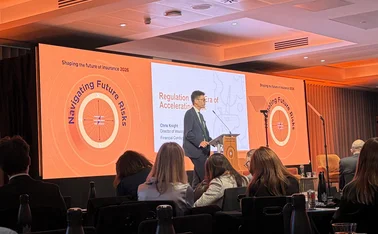
FCA’s Knight updates on cyber insurance report
Chris Knight, director of insurance at the FCA, has updated on the progress of its report into the take up of cyber insurance, and how the regulator has to keep pace with technological advancements.

Growing FCA attestation appetite a warning for brokers
The Financial Conduct Authority has increased the level of attestation requests dished out to insurance firms in recent years, and the serious regulatory tool is one brokers need to keep a keen eye on according to compliance specialists.

Why insurer oversight cannot become another regulatory box-ticking exercise
With regulatory workloads continuing to grow and the FCA maintaining its focus on customer outcomes, Insurance DataLab co-founder Matt Scott explains why brokers need a practical, evidence-led approach to insurer oversight.

FCA cancels insurance distribution business’ permissions
The Financial Conduct Authority cancelled Professional Liability Network’s permission to carry out regulated activities on 11 September 2026.