

Broker Management Forum
The Broker Management Forum is a series of live, interactive debates tackling the issues that matter....
The Broker Management Forum is a series of live, interactive debates tackling the issues that matter. Here, the first of Professional Broking's Broker Management Forums discusses the implications of the soft market for brokers and asks whether insurers have failed to learn the lessons of the past. Alex Broad reportsChaired by Richard Adams, editor of Professional Broking, the panel comprised Eric Galbraith, chief executive of the British Insurance Brokers' Association, Kevin O'Flanaghan, managing director of Aascent Finance, and Chris Hill, head of casualty underwriting for Norwich Union Insurance.
Richard Adams: The overwhelming feeling that came through from brokers while conducting research for this programme is one of nervousness about how soft rates will become and where it will all end. Another commonly shared sentiment is that this, the first soft market since the events of 11 September 2001 - and since regulation by the Financial Services Authority - is a failure by insurers to learn lessons of the past. Chris, could I ask you to shed some light on that to begin?
Chris Hill: It is fair to say that, in 2004 and in 2005, we have certainly seen competition and capacity come back into the market, which has had an impact on the level of pricing. Having said that, I think that was inevitable from where we were at the end of 2002 and 2003 and, at the moment, the level of rate increases that are out there are in line with expectations. We do see this year as being pivotal in terms of how we manage the underwriting cycle and we currently have a situation where claims inflation is running at somewhere between 8% and 10%, whereas premium increases are now beginning to cut underneath that. So the time is coming where, as an industry, we need to look at that and ask: at what point do we need to start looking to talk prices up again?
Richard Adams: Kevin, do you agree with that and at what point in the cycle do insurers consider we are?
Kevin O'Flanaghan: In general, I agree with Chris, but I would say we are probably mid cycle. I do not think it is going to be as deep as previous cycles because there is one major economic factor that is different this time from previous cycles. In the past it is has been known that underwriters wrote for cash flow to gain investment income, but the investment returns are not out there now so companies cannot afford to write at operating ratios of anything in excess of 100%. So I think the cycle will be quite shallow and not very long.
Richard Adams: Eric, are British Insurance Brokers' Association members aware of these arguments suggesting that, because things are different this time, rates are unlikely to become too soft for too long? If so, are they convinced by them?
Eric Galbraith: Well, speaking to BIBA members at the moment I would say we are definitely in a softening market. If not, looking at statistics that are available, one would say that, in 2005, this is actually a peak we are in. So we have the soft market, we have the issues that surround that; the soft market is a very complex issue - affecting everything from the capital, to the equity, to the investment, to claims preserving, to liability long-tail issues. It is a complex issue and that is what affects it.
Richard Adams: I appreciate there are many factors affecting the market cycle but, from what you are saying, if we are either mid cycle or at the peak, would any of you care to hazard a guess as to when things will start to change?
Eric Galbraith: Looking at facts and figures on other peaks, they seem to run for a period - from the information I'm given - of about seven years. If we are at this stage, if we are at the peak at the moment, then it is going to run for a bit longer.
Chris Hill: I think you have got to look at it by class of business as well. Motor fleet, for example, traditionally leads the market, both in terms of the downturn and the upturn, and I know that the fleet market at the moment is feeling that it is about as far as it wants to go, which is not as far as it has been previously. We are not going back to where we were. But the view generally around the market now is that fleet rates need to start rising and probably from here on in, certainly towards the end of this year we should start to see fleet increases.
Richard Adams: We have had a question submitted by a broker for the panel - how far do you feel that motor, and particularly fleet, is a barometer for where the market is going?
Kevin O'Flanaghan: As Chris said, because it is the one that is easiest to tweak and, to some extent, it is the easiest to technically underwrite because the claims come through quite quickly, so you can actually price it very finely and you have the results of that within 12 months. So it is not long tail like liability.
Chris Hill: Kevin is right, fleet is probably the easiest class of business. It is driven by claims, motor claims and accident damage claims in the main. You know your results at the end of the 12-month period but, with legal liability and employer's liability, you might not know your results for four or five years.
Eric Galbraith: Do you not think the challenge is with the reserving on the liability and the outstanding liabilities, which seem to change?
Chris Hill: You are right Eric. Reserving is a big issue on liability classes, getting the adequacy reserve against today's claims but also claims that are going to be charged to this year, which we do not know about at the moment. That is the other big problem we have on liability. We have claims that we are occurring today that, as an insurance industry, we do not know about and, therefore, we are not properly reflecting that in the price to the customer. And that is a difficult one; it is very difficult to explain to the customer as well.
Richard Adams: Do you think brokers had an expectation that, because fewer insurers control a large market share of the market, there would be a tighter rein on the cycle?
Kevin O'Flanaghan: I would think that is a wrong view because, as Chris said earlier, as profits have increased it is going to attract more newcomers to the market or more capacity into the market and it is a free market. So, even though the market may have effectively contracted in terms of the number of insurers, as part of the EU and effectively a worldwide open insurance market, capacity can increase at quite short notice. So it is always a free market and it is a moving one because money is attracted into this market by non-insurers who see that fair profits can be made from investing in insurance, and that will always happen. So, saying that because the number of insurers is reducing is going to lead to more stability is a very short-term view. In the long term, it does not work. It does not work in any industry.
Richard Adams: I have a question from Peter Stevenson of the Allen-Stevenson partnership. He asks: What is the FSA doing about new entrants that, because they have no legacy claim issues, have a competitive advantage? Are new entrants threatening to destabilise the market and is it a regulator's job to stop them?
Eric Galbraith: I think new entrants are a challenge to the market - brokers and customers - to identify that there is the right security there and that they are choosing that as a market. But this is part of the open and competitive market. It is a challenge.
Chris Hill: One of the complaints we have had is that the barriers to entry in our market are quite low. Capital comes in and goes out very quickly and, when you are talking about some long-tail liability classes, it makes it very difficult for those insurers that are around for the long term. And they have to deal with the people that come in looking for quick returns and then are prepared to go back out and invest their money into a completely different industry.
Richard Adams: Would you say that there is any threat of that happening at the moment? Are there new entrants currently threatening particular classes?
Eric Galbraith: There have been new entrants in the liability market - yes.
Chris Hill: I think what we are seeing is a change in market place. The traditional insurance market place of four or five large companies has changed because of mergers and consolidations. The large banks such as the Royal Bank of Scotland and Barclays are looking at the insurance market and are seeking opportunities, so they are expanding their brands away from banking into other financial services. That is the challenge with which the traditional insurance company has to deal.
Richard Adams: Do you think the fact that the market is now regulated by the FSA is a barrier to those that may look to come in and come out quite quickly just for a quick profit?
Kevin O'Flanaghan: I wouldn't think it is a barrier to entry or exit, providing they obey the rules. We are all participants in the market and subject to the same rules and, providing you have got capital adequacy and obey the rules, you can enter or leave the market. The main threat, as it were, to the market previously was the Bermuda captive reinsurers, or some of the other offshore operations are probably more of a threat than the fewer entrants into the UK market. But regulation - or deregulation, as the case may be - is neither a hindrance nor a threat.
Richard Adams: Ian Mantel of Manor Insurance Services asks: "Now that the FSA is looking at transparency, will insurers continue to be able to justify differing rates via brokers?"
Chris Hill: It is an interesting question. In pure underwriting terms, there is always a rate for the risk irrespective of who that risk is broked through. What then have is the added dynamics of the costs of servicing that risk and, if certain distribution channels or certain brokerages can do it at a differential cost, then that could be a factor in why you get different rates. Fundamentally, however, there is one price for one risk in terms of what that risk is worth.
Kevin O'Flanaghan: I was involved in Commercial Union for 14 years on the finance and planning and general pricing side, and what Chris said has always been the basis of insurance. You price the type of risk and then you price the distribution channel, and that is what it is.
Eric Galbraith: The FSA has set down the rules so I would not agree that the FSA is looking at transparency. What they will be looking at is conflict management within these rules to deal with that and, unless I have misunderstood this question, I would have thought there is an element of rates of brokerage in the market and that might be an area. And the answer is yes - they should be able to charge different rates of brokerage.
Richard Adams: David Abrahams of Carl Insurance Brokers has asked: "How should brokers stabilise their income during the current soft-market environment?" Is BIBA increasingly advising its members on how to reduce or balance their reliance on commissions from insurers? If so, would you say brokers seeking alternative revenue is driven by the softening market or is the cost of regulation a contributing, or even greater, driver?
Eric Galbraith: First of all, BIBA is not doing anything to advise the brokers on that. Brokers are very dynamic. I think the key issue here is to understand, as far as possible, your position in the market, for the broker to realise the position that they are in and to keep customers in the loop with regard to the soft or hard market. Thereafter, there are various opportunities, which each of BIBA's members will actually pursue to ensure that they maintain a margin. But it is difficult at the moment. We have had the cost of regulation, we have the soft market - it is not easy. It is quite a challenge out there.
Richard Adams: Do you think that it might, for example, force some brokers to look again at charging fees rather than just purely relying on commission?
Eric Galbraith: Many brokers already charge fees. Many have a combination of fees and commission, depending on the type of business they are in, so that is already out there and they do that. I am sure that many of our members will be in discussion with the insurers with regard to what they do for insurers and the brokerage that they earn, or the work that they do and how they are going to be paid for that.
Richard Adams: Kevin, what are your views on the soft market acting as a catalyst for all this?
Kevin O'Flanaghan: I am actually going to go back to the hard market, which we have just come through, which is rather interesting in that the larger corporate clients in the commercial sector put a lot of pressure on most of the larger broking houses to go away from commission-based income to fees so, at the peak of the market, some of the larger broking houses - and those brokers with larger commercial risks - had already transferred a lot of their business onto a fee-income basis. So now that we have a softer market, they have a different charging structure and, to some extent, they are insulated. But there is a large catalyst on risk-management fees now in trying to separate out what is the pure commission element of insurance placing and risk-management fees. Also, we have noticed a further move for third-party premium financing, which is the type of business that we are in because brokers can earn fee income on that as well
Richard Adams: Fifty-nine per cent of Broker Management Forum members have said that, because of the softening market, they would consider alternate revenues such as moving to charging on a fee basis. Chris, at Norwich Union have you been encouraging your brokers or your distribution partners to behave in this way?
Chris Hill: I think as Kevin and Eric said, there is a real mixed bag out there. Some brokers have already moved to fees, some are very traditionally commission-based. What we have been trying to do with brokers from a Norwich Union perspective is help them with their cost base. So, if their income is under pressure, one other area you look at is your cost base. Norwich Union has been working with its brokers, as I am sure other insurers have, on access to third-party suppliers, on streamlining business, doing more over the internet and e-trading so that the broker can look at the costs that he has incurred in his business and perhaps tackle it from that angle as well.
Richard Adams: I have a question from Peter Wilby: "We are increasingly finding competing brokers putting forward 'desktop' quotes on the commercial business, promising savings of 30% or so. They apparently then find insurers willing to write the business at this price, even though full marketing of the risk has been carried out by ourselves in the last one or two years. We regard this method as unprofessional and unethical."
Eric Galbraith: It is totally unprofessional. I have seen it in my career where other brokers are 'desktopping'. It is a sad reflection of the market's actual response to those desktop quotes. I do not know if it is part of the very competitive market we are in and we will continue to see it but, quite frankly, if that is encouraged by insurers, I would think that is very wrong and very unprofessional.
Chris Hill: I totally agree with Eric. We are totally against desktopping. All our staff have clear guidelines on how we deal in terms of trading protocols for quotations. The difficulty is that we are talking about a business that involves people and you need to find just the weakest link in the chain and somebody to respond to a desktopping quote and, suddenly, that can become the benchmark. So I totally agree with Eric - I think professional broking should be responded to with professional underwriting, and there is no place for desktopping.
Eric Galbraith: And it does highlight another issue, which is the focus on price only, and the customer and the broker should be concentrating on the added value that is provided and the actual cover and the services within.
Richard Adams: Does anyone have any closing comments?
Eric Galbraith: I would like to see insurers looking much more closely at how they underwrite some of the risk and how they deal with the reserving and the timing involved in that when they come forward. I think there are issues around there and I do not think we will get rid of the cycle but I think there are areas that we should be addressing within the way we operate as an industry to actually try and achieve that. To jump from 100% increases back to a 90% reduction over a two- or three-year period is, quite frankly, ridiculous and causes endless problems with our clients and the general public as well.
Chris Hill: The other thing I would say, to hopefully provide some support to Eric and his brokers, is that insurers continually talk about disciplined underwriting; it is about not making the mistakes of the past.
Kevin O'Flanaghan: The challenge for brokers - and I think it is a good one this time - is that I do not think the cycle is going to be as long or prolonged, and the peaks and troughs are not going to be the same. The catalyst has to be to get more stable fee income so that the broker is insulated against these peaks and troughs in the future. But, that also means that they will not share in the massive 100% increases if they ever come again, but at least they will have a stable growing income base in the future.
THE PANEL Richard Adams
Eric Galbraith
Chris Hill
Kevin O'Flanaghan
Brokers can listen to the debate, submit questions before or during the proceedings and vote in the online polls, all from the comfort of their desks. To register as a member to participate in future debates, please visit the website at: www.brokermanagementforum.com.
Only users who have a paid subscription or are part of a corporate subscription are able to print or copy content.
To access these options, along with all other subscription benefits, please contact info@insuranceage.co.uk or view our subscription options here: https://subscriptions.insuranceage.co.uk/subscribe
You are currently unable to print this content. Please contact info@insuranceage.co.uk to find out more.
You are currently unable to copy this content. Please contact info@insuranceage.co.uk to find out more.
Copyright Infopro Digital Limited. All rights reserved.
As outlined in our terms and conditions, https://www.infopro-digital.com/terms-and-conditions/subscriptions/ (point 2.4), printing is limited to a single copy.
If you would like to purchase additional rights please email info@insuranceage.co.uk
Copyright Infopro Digital Limited. All rights reserved.
You may share this content using our article tools. As outlined in our terms and conditions, https://www.infopro-digital.com/terms-and-conditions/subscriptions/ (clause 2.4), an Authorised User may only make one copy of the materials for their own personal use. You must also comply with the restrictions in clause 2.5.
If you would like to purchase additional rights please email info@insuranceage.co.uk
More on Regulation

Which? demands ban on brokers charging high motor APRs
Which? has named and shamed motor insurance brokers charging high interest rates on monthly policies and called for a ban on the practice.

No ‘particular targets’ for insurance regulation simplification, says FCA
Consumer Duty will be a building block for any future work on the simplification of insurance regulations that affect brokers, according to David Geale, executive director of consumers, payments and competition at the Financial Conduct Authority.

FCA kicked off financial year with improved authorisation service bar one outlier
The Financial Conduct Authority has upped its game on authorisation service levels in categories affecting brokers, with improvements in four areas, but one notable outlier where the performance dipped.

FCA alerts of Kent-based broker clone
Quotemetoday.co.uk has made clear it has no affiliation with Quote Me Go as the Financial Conduct Authority has reported fraudsters have been impersonating the Kent-headquartered broker.
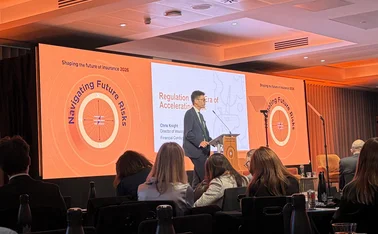
FCA’s Knight updates on cyber insurance report
Chris Knight, director of insurance at the FCA, has updated on the progress of its report into the take up of cyber insurance, and how the regulator has to keep pace with technological advancements.

Growing FCA attestation appetite a warning for brokers
The Financial Conduct Authority has increased the level of attestation requests dished out to insurance firms in recent years, and the serious regulatory tool is one brokers need to keep a keen eye on according to compliance specialists.

Why insurer oversight cannot become another regulatory box-ticking exercise
With regulatory workloads continuing to grow and the FCA maintaining its focus on customer outcomes, Insurance DataLab co-founder Matt Scott explains why brokers need a practical, evidence-led approach to insurer oversight.

FCA cancels insurance distribution business’ permissions
The Financial Conduct Authority cancelled Professional Liability Network’s permission to carry out regulated activities on 11 September 2026.