

Storm clouds gather
The shockwaves of the Spitzer inquiry felt in the US have also hit hard in the UK, with the Financial Services Authority taking the reins and having the final say on broker remuneration. Marcus Alcock reports on brokers' concerns here in the UK
With the prospect of statutory regulation looming, UK insurance brokers had enough to contend with as 2004 drew to a close. Now, the events on the other side of the Atlantic are about to cause further turmoil.
The decision by the New York State Attorney General to launch an investigation into alleged market-rigging practices and the use of so-called contingency commissions cast an uncomfortable spotlight on the practice of brokers that continues to shine to this day. And the ramifications have been enormous, with Marsh - the broker that first came to light as part of the investigations - losing its chief executive, shedding 3000 jobs worldwide and, last month, agreeing to a staggering settlement of some $850m (£450m).
It is not only Marsh that has suffered as a result of the investigations.
Munich Re and Swiss Re have been asked to provide evidence while, according to the office of Eliot Spitzer, six executives at AIG, Marsh, Zurich American Insurance and Ace have pleaded guilty to criminal charges in the probe.
Specifically on the broker front, the world's largest insurance and reinsurance brokers have also been quick to declare that they are halting the practice of accepting contingent commissions.
There is no doubt then that brokers are experiencing a great degree of turbulence, with the practice of broker inducements being the real issue.
For the largest London Market brokers, statements were made last autumn declaring that such practices would stop. This is all well and good, but what exactly will happen going forward if such a well-established form of remuneration is no longer going to be practised, and what lies ahead for the rest of the UK commercial and personal lines sector?
An interesting lead has already been taken by the Financial Services Authority, which, after all, has the final say on whether the practice of certain brokers receiving increased remuneration for passing extra business to insurers is allowable going forward. Although the issue was widely consulted upon in the run-up to regulation and was deemed to be acceptable, the Spitzer investigation forced the FSA to reconsider the subject and, in recent months, it has embarked upon another round of deliberations as to what really is the best method.
To the relief of the broking community, the FSA has decided to stick with its original decision and not outlaw inducements. Thus, last month it released a guidance paper spelling out the principles that should govern broker conduct. Significantly, it did not prohibit the use of contingency commissions, saying that it does not believe it would be proportionate at this stage to ban specific arrangements and be mindful of the potential impact on market structure before contemplating such a step.
According to the regulator, a broker should not put itself in a position where there is a significant likelihood of conflict, which, if not addressed, would result in material detriment to one or more customers. Importantly, the FSA also stressed that the context of an inducement is key, such as the circumstances in which an inducement operates, the way in which it is structured and whether it is in practice used in a way that results in customers being treated unfairly.
Despite the stance taken by the FSA, brokers have not been let entirely off the hook, as they will nonetheless have to ensure that they have appropriate procedures in place to manage any potential conflicts of interest. Crucially, the regulator has stressed that it will ensure that such procedures are in place as an early supervisory priority and will even go so far as to publish the findings of good and bad practices in the market.
Steve White, regulation and compliance manager at the British Insurance Brokers' Association, said he is pleased that the regulator has taken a pragmatic approach to the issue and that it has demonstrated a consistent approach: "The FSA is not changing the rules and thinks that the logic (on broker inducements) is sound; it is really saying that this is a conflict management issue." He encourages BIBA members to have another look at their internal procedures over this crucial issue to ensure they will stand up to any future analysis.
The FSA's decision has not only appealed to the broking sector - it has also come as welcome news to many insurers. After all, the practice of broker inducements is a well-established part of the UK broking market and has for some years been an integral aspect of the intermediated dealings of the largest insurers.
Greg Gladwell, director of intermediary business services at Norwich Union, says he is pleased with the FSA's decision, as it has given clarity to the rumours that were circulating. "They have seen it as the broker's requirement to make sure it does not influence the giving of advice." He adds that, as far as NU is concerned, it will not be stopping its long-established practices of rewarding the brokers that provide it with the best business, though it has undertaken a review of the area.
As a result of the review, NU has introduced new wording into the contracts it has with its brokers, stipulating that any deal will be subject to cancellation if there is found to be market abuse occurring. Nonetheless, he says, the insurer will continue offering the top 500 out of the 4000 brokers it deals with in the UK either enhanced commission or the opportunity to take advantage of another form of reward such as broker training.
"That has been going on for eons," he says, stressing that the practice does not work to the detriment of the customer because they are given an end-price and any extra commission that certain brokers may make is separated from what the customer is charged.
Amanda Blanc, distribution and customer service director at Groupama, is adamant that the practice of broker inducements will continue, for, as far as the insurer is concerned, there is absolutely nothing wrong with it in principle: "It is totally competitive, as brokers do their absolute best. No one goes into Sainsbury's and asks what their mark-up is."
She stresses that the most important response to the issue going forward is not to have a knee-jerk reaction to it. "We have said let us wait and see - at the time (that Spitzer first broke) there was a lot of hot air about it but, since then, the regional brokers have been fairly level-headed about it," she comments. As far as Blanc is concerned, commission levels at present are 'fair and equitable' and, where commissions do vary from broker to broker, such a variation will be 'reasonable and justifiable'.
Despite such firmly held opinions, however, Blanc nonetheless concedes that there may well have to be some sort of new pricing structure, and accepts that some insurance companies may well want to look at their pricing.
Despite the view of the likes of Norwich Union and Groupama that the current practice is essentially acceptable and does not need major tweaking, not everyone agrees. Ian Ritchens, chief executive of regional broker FM Green, explains that some things will have to change: "Personally I think that profit schemes - as long as they are disclosed - are all right, but, when talking about volume overriders where an insurer comes in September and says to the broker "we will give you an extra £5m if you do X amount of business before the end of the year", that is a problem. I think that such practices will eventually be declared illegal and that the FSA will come down quite hard on this. There is no advantage to the client whatsoever - you are purely moving business to the benefit of your own margins."
Despite the relatively hands-off stance so far set out by the FSA, Ritchens suspects that the regulator will nonetheless look at these types of arrangements very closely indeed. He says that, as far as FM Green is concerned, the broker would prefer a different form of remuneration altogether and that some insurers have already gone down this route: "Zurich does not have profit share any longer but, for its elite brokers, is providing an extra 2% commission. It is completely transparent and there are no extras to disclose."
He adds that Zurich may not be the only insurer to alter its remuneration arrangements with its intermediaries in future: "I have let companies know that (extra commission) is our preferred route. We are still in negotiations with several insurers but we have had one or two say they will do this."
For the time being, it seems that such arrangements will be left to individual negotiations between brokers and insurers, and that pressure will not be placed on either side to alter their codes of conduct. For example, a spokeswoman for the Association of British Insurers says that it has not taken a stance on the subject and is merely keeping a watching brief on events, especially in the light of the fine that has been levied on Marsh.
It would appear then that, although some insurers will maintain the traditional practice of broker inducements, not all brokers want to continue with this model anyway, especially those in the London Market. After all, the likes of Marsh, Aon, Willis and Jardine Lloyd Thompson have all said that they are stopping the practice of accepting contingent commissions. According to Barrie Cornes, an insurance analyst at Cheuvreux, the ramifications of such decisions could be widespread indeed and could affect the future of the biggest brokers in the market on several levels.
On one level he says the obvious question that needs to be addressed is an examination of the models to see how exactly the loss of remuneration from contingent commissions is going to be reflected in terms of the overall company organisation. This may well entail a streamlining of the business, which could result in further job losses. Although he accepts that such drastic action may well occur - after all, Marsh has already introduced a substantial staff-reduction programme - he says it is important that, if other insurance brokers let staff go, that it is done in a fair and consistent manner.
Another ramification of the abolition of contingent commissions will simply be the question of what is going to replace the lost revenue. One suggestion, as FM Green is already doing, is to put pressure on insurers to pay higher commissions instead. Interestingly, however, Cornes suggests that another option is for the client to pay a higher fee in future. Whether this will be seen as an acceptable alternative by risk managers dealing with the London Market remains to be seen.
Interestingly, the issue of broker inducements could ultimately have a major impact on the overall balance of power within the UK broking sector itself, Cornes suggests, pointing out that, with so many share options plummeting at major brokers, good staff may look to move of their own accord and take the opportunity to establish a 'new, clean broker'. Now that really would set the cat among the pigeons.
Only users who have a paid subscription or are part of a corporate subscription are able to print or copy content.
To access these options, along with all other subscription benefits, please contact info@insuranceage.co.uk or view our subscription options here: https://subscriptions.insuranceage.co.uk/subscribe
You are currently unable to print this content. Please contact info@insuranceage.co.uk to find out more.
You are currently unable to copy this content. Please contact info@insuranceage.co.uk to find out more.
Copyright Infopro Digital Limited. All rights reserved.
As outlined in our terms and conditions, https://www.infopro-digital.com/terms-and-conditions/subscriptions/ (point 2.4), printing is limited to a single copy.
If you would like to purchase additional rights please email info@insuranceage.co.uk
Copyright Infopro Digital Limited. All rights reserved.
You may share this content using our article tools. As outlined in our terms and conditions, https://www.infopro-digital.com/terms-and-conditions/subscriptions/ (clause 2.4), an Authorised User may only make one copy of the materials for their own personal use. You must also comply with the restrictions in clause 2.5.
If you would like to purchase additional rights please email info@insuranceage.co.uk
More on Regulation

Which? demands ban on brokers charging high motor APRs
Which? has named and shamed motor insurance brokers charging high interest rates on monthly policies and called for a ban on the practice.

No ‘particular targets’ for insurance regulation simplification, says FCA
Consumer Duty will be a building block for any future work on the simplification of insurance regulations that affect brokers, according to David Geale, executive director of consumers, payments and competition at the Financial Conduct Authority.

FCA kicked off financial year with improved authorisation service bar one outlier
The Financial Conduct Authority has upped its game on authorisation service levels in categories affecting brokers, with improvements in four areas, but one notable outlier where the performance dipped.

FCA alerts of Kent-based broker clone
Quotemetoday.co.uk has made clear it has no affiliation with Quote Me Go as the Financial Conduct Authority has reported fraudsters have been impersonating the Kent-headquartered broker.
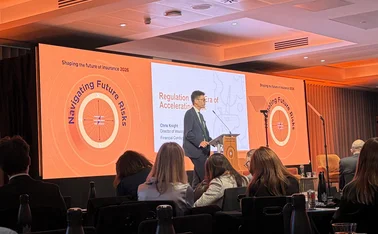
FCA’s Knight updates on cyber insurance report
Chris Knight, director of insurance at the FCA, has updated on the progress of its report into the take up of cyber insurance, and how the regulator has to keep pace with technological advancements.

Growing FCA attestation appetite a warning for brokers
The Financial Conduct Authority has increased the level of attestation requests dished out to insurance firms in recent years, and the serious regulatory tool is one brokers need to keep a keen eye on according to compliance specialists.

Why insurer oversight cannot become another regulatory box-ticking exercise
With regulatory workloads continuing to grow and the FCA maintaining its focus on customer outcomes, Insurance DataLab co-founder Matt Scott explains why brokers need a practical, evidence-led approach to insurer oversight.

FCA cancels insurance distribution business’ permissions
The Financial Conduct Authority cancelled Professional Liability Network’s permission to carry out regulated activities on 11 September 2026.