

June's debate
In June's debate our panellists discussed the issues surrounding delegated authority claims handling
Richard Adams: Given the feedback we have had during research for this programme, it seems appropriate to spend some time looking at the mechanics of how a broker goes about gaining an insurer's permission to handle claims. How big a leap is it from doing claims processing and chasing insurers for payment to taking on full delegated authority?
Graham Trudgill: We hear from Biba members that insurers look for brokers that have a particularly good relationship with them. These usually have a decent sized account, quite often over £100,000. However, if it is a specialist niche area, it may not need to be that large an account if the broker can bring a lot of expertise. Expertise is everything to insurers, so they know a broker knows what they are doing and can be trusted.
Dick Tucker: I agree, regarding niche schemes where the expertise rests with the broker. In those instances, any claims would probably just go into the general claims department of an insurer and sometimes you do not get the correct result from the insurer in terms of understanding the full cover. Brokers in niche areas should push for claims DA. Also, whenever considering a claims DA, a broker should ensure they will be dealing with a sufficient number of claims as a handful per year is not worth while. What the benefits are and what they are going to get from handling the claims is another consideration. If they can see it would be a benefit to their clients and to their business, then that is another reason to push for DA.
Sean Ball: From Cunningham's perspective, we often find that a broker, having obtained DA, has found that they are actually able to get a higher DA if they are essentially recommending that it is passed to the likes of someone like us or whoever. Often, the technical level that can be brought to the handling of the claims from the insurers viewpoint is felt to be higher. It does not necessarily mean that the broker could not do that but it is perhaps a perceived view from the insurer.
Richard Adams: So, an insurer might look more favourably on a broker's application to process claims if it has an association with a loss adjuster or another third-party claims provider?
Sean Ball: I am not necessarily saying that they have to have that relationship in place already, it is more if they were to say rather than us taking on the responsibility of dealing with the claims ourselves, we would be interested in using a third party to run that. Insurers have often been more willing to give the DA but also to give a higher level. Obviously, the higher the level you can achieve means having the ability to investigate and resolve claims quickly and proactively which is what it is all about. So it is just an additional layer of confidence the insurer has if they are effectively outsourcing that DA.
Richard Adams: What are the basic skill level requirements within a brokerage for claims DA?
Dick Tucker: Under Financial Services Authority training, competency is very much in the fore, and is a major issue for them to look at with firms across the board. So, any broker that is looking to take on a DA and handle claims does need competent staff. This is from an FSA point of view but also from a business point of view and from a technical standpoint of understanding the products and the claims handling while also having the soft skills. Having those good relationship skills to deal with people is also very important as, if you are handling claims, you will get complaints. Handling them positively and assertively is very important. It is also about having an adequate number of people and resource to be able to handle the claims.
Graham Trudgill: Insurers give different levels of training so each broker needs to consider what level of training is relevant. Also, the insurer does have the ultimate responsibility. If the claim goes wrong, then the FSA is going to come down on the insurer but the insurer will have some come back against the broker.
Dick Tucker: In most instances, insurers will want to know who is actually going to be handling the claims and will probably want evidence of competence. With us, claims handlers are named in the agreement so it's clear to the insurer who is actually handling the claims. We are very keen to do that because it is a partnership with the insurer.
Dick Tucker: In terms of minimum staff required to handle claims it depends on the authority and volume of claims. Generally there should be a minimum of two people to cover sick leave or holiday. However, if you have a large property account and you have got authority to handle claims up to £2500, maybe £5000, then you will get numerous claims and may need three to five people.
Richard Adams: There is the question of whether it is morally right to be acting on behalf of both the customer and the insurance company. Dick, could you explain how you approached and resolved this, and was the process mostly covered off by following FSA guidelines?
Dick Tucker: If you look at Insurance: Conduct of Business, it is clear that intermediaries should avoid conflicts of interest and, in fact, it states that it must not put itself in a position where its own interest or its duty to act for any person conflicts with its duty to the end customer. However, it also says that unless there is proper disclosure to the customer, and you have obtained prior informed consent, then certainly one of the requirements under ICOB 7.4 is that where you are acting for an insurer, you must inform the customer. Whatever business you are in there is always a conflict of interest and I accept that there is a conflict in handling claims but there is also a conflict for the insurer when they are handling the claims. So, it is not a different conflict than insurers. We have a separate claims handling team and we built a Chinese wall between the account handlers and the claims handlers, so the former look after the client from the claims perspective. We are also audited twice a year by some insurers and at least once by others. However, we also ensure we carry out our own audits to further minimise any conflict.
Richard Adams: So how does the Chinese wall stop the account handlers telling your claims handlers 'you have got to pay this or otherwise we are going to lose this great piece of business'?
Dick Tucker: We keep it very much at a very senior level as to the details about profit shares, so the account handlers would not know that.
Richard Adams: Thanks for that overview of regulation in practice. Graham, is there anything you would want to add? Would you agree there is a conflict but that it is a manageable one?
Graham Trudgill: Yes, the key thing is for the broker to identify and manage that conflict. There are certain safeguards that can be put in place by the insurer of a proper comprehensive conflict management policy and a claims handling policy. The audits need to be put in place by the insurance company to make sure that there is a written process that they have to go through periodically. Employees with the profit share authority and who know of it should not be in a position to dictate to the claims staff. All staff need to be trained in the actual conflict management themselves, so they are aware of the issue and they can demonstrate to the FSA that they are aware of it and they are doing their best to manage it. Claims staff should not be paid according to the profitability of an account, so if they are throwing out more claims, that really should not affect their income. The bottom line is, if the broker is doing their job properly, if they are managing it, then it is not a concern.
Richard Adams: Does claims handling authority always go hand in hand with delegated underwriting authority? And does the authority for claims always involve property?
Dick Tucker: No, it doesn't always go hand in hand with underwriting but an insurer is usually less likely to give you a claims authority if you have not already got some underwriting authority. Certainly, on the property side, we have claims authority without having the underwriting authority so it does not always go hand in hand.
Sean Ball: Insurers are more keen to grant delegated authorities where it is a property or mature damage based sort of claims portfolio. That is not to say they will not grant DA for liability scenarios, they may form part of a package wording, etc. But in our experience, they have greater reservations about outsourcing where the claims arising relate to liability. Essentially, you are right Richard, the majority of DA accounts seem to relate to some form of property based account.
Graham Trudgill: We have spoken to several insurers and they have different viewpoints, which is interesting. One particular large insurer was concerned that it would raise too many conflict issues if they gave the claims authority and the underwriting authority to a small broker. However, they are not so concerned with the larger brokers because there are the Chinese walls are in place.
Richard Adams: I want now to turn our attention to the benefits that brokers gain from undertaking all of the above.
Graham Trudgill: The broker needs to differentiate themselves in the distribution channel over the many other channels that are competing. By taking control of the claim, they are really adding value and they are helping their client. They are cutting out some of the delays giving them much faster service, really taking ownership of that claim. That is their shop window at the end of the day, their clients are with them because their claims are being looked after and paid.
Richard Adams: Thanks for that Graham. Dick, you mentioned earlier that this can open doors to other things. Can you tell us about some of the spin-off benefits?
Dick Tucker: I think one of the benefits is that where you are dealing with a customer, it becomes a bit of a one-stop shop. You know, they actually only talk to Stewart Alexander, they do not have to talk to the insurer. This helps to get more business in, which, at the end of the day, is obviously what we are looking to do.
Richard Adams: So it does boost organic growth as well?
Dick Tucker: Yes. That is right.
Richard Adams: Graham, is a factor driving this trend inadequate performance from insurers' claims departments?
Graham Trudgill: Yes, we had a lot of members saying to us that they are not happy and there are various reasons for that. Obviously going back 10 years there were regional branch networks and relationships which helped move things along quickly. Now that has changed, the regional branches are not what they used to be and there are not so many of them. So the broker is ending up in a call centre and it could be a different person every time they phone up. Some of this has been outsourced abroad where they really do not have much knowledge.
Richard Adams: Your concluding remarks please.
Sean Ball: I would say that DA brings great benefits to anyone that does take it on, whether they do it themselves or uses a third-party administrator is obviously the decision they need to make. And that would be driven by the outcomes they want to achieve.
Dick Tucker: Always look at the benefits of having a claims DA first before considering it. Then make sure you have got adequate numbers of competent staff to deal with it. Make sure that you can meet any service level agreements to avoid a breach of contract situation.
Graham Trudgill: Yes, I think it is something that if the broker is interested in doing, they should definitely research. However, ask if you can add the value, can you balance the cost of doing it and can you manage the conflicts? You should be able to, so make sure your staff are trained and competent and obviously regularly review everything.
THE PANEL
Richard Adams, Editor, Professional Broking magazine
Graham Trudgill, Technical services manager British Insurance Brokers' Association
Dick Tucker, Compliance manager, Stuart Alexander
Sean Ball, Specialist sector business development director Cunningham Lindsey
- Hear this debate in full, and previous debates, by accessing the archive on the website at www.brokermanagementforum.com
- Membership is free. Register online now to secure your place in next months's event on 'winning the war for talent'.
Only users who have a paid subscription or are part of a corporate subscription are able to print or copy content.
To access these options, along with all other subscription benefits, please contact info@insuranceage.co.uk or view our subscription options here: https://subscriptions.insuranceage.co.uk/subscribe
You are currently unable to print this content. Please contact info@insuranceage.co.uk to find out more.
You are currently unable to copy this content. Please contact info@insuranceage.co.uk to find out more.
Copyright Infopro Digital Limited. All rights reserved.
As outlined in our terms and conditions, https://www.infopro-digital.com/terms-and-conditions/subscriptions/ (point 2.4), printing is limited to a single copy.
If you would like to purchase additional rights please email info@insuranceage.co.uk
Copyright Infopro Digital Limited. All rights reserved.
You may share this content using our article tools. As outlined in our terms and conditions, https://www.infopro-digital.com/terms-and-conditions/subscriptions/ (clause 2.4), an Authorised User may only make one copy of the materials for their own personal use. You must also comply with the restrictions in clause 2.5.
If you would like to purchase additional rights please email info@insuranceage.co.uk
More on Regulation

Which? demands ban on brokers charging high motor APRs
Which? has named and shamed motor insurance brokers charging high interest rates on monthly policies and called for a ban on the practice.

No ‘particular targets’ for insurance regulation simplification, says FCA
Consumer Duty will be a building block for any future work on the simplification of insurance regulations that affect brokers, according to David Geale, executive director of consumers, payments and competition at the Financial Conduct Authority.

FCA kicked off financial year with improved authorisation service bar one outlier
The Financial Conduct Authority has upped its game on authorisation service levels in categories affecting brokers, with improvements in four areas, but one notable outlier where the performance dipped.

FCA alerts of Kent-based broker clone
Quotemetoday.co.uk has made clear it has no affiliation with Quote Me Go as the Financial Conduct Authority has reported fraudsters have been impersonating the Kent-headquartered broker.
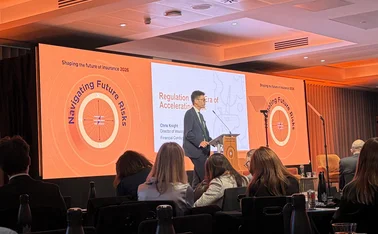
FCA’s Knight updates on cyber insurance report
Chris Knight, director of insurance at the FCA, has updated on the progress of its report into the take up of cyber insurance, and how the regulator has to keep pace with technological advancements.

Growing FCA attestation appetite a warning for brokers
The Financial Conduct Authority has increased the level of attestation requests dished out to insurance firms in recent years, and the serious regulatory tool is one brokers need to keep a keen eye on according to compliance specialists.

Why insurer oversight cannot become another regulatory box-ticking exercise
With regulatory workloads continuing to grow and the FCA maintaining its focus on customer outcomes, Insurance DataLab co-founder Matt Scott explains why brokers need a practical, evidence-led approach to insurer oversight.

FCA cancels insurance distribution business’ permissions
The Financial Conduct Authority cancelled Professional Liability Network’s permission to carry out regulated activities on 11 September 2026.