

Getting away with murder?
Despite the hype and media attention surrounding corporate manslaughter, many believe a proposed new bill lacks any real teeth. Marcus Alcock outlines the implications for brokers and the wider insurance industry
Despite a number of high-profile prosecutions in recent years it seems that the corporate manslaughter regime in the UK has hardly changed at all, with the system seemingly unable to pinpoint blame where directors of large companies are concerned. And, despite the fact that the government has finally laid out proposals for reform of the law and intends to introduce a new Corporate Manslaughter Bill, parliamentary time has still not been allocated for the legislation. Observers are rightly wondering whether any lasting change will ever happen after so many disappointments, prevarications and lack of willpower on the part of those with the power to reform.
The weakness of the present set-up was most vividly demonstrated in failure of the most recent high-profile trial to secure convictions for corporate manslaughter - that following the 2000 Hatfield train crash. Four people died and 102 were injured when the London to Leeds train was derailed by a cracked section of track. Balfour Beatty and five rail executives faced charges of corporate manslaughter but were formally cleared by the judge due to lack of evidence. Instead, Network Rail and Balfour Beatty were fined a total of £13.5m for breaching health and safety regulations.
Fiona Gill, a partner at law firm Davies Arnold Cooper, explains the difficulties of the current set-up that were exemplified by the most recent decision: "Hatfield was a particularly difficult case because, after the accident, six directors, Balfour Beatty and Network Rail were all charged with manslaughter - there were both individual and corporate manslaughter charges - so they went into it with all guns blazing. The problem at the moment is the identification principle, which is that the guiding mind of a company also has to be guilty of manslaughter."
As Gill points out, the historic difficulty with any large company - which was exactly the same in the Hatfield case - is that it is virtually impossible to identify the 'controlling mind' where there is such a diffuse management structure: "Under existing law it is very difficult to charge even a medium-sized company with manslaughter."
So, will the situation change once the proposed act becomes law? "Hatfield is the latest in a long line of disasters, stemming from the Herald of Free Enterprise, through to the King's Cross underground station fire and including five major rail crashes in recent years, not one of which has resulted in the prosecution of those responsible," says Phil Wright, chief engineer at Allianz Cornhill Engineering.
He suggests the proposed Corporate Manslaughter Bill will not be the panacea that people were hoping for: "What is the Corporate Manslaughter Bill going to achieve? Because it has been watered down it is not going to address individuals - there will be no jail sentences involved - so, in a way, it does little more than what the existing health and safety legislation already does."
This theme is picked up Dorothy Flowers, a partner at law firm Reynolds Porter Chamberlain. "The current law on corporate manslaughter requires the identity of a controlling mind, and it has worked with very small companies where the person in charge of the company is the one taking all the decisions. But, with Hatfield we had Balfour Beatty and Network Rail, in organisations of that size it is almost impossible to identify a controlling mind. But at Hatfield we saw Health and Safety Executive prosecutions with enormous fines, so it is difficult to see how the bill will change things beyond bringing the stigma of a criminal conviction. But, in practical terms, the outcome of the new legislation will be a substantial fine, so it is not that different from the current situation."
Flowers says the situation is continuing even after Hatfield, with a current case once again highlighting the difficulty of the existing legislation. "Southampton Hospital is facing prosecution as a result of the death of a patient from MRSA, and there have already been two prosecutions of individuals. However, because of the current law, it is not possible to get a prosecution under corporate manslaughter so they are going for it under health and safety legislation."
Of course, it is not only the companies in the firing line of prosecutions that may be wondering how they will be affected by the new legislation - brokers who may have advised their clients on establishing effective risk-management procedures may also be wondering whether they can be implicated in any action.
The good news, according to Flowers, is that such a possibility is highly unlikely. She takes as an example a hospital that could face charges of corporate manslaughter. "The hospital is responsible for its risk-management procedures and it can choose to obtain advice from outside. If that advice turns out to be bad advice, the hospital could decide to take action against the advisers," she comments, but adds that such an action would have to be one taken separately - brokers will not be directly targeted in this way. This is not to suggest that intermediaries are entirely off the hook, as she warns: "If [an organisation] has employed a broker for their risk management, they could use that as part of their defence."
Looking on the positive side, Wright thinks that the risk-management aspect of brokers will become all the more important in future. "I think brokers will do a good job for their clients if they work with them on issues such as ensuring that HSE records are kept up to date, that there are proper audit trails, there is a proper risk-assessment policy and they are aware of changes to the law," he says. "So I think that brokers should have their own check lists."
Despite the fact that the bill is not necessarily going to be as far-reaching as was once hoped, it will nonetheless have an impact on the insurance market. According to Wright: "I think there is certainly a likelihood that there will need to be an increase in the size of employers' liability insurance and probably public liability insurance as well. One of the things that will happen is that the public prosecutor will have far more of a stomach to have a go at companies under the new act. There will be more of an avenue for prosecutions to take place as you will not have to identify individuals, which has always been the stumbling block."
Insurers might also have to consider altering policies once the new law comes into effect, Wright adds: "Law firms are already saying that the wording of EL and PL policies might have to be revised, as there is a concern that such policies do not cover such prosecutions as can be brought under the new bill."
The area of directors' and officers' cover is also one that could be affected by the changing corporate manslaughter environment, claims DAC's Fiona Gill. She says that, as far as brokers are concerned, the demand for D&O insurance could increase, even if the new legislation does not change affairs dramatically, as there is now so much activity from the regulatory authorities, as well as increased shareholder activism, making the likelihood of prosecution higher. And the scope for prosecution is quite wide, as she outlines: "It is not just the HSE, it is also other authorities such as the Environmental Agency. I have a case at the moment where the director of a company is being tried under the Wildlife Offences Act."
Nick Allen, D&O product leader at Royal & SunAlliance, says that D&O insurance will become even more important under the new act precisely because it covers legal acts for criminal prosecutions - something that EL and PL policies do not do. "I believe that PL and EL policies can provide an element of cover for defence costs, but not for criminal actions," he comments. Despite this difference, he is measured as to whether there will be a significant increase in the uptake of D&O cover as a result of a similar surge in prosecutions: "The draft bill does not address the issues of individual accountability, and people are still pushing for an element of personal accountability, and it is a difficult balance to find. But, if directors are drawn into investigations - and it may be easier to draw directors into investigations, though at this stage it is difficult to tell - then there could be potentially more opportunity (for the D&O market)."
Whether or not more prosecutions are brought in future, one thing that does appear to be changing is that the fines imposed on companies are increasing. Although, in terms of overall company turnover, the fines imposed in the Hatfield trial have been criticised in some quarters as simply too small, they nonetheless represent a significant increase from the sorts of fines that have been handed down previously.
"It has been a criticism of the HSE offences that the courts are unwilling to fine enough," says Gill. "But the Crown Court has the power to levy unlimited fines and, when you consider that the fines imposed following the Southall rail disaster were in the region of £1.5m and the fines for Hatfield are £13.5m, that is a massive jump."
It is not just the new corporate manslaughter legislation and increasing fines that could alter affairs, Gill adds, the new Companies Act is a significant factor. According to observers, under the recent relaxation of the Companies Act provisions on indemnification, there is a risk that, if a company does not currently indemnify its directors and other officers to the maximum extent now permitted by law, a coverage mis-match may arise leaving certain liabilities outside both the D&O insurance and the protection offered by the company itself.
As Gill adds: "The old Companies Act was fairly restrictive on how it indemnified individuals, but that has now been opened up slightly, so those companies that want to review their articles may want to review their D&O cover as well."
Despite the new bill, the new Companies Act, and increased fines, not everyone is convinced that the market will change dramatically, however. One London Market broker is extremely sceptical that the situation will alter at all: "The Corporate Manslaughter Bill is not law yet - in fact I do not even think it has had its first reading in parliament so it will not be law for at least the next 12 months," he says.
"The Hatfield prosecutions were brought under the existing law, which has not changed for decades. And directors are not worried because the new law will not allow them to be prosecuted personally (that is why it is called corporate manslaughter). There are no implications for insurance advice because you cannot insure against a criminal penalty."
Whether this is overstating the case is a moot point, but that fact that the Corporate Manslaughter Bill has not even had its first reading yet should act as something of a warning - after all, such legislation was first promised in the Labour Party Manifesto of 1997. What is more tangible in the wake of Hatfield is that, unfortunately, individual criminal prosecutions for large companies seem more improbable than ever.
Only users who have a paid subscription or are part of a corporate subscription are able to print or copy content.
To access these options, along with all other subscription benefits, please contact info@insuranceage.co.uk or view our subscription options here: https://subscriptions.insuranceage.co.uk/subscribe
You are currently unable to print this content. Please contact info@insuranceage.co.uk to find out more.
You are currently unable to copy this content. Please contact info@insuranceage.co.uk to find out more.
Copyright Infopro Digital Limited. All rights reserved.
As outlined in our terms and conditions, https://www.infopro-digital.com/terms-and-conditions/subscriptions/ (point 2.4), printing is limited to a single copy.
If you would like to purchase additional rights please email info@insuranceage.co.uk
Copyright Infopro Digital Limited. All rights reserved.
You may share this content using our article tools. As outlined in our terms and conditions, https://www.infopro-digital.com/terms-and-conditions/subscriptions/ (clause 2.4), an Authorised User may only make one copy of the materials for their own personal use. You must also comply with the restrictions in clause 2.5.
If you would like to purchase additional rights please email info@insuranceage.co.uk
More on Commercial
From transactional to tailored: rethinking insurance for the middle market
The opportunity for the market is to return to the fundamentals of insurance says Stuart Sutherland, head of UK retail at Liberty Specialty Markets, as he tackles the dangers of commoditisation for mid-market businesses and the risks of a one-size-fits-all approach.

Adler Fairways buys Mason Owen Financial Services
Adler Fairways Insurance Group has bought Liverpool-headquartered Mason Owen Financial Services expanding into the North and East of England, Insurance Age can reveal.

Meet the MGA: Lumara
Having helped set-up one MGA in Arista two decades ago, Lumara CEO David Aslin explains why he is going again, seeking to be a top three partner with its brokers through a combination of expertise, flexible products and agency exclusivity.

Jensten buys largest Coversure franchise in Midlands deal
Jensten Group has signed up to buy Coversure Midlands, the largest in its franchise network.
Gallagher partners with HSBC bank in business insurance launch
Gallagher is working with HSBC UK providing insurance services to the bank’s commercial clients, the pair have confirmed.

Simply Business adds MGA to panel expanding its landlord offering
Simply Business has partnered with Mission-backed commercial and residential property managing general agent Ventis, to expand its landlord insurance offering.

MGAs increasingly important in placing niche fleet, according to broker survey
Waste, hazardous and recycling fleets are the hardest commercial motor segment to place due to limited market capacity, according to 71% of brokers surveyed by Direct Commercial.
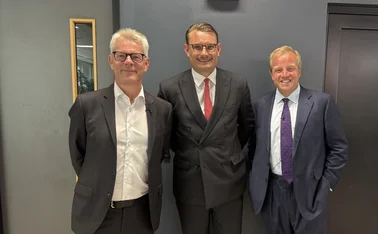
Podcast: Reid and Clegg present Double Indemnity – episode 12, Cameron Specialty’s Tom Kirkland
MGA entrepreneur Tom Kirkland joins Stuart Reid and Toby Clegg for the latest episode of the Double Indemnity podcast series.