

The Euro vision
The Insurance Mediation Directive and the proposed Environmental Liability Directive and Fifth EU Motor Directive mean the European Union is making its presence felt in the UK insurance industry. Sophie Timms looks at how brokers and insurers can adapt to new legislation
The European Union has long been viewed with suspicion in the UK, with Brussels blamed every time an unpleasant piece of legislation comes up. However, legislation does not appear from nowhere. It has usually been in the pipeline for some time.
The EU has been passing laws since its inception in the 1950s and has been impacting UK legislation since the UK joined the Common Market in 1974. There have been directives in the insurance field for many years, as well as life and non-life insurance directives and four motor insurance directives (with another pending).
However, the passing of the Insurance Mediation Directive in 2001 pushed EU policies into the insurance industry limelight. This Directive needed to be implemented by a statutory body, which led to the decision for the Financial Services Authority to take over regulatory responsibility.
Financial action plan
The IMD forms part of the EU's Financial Services Action Plan. It was agreed at the Lisbon Summit in 2000 that there should be a drive to make the EU a fully-functioning single market in financial services, equal to the US by 2005. The action plan covers how financial services companies prepare accounts, provide for future liabilities and market products, as well as covering where products can be marketed and to what information clients are entitled.
The EU has a crucial legislative role that impacts all its member states and it is made up of several institutions to ensure a system of checks and balances.
The highest profile institution is the European Commission, which tries to uphold the general interest of the EU and ensure treaty goals are met.
It is staffed by 15,000 civil servants, the majority of whom work in the 17 Directorate-Generals dedicated to EU policy. These 15,000 people have to serve a union of 374million people.
The Commission has the sole right to initiate legislation. It drafts the directives that go forward to the two other legislative giants - the European Parliament and the Council of Ministers.
The European Parliament, whose base is split between Brussels and Strasbourg, is the EU's only directly-elected institution. It has been growing in power and stature during the past 20 years and now holds joint responsibility with the Council for overseeing the passage of legislation.
Made up of 626 MEPs, the consumer/constituency stamp is often put on legislation by the Parliament. Many of the Brussels lobbyists find MEPs invaluable as a key area to influence, as the tabling of minor amendments can affect proposals.
EU portfolios
The Council of Ministers, by contrast, is not directly elected, though it has equal power. It embodies the national government of the EU's member states in Brussels and means UK Cabinet ministers have a direct say on their corresponding EU portfolios although, owing to domestic responsibilities, much of this power is delegated to civil servants on secondment from government departments. The Council is the place where deals are thrashed out between EU countries.
Delays can occur between the Parliament and Council, which is why it is not uncommon for directives to take 10 or more years to be passed.
It is crucial to remember that proposals for directives or regulations are the result of something agreed in an EU treaty or because member states have agreed it is necessary.
The IMD is now firmly embedded in the UK statute book but more directives are working their way through the Parliament and Council. Two of these could have a big impact on insurance - the Environmental Liability Directive and Fifth EU Motor Directive.
The ELD aims to make businesses responsible for damage they cause to the environment. Polluting businesses will have to have insurance or the financial security to pay for any damage to be cleaned up.
There have been frequent calls for financial guarantees to be compulsory, similar to employers' liability insurance in the UK. This has not yet happened but if it does could impact on the availability and capacity in the UK market. It would also impact on the businesses that have to buy it, especially small and medium-sized enterprises.
Driving force
The Fifth EU Motor Directive is slightly less onerous but nevertheless contains issues contrary to UK insurance. It aims to adapt the level or scope of coverage of compulsory insurance. And, in the Directive's purest form, car drivers could be automatically deemed liable for accidents involving pedestrians or cyclists.
In addition, EU member states may not limit or exclude the payment of compensation in the event of damages by an unidentified vehicle, if the victim has suffered "significant personal injuries". The Commission has not defined what it means by significant.
Another regulation in discussion at the EU is the new Feed Hygiene Regulations.
This proposes the regulation of everything in the food supply chain - from farm to table - and could, specifically, lead to a rise in the need of product recall insurance.
It is important to note the distinction between a regulation and a directive.
A regulation does not enjoy the benefit of leeway, though a directive does. Therefore, when a regulation hits the UK it must be enacted to the letter, but a directive affords EU member states more room for manoeuvre.
It is also important to look at the financial services landscape of the EU as a whole. In 2001, Baron Lamfalussy laid down plans to extend a fast-track legislative process to financial services regulation in the EU, which will mean the more detailed rules of financial services regulation will be decided before they reach the UK FSA level.
At the first level, framework principles of financial services regulation will be decided in the normal fashion. For example, a proposal by the Commission for Directives or Regulations will be sent to the Council of Ministers or European Parliament.
Secondly, two new committees will be established - the EU Banking Committee and the European Committee on Insurance and Occupational Pensions. These will be made up of finance ministry representatives and will assist the EC in determining how to implement the details of the first level.
At the third level, supervisory committees for insurance and pensions (the Committee of European Insurance and Occupational Pensions Supervisors) banking and insurance (the Committee of European Banking Supervisors) will be established. These will be made up of representatives from member states' financial services regulators (including the FSA) and will be responsible for improving the common and uniform implementation of the first two acts in the member states.
The Lamfalussy experience in the securities sector, in operation since June 2001, has been deemed successful. Indeed, it has been so successful that the Commission is now pressing for a similar structure for insurance and banking. It brings with it, however, the question of whether more power is being foisted on the EU. The knock-on effect domestically, on national regulators and those being consulted by them, is uncertain. It could streamline regulation but could also make it harder for the insurance industry's voice to be heard.
The Commission has not ruled this out but would require agreement on a single set of rules for financial services. The Financial Services Action Plan has not progressed as smoothly as some would have hoped and some countries are still clinging to their national sovereignty.
This is further compounded by the first wave of EU enlargement, which starts next year with the accession of 10 new members. But while enlargement could lead to an expanded single market and increased competition, it will also bring a plethora of other issues.
The new states are unlikely to have the same level of financial regulation and supervision as existing members, and no one knows how long it will take these countries to fully integrate. There are also fears that an enlarged EU will slow down the decision-making process, including at the Lamfalussy supervisory level.
All in all, the EU is a minefield for the UK insurance industry. While the industry's voice is being represented and heard via individual companies and trade associations, the market needs to do more. The insurance industry is sometimes accused of short-termism, a profit-driven economy that focuses on immediate pressures.
However, it is short-sighted to sideline a piece of legislation on the grounds it might not hit the bottom line for a few years. Forewarned is forearmed and building Brussels into your business plans could save you, your company and its balance sheet a small fortune.
Only users who have a paid subscription or are part of a corporate subscription are able to print or copy content.
To access these options, along with all other subscription benefits, please contact info@insuranceage.co.uk or view our subscription options here: https://subscriptions.insuranceage.co.uk/subscribe
You are currently unable to print this content. Please contact info@insuranceage.co.uk to find out more.
You are currently unable to copy this content. Please contact info@insuranceage.co.uk to find out more.
Copyright Infopro Digital Limited. All rights reserved.
As outlined in our terms and conditions, https://www.infopro-digital.com/terms-and-conditions/subscriptions/ (point 2.4), printing is limited to a single copy.
If you would like to purchase additional rights please email info@insuranceage.co.uk
Copyright Infopro Digital Limited. All rights reserved.
You may share this content using our article tools. As outlined in our terms and conditions, https://www.infopro-digital.com/terms-and-conditions/subscriptions/ (clause 2.4), an Authorised User may only make one copy of the materials for their own personal use. You must also comply with the restrictions in clause 2.5.
If you would like to purchase additional rights please email info@insuranceage.co.uk
More on Regulation

Which? demands ban on brokers charging high motor APRs
Which? has named and shamed motor insurance brokers charging high interest rates on monthly policies and called for a ban on the practice.

No ‘particular targets’ for insurance regulation simplification, says FCA
Consumer Duty will be a building block for any future work on the simplification of insurance regulations that affect brokers, according to David Geale, executive director of consumers, payments and competition at the Financial Conduct Authority.

FCA kicked off financial year with improved authorisation service bar one outlier
The Financial Conduct Authority has upped its game on authorisation service levels in categories affecting brokers, with improvements in four areas, but one notable outlier where the performance dipped.

FCA alerts of Kent-based broker clone
Quotemetoday.co.uk has made clear it has no affiliation with Quote Me Go as the Financial Conduct Authority has reported fraudsters have been impersonating the Kent-headquartered broker.
FCA’s Knight updates on cyber insurance report
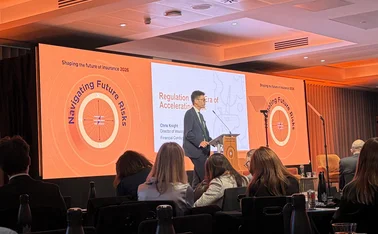
Chris Knight, director of insurance at the FCA, has updated on the progress of its report into the take up of cyber insurance, and how the regulator has to keep pace with technological advancements.
Growing FCA attestation appetite a warning for brokers
The Financial Conduct Authority has increased the level of attestation requests dished out to insurance firms in recent years, and the serious regulatory tool is one brokers need to keep a keen eye on according to compliance specialists.

Why insurer oversight cannot become another regulatory box-ticking exercise
With regulatory workloads continuing to grow and the FCA maintaining its focus on customer outcomes, Insurance DataLab co-founder Matt Scott explains why brokers need a practical, evidence-led approach to insurer oversight.

FCA cancels insurance distribution business’ permissions
The Financial Conduct Authority cancelled Professional Liability Network’s permission to carry out regulated activities on 11 September 2026.