

Honourable intentions
Simon Burgess looks at what exactly constitutes an inducement and why the boundaries are so blurred
When New York Attorney General Eliot Spitzer investigated bid-rigging and illegal inducements among global brokers in October 2004, it resulted in job losses at those firms and an overhaul of business models and commission structures. This 'honourable' profession fell swiftly from grace and continues to suffer a tarnished reputation.
While much work is being done to improve that reputation, insurance is an integral part of society and deserves a better profile. In the aftermath of Spitzer, brokers were under increasing pressure to implement conflict management policies and document how they are avoiding conflicts of interest.
The British Insurance Broker's Association advises that brokers should have a CMP covering corporate hospitality and gifts from other insurers as well as the profit share, volume and over-rider agreements and differential commission rates. As there are no hard and fast rules defining corporate hospitality, this would seem to be open to interpretation.
Very few brokers have their own rules in place - Aon took a firm stand and announced it was limiting the amount clients could spend on its brokers to £70 a time, while Marsh stated it was stopping corporate hospitality for insurers.
Corporate hospitality is the one area that the Financial Service Authority is not keen to regulate. It believes common sense will prevail. While this view may be met with a sigh of relief, it is an area that needs greater clarity.
In November, the FSA reminded CEOs of their responsibilities to implement processes to enable firms to manage their conflicts of interest effectively. Its Insurance Conduct Of Business rules state: "A firm must take reasonable steps to ensure that it, and any person acting on its behalf, does not offer, give, solicit or accept an inducement.
"An inducement is a benefit offered to a firm, or any person acting on its behalf, with a view to that firm, or that person, adopting a particular course of action. This can include, but is not limited to, cash, cash equivalents, commission, goods, corporate hospitality or training programs."
So, when does corporate hospitality or training, for example, become an inducement? Is it enough for brokers to say they are following the FSA's principles with clear internal policies on what is appropriate? It is difficult as an industry to quantify what is appropriate or what detail of record keeping should be drilled down to, as there are no tangible guidelines.
Spitzer has forced our industry to take a step back and tackle its conflict of interest issues. This has led to a greater formalisation of corporate hospitality programs but with this comes greater confusion amongst brokers as to what is acceptable and what crosses the inducement boundaries. This increased focus on ethics and transparency brings with it a need for brokers to reassess their rationale for running and attending corporate hospitality events.
While many do not agree with the amount of money wasted on corporate hospitality - which could be better channelled into reducing premiums or donating to charitable causes - it is here to stay and more formal processes do appear to be in place.
The general consensus is that it is now common practice to invite larger numbers of people to fixed events during the year - this ensures the host is not directly influencing one person or a company. Those firms that run corporate hospitality programs are adamant they do not pose any conflict issues.
Their events are held to recognise and reward business partners and attendance is not evidence that guests will be obliged to act unprofessionally or operate against their duties to their customers.
Corporate hospitality is considered to be part of a relationship-building mix - insurers are keen to get their products and services in front of potential clients and will use conferences, seminars and non-conflicting events to do this. Broker-only insurer, MMA believes that, in isolation, hospitality adds little value. The business views its effectiveness in a wider process of building strong and productive relationships with intermediary partners.
Cardif Pinnacle's Steve Devine feels that corporate hospitality is not sinister and should form part of a wider sponsorship programme.
If there is a general move away from one-to-one entertaining, does this mean that the personal touch is disappearing from our industry? This is a business to business market - the industry is based on people and relationships. Historically this is how business has been conducted and there is little evidence of it changing.
However, brokers have enough integrity to base their business decisions on service, innovation and value for money.
It is no secret that brokers feel overwhelmed with the number of regulatory controls and record-keeping demands put upon them. Many feel it is detracting from day to day business and are concerned they now operate within a 'big brother' environment. Biba's view is that if everything is open, above-aboard and recorded properly, then brokers should welcome the chance to evidence their transparency. However, what should be recorded is the issue. Does attendance at a social event merit detail? Ian Moffat from Assurant Solutions says he would be concerned if he was unable to thank his business partners for their support.
Many agree, it would be a sad day when people could not meet and discuss issues socially. However, a lot of the business in our industry has been gained through the corporate hospitality process and at possibly no benefit to the clients.
The way forward is to avoid the corporate hospitality carousel. Brokers should acquire the best deals for their clients and switch allegiance if a better proposition comes along. This is an honourable intention - professionalism, excellent service, innovation and value for money for customers - not events and corporate freebies.
Simon Burgess, Managing director, Britishinsurance.com.
Only users who have a paid subscription or are part of a corporate subscription are able to print or copy content.
To access these options, along with all other subscription benefits, please contact info@insuranceage.co.uk or view our subscription options here: https://subscriptions.insuranceage.co.uk/subscribe
You are currently unable to print this content. Please contact info@insuranceage.co.uk to find out more.
You are currently unable to copy this content. Please contact info@insuranceage.co.uk to find out more.
Copyright Infopro Digital Limited. All rights reserved.
As outlined in our terms and conditions, https://www.infopro-digital.com/terms-and-conditions/subscriptions/ (point 2.4), printing is limited to a single copy.
If you would like to purchase additional rights please email info@insuranceage.co.uk
Copyright Infopro Digital Limited. All rights reserved.
You may share this content using our article tools. As outlined in our terms and conditions, https://www.infopro-digital.com/terms-and-conditions/subscriptions/ (clause 2.4), an Authorised User may only make one copy of the materials for their own personal use. You must also comply with the restrictions in clause 2.5.
If you would like to purchase additional rights please email info@insuranceage.co.uk
More on Regulation

Which? demands ban on brokers charging high motor APRs
Which? has named and shamed motor insurance brokers charging high interest rates on monthly policies and called for a ban on the practice.

No ‘particular targets’ for insurance regulation simplification, says FCA
Consumer Duty will be a building block for any future work on the simplification of insurance regulations that affect brokers, according to David Geale, executive director of consumers, payments and competition at the Financial Conduct Authority.

FCA kicked off financial year with improved authorisation service bar one outlier
The Financial Conduct Authority has upped its game on authorisation service levels in categories affecting brokers, with improvements in four areas, but one notable outlier where the performance dipped.

FCA alerts of Kent-based broker clone
Quotemetoday.co.uk has made clear it has no affiliation with Quote Me Go as the Financial Conduct Authority has reported fraudsters have been impersonating the Kent-headquartered broker.
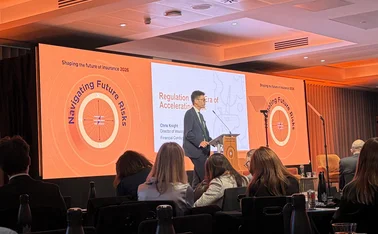
FCA’s Knight updates on cyber insurance report
Chris Knight, director of insurance at the FCA, has updated on the progress of its report into the take up of cyber insurance, and how the regulator has to keep pace with technological advancements.

Growing FCA attestation appetite a warning for brokers
The Financial Conduct Authority has increased the level of attestation requests dished out to insurance firms in recent years, and the serious regulatory tool is one brokers need to keep a keen eye on according to compliance specialists.

Why insurer oversight cannot become another regulatory box-ticking exercise
With regulatory workloads continuing to grow and the FCA maintaining its focus on customer outcomes, Insurance DataLab co-founder Matt Scott explains why brokers need a practical, evidence-led approach to insurer oversight.

FCA cancels insurance distribution business’ permissions
The Financial Conduct Authority cancelled Professional Liability Network’s permission to carry out regulated activities on 11 September 2026.