

Prophets of boom
As aspirational declarations about a hardening market were being made by insurer chief executives at the end of 2005, Marcus Alcock assesses whether what they desire will become reality
If any insurance professional really knew what was going to happen with regard to rates in 2006, then that person deserves a medal. The truth of the matter is that, despite what the great and good might want to happen next year, no one really knows what insurance rates will actually do - and to what extent - from one year to the next.
That is not to say that some good guesses cannot be made. After all, the biggest players in the market have made clear their intention to maintain market discipline. There is also some hope that, with a less-than-spectacular investment market, reasonable capacity levels in some areas, as well as the effects of expected reinsurance hikes in the wake of this autumn's spectacular hurricane season, some degree of hardening - or, at the very least, levelling - might be expected in some classes next year. And, with claims inflation still rampant, liability losses both past and present continuing to hurt and reinsurance costs hardly going down, some degree of remedial action would seem necessary next year if companies are to avoid causing themselves more serious damage.
As Royal & SunAlliance chief executive Andy Haste stated in Professional Broking recently (Reinvention tension, November 2005, p26): "In 2006 there has to be a hard market or carriers will be feeling the pain in 2007 if they chase market share at the expense of profit."
Naturally, one of the biggest drivers of any action regarding rates next year will be as a result of the 2005 hurricane season, a point accepted by Paul Hutchins, commercial property manager at Allianz Cornhill. "The market rumour at the moment with regard to reinsurance price increases is that they will be between 15% and 25%," he says. "The UK cannot be immune, which means that the impacts of Hurricanes Katrina, Wilma and so on will invariably have an impact here."
Deployment of capital
According to Hutchins, however, the most important effect on rates going forward will be capital deployment. His view is that, for the time being, the market probably has sensible levels of capital in order to drive home reasonable returns.
Yet, not everyone is convinced that the market remains tight enough in certain areas for rates next year to stabilise or even improve. According to Amanda Blanc, distribution and customer services director at broker-only insurer Groupama, as far as the personal lines side of the market is concerned there could still be some difficulties in the UK next year, with capacity levels sustaining competitive underwriting and poor rating levels.
"On motor we are seeing a fairly flat market for 2006, though we are hoping there will be some increases to account for the level of claims inflation," she says, nonetheless conceding that the prospect of a significantly harder motor market next year remains a distant one. "Which is a shame, as I think the market does need some increases," she adds.
"Whatever happens to motor, however, the real killer when it comes to a continuing soft market in 2006 is the UK household market: "There is so much competition, with everybody competing for the same lines, and banks and building societies with 52% of the market that brokers are now only left with 25% of the market and rates are still in decline."
Not everyone is convinced that the UK household market will be so difficult next year, however. "The drivers here are a little bit different because it is so influenced by the weather, so the performance of the account can be quite volatile," says John Seaton, director of underwriting at Norwich Union, who believes that the wider impact of reinsurance renewals could even percolate down to this level and bring some redress to the pricing situation.
"One of the factors affecting things is Katrina, which seems an awfully long way away," he adds. "But everyone will feel the effects of that when they renew their reinsurance treaties, so that the effect of Katrina will be to slow down, possibly stop and maybe even create a slight uplift in profits. There will be a stabilising influence, and I would expect a settled UK household market if we have a major weather event here."
Liability
One area that continues to cause anxiety is that notorious class - liability. Only very recently, with rates extremely poor and carriers no longer prepared to put up with a line that offered not only very little income but an enormous claims potential, the market contracted severely. As many will be aware, the contraction was so severe that the market hardened dramatically - seemingly overnight - forcing the government to intervene and ask pertinent questions as to why the situation should have suddenly become so troublesome. One would have thought that, in the wake of the recent liability crisis, the market might have stabilised somewhat. With the players in the market being those in it for the long term and whose rating levels, although softened somewhat in the last couple of years, would nonetheless reflect the reality of a class that is still written on a long-tail, losses-occurring basis.
After all, would the new regulatory regime in the UK insurance arena really put up with any undercapitalised, 'fly-by-night' liability underwriters these days? It would appear from those in the market that, unfortunately, the UK liability sector is as competitive as ever, with new entrants - not all of whom are subject to the whims and wherefores of the Financial Services Authority - continuing to upset the apple cart and elongating the soft market at just a time when it could least afford it.
As Seaton put it: "We have all seen liability insurers go bust in recent years, so you would therefore expect the regulators to ask questions about the levels of reserving in liability insurers." He adds that the UK liability market is once again facing a difficult situation, with rates being offered in some places that are simply not adequate for the risks involved.
Some people are slightly more upbeat about the prospects for the UK liability market next year. Roy Watkinson, interim underwriting director at Axa, believes that some balancing acts will occur in this class: "There will be flattening-off of pricing levels in property and public liability classes, after some market correction (reductions) in 2005. I expect that insurers will generally maintain a disciplined underwriting approach and work closely to technical pricing requirements. On employers' liability, prices will increase slightly to help pay for the continuing inflation in bodily injury claims costs - this inflation is currently running at about 10%." He does accept the need for some sort of upward movement, nonetheless, adding the important note that rates do need to keep moving forward in EL.
Watkinson is also convinced that the other commercial lines are likely to see an improvement next year, especially on the fleet side. As he explains: "Commercial motor rates are likely to increase in 2006, at least by the second half of the year, as we have just about reached the bottom of the cycle, particularly in fleet."
This last point is echoed by Seaton, who points out that, if rates in the motor market generally were left unchecked until 2006/2007, then with the level of claims inflation continuing to run on as it has been this year, the underwriting market would soon become extremely unprofitable. And, naturally, insurers still need to keep their minds focused on this side of the business, as he explains: "There is more discipline in the market now than there was in the mid 1990s, and stakeholders have become increasingly important. Insurers need to continue to focus on underwriting a lot more these days rather than relying on investment income."
Hutchins believes there are other reasons to expect the commercial side of the UK market will perform better next year. Aside from the fact that the appetite is one that is searching for profitable underwriting while equity returns remain depressed, personality issues could ultimately sway the day: "Two of the biggest commercial lines insurers in the UK have new teams that will want to prove that they can handle the challenging conditions."
Yet, where other commercial lines are concerned, not everyone is convinced that the rating environment will change dramatically in 2006. "The results are still very good and people are being very competitive," says Blanc, adding: "There has been some tough competition and I do not see that is going to suddenly stop on 31 December."
So, it would appear that, for the conceivable future, brokers can continue to shop around for reasonable prices for a number of UK lines - both personal and commercial - with no dramatic turnaround in rates likely to happen suddenly, at least as far as the domestic market is concerned. However, in the London Market the prospects would appear to be somewhat different. A number of Lloyd's insurers have already announced plans to establish new companies in Bermuda next year to take advantage of the attractive rates on offer for international reinsurance and property lines and, despite the fact that this offshore location is the domicile of choice for so many UK businesses, it does not mean that London Market brokers have been left entirely out of the picture.
After all, Lloyd's insurer Beazley has indicated that it is considering establishing a new third syndicate in 2006, and the likelihood remains that Beazley will not be the only new start-up within a close radius of Lime Street next year. Furthermore, there is no doubt that such entities would not be starting out if it weren't for the prospect of extremely attractive rates going forward.
The name of the game
Yet, for all the talk of what is going to happen next year, the bald truth is that no one really knows. Although capacity levels can be tracked and the appetite of the major carriers measured with some degree of accuracy, the fact remains that this is a volatile business where pricing remains dependent on events. After all, who could have predicted the extent of the damage wreaked by the 2005 hurricane season, which the modelling agencies have estimated could eventually cost the industry an astonishing $50bn (£28.75bn).
As Stuart Reid, managing director of broker Stuart Alexander, outlines: "At the end of the day, you can talk all you like about it, but no one has any idea over rates whatsoever. How could they? We could have a storm next week."
And, despite all the talk that has been uttered over the festive season about the need to maintain 'underwriting discipline', no one can legislate against the prospect of new capital coming in at any point in the cycle and decimating the best efforts of the established players to write sensibly. But that is the name of the game.
Only users who have a paid subscription or are part of a corporate subscription are able to print or copy content.
To access these options, along with all other subscription benefits, please contact info@insuranceage.co.uk or view our subscription options here: https://subscriptions.insuranceage.co.uk/subscribe
You are currently unable to print this content. Please contact info@insuranceage.co.uk to find out more.
You are currently unable to copy this content. Please contact info@insuranceage.co.uk to find out more.
Copyright Infopro Digital Limited. All rights reserved.
As outlined in our terms and conditions, https://www.infopro-digital.com/terms-and-conditions/subscriptions/ (point 2.4), printing is limited to a single copy.
If you would like to purchase additional rights please email info@insuranceage.co.uk
Copyright Infopro Digital Limited. All rights reserved.
You may share this content using our article tools. As outlined in our terms and conditions, https://www.infopro-digital.com/terms-and-conditions/subscriptions/ (clause 2.4), an Authorised User may only make one copy of the materials for their own personal use. You must also comply with the restrictions in clause 2.5.
If you would like to purchase additional rights please email info@insuranceage.co.uk
More on Regulation

Which? demands ban on brokers charging high motor APRs
Which? has named and shamed motor insurance brokers charging high interest rates on monthly policies and called for a ban on the practice.

No ‘particular targets’ for insurance regulation simplification, says FCA
Consumer Duty will be a building block for any future work on the simplification of insurance regulations that affect brokers, according to David Geale, executive director of consumers, payments and competition at the Financial Conduct Authority.

FCA kicked off financial year with improved authorisation service bar one outlier
The Financial Conduct Authority has upped its game on authorisation service levels in categories affecting brokers, with improvements in four areas, but one notable outlier where the performance dipped.

FCA alerts of Kent-based broker clone
Quotemetoday.co.uk has made clear it has no affiliation with Quote Me Go as the Financial Conduct Authority has reported fraudsters have been impersonating the Kent-headquartered broker.
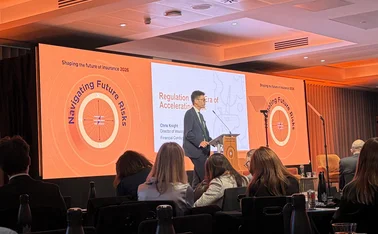
FCA’s Knight updates on cyber insurance report
Chris Knight, director of insurance at the FCA, has updated on the progress of its report into the take up of cyber insurance, and how the regulator has to keep pace with technological advancements.
Growing FCA attestation appetite a warning for brokers
The Financial Conduct Authority has increased the level of attestation requests dished out to insurance firms in recent years, and the serious regulatory tool is one brokers need to keep a keen eye on according to compliance specialists.

Why insurer oversight cannot become another regulatory box-ticking exercise
With regulatory workloads continuing to grow and the FCA maintaining its focus on customer outcomes, Insurance DataLab co-founder Matt Scott explains why brokers need a practical, evidence-led approach to insurer oversight.

FCA cancels insurance distribution business’ permissions
The Financial Conduct Authority cancelled Professional Liability Network’s permission to carry out regulated activities on 11 September 2026.