

New global market - old values
Virtually all facets of the financial services industry in the US have undergone significant transformation during the past decade, sparking significant merger and consolidation activity. Erik Nikodem looks at the current situation
The alteration and subsequent removal of certain legislative barriers affecting the US banking and insurance communities has sparked a massive wave of mergers and consolidation in the last decade. Insurance-related concerns are vying to compete for pure market share in unchartered territories, citing the principal motivating factor as the realisation of synergy to serve the dual financial services and risk management needs of customers.
Where does this leave the mid-sized, independent intermediary in relation to the giants bent on controlling the market?
While not necessarily an indication of what awaits the insurance market, one only needs to look briefly back into history at other industry segments to understand the potential ramifications of industry consolidation. For instance, several conglomerates were devised with the intention of servicing, perhaps even controlling, the needs of customers in the publishing/media field (AOL Time Warner), the telecommunications sector (AT&T, Global Crossing) and in the computer/printing area (Hewlett-Packard).
With the exception of the latter, at time of writing, these firms and many others were bonded, only to be subsequently broken apart. The predominant impetus for the eventual unwinding included such factors as: realisation of cost savings, but absence of a business model that capitalised on the newly created revenue streams; bureaucratic distractions that rendered internal objectives a higher priority than external goals; and a divergence from technical superiority and added value in exchange for chasing holistic, ordinary market share.
There is no suggestion that these examples represent the eventual future of the insurance industry, however, independent intermediaries can glean valuable insight into how and why they can now more meaningfully and successfully compete with brokerages that dwarf their firms despite their apparent lack of size and leverage.
Seeking alternatives and options
Having numerous locations and an abundance of employees does not systematically translate into technical expertise or capability. Risk managers, chief financial officers and other insurance buyers are seeking intermediaries that can understand problems and creatively and effectively promote solutions.
It is seemingly more valuable to utilise a mega-firm's name in identifying yourself as a producer or broker. Nonetheless, independent intermediaries that are more technically qualified to add value should not be intimidated about mentioning a lesser-known firm's name.
Buyers are concerned that the largest brokers function in an all too similar manner; one that is primarily focused on exhorting clout-oriented leverage upon underwriters for price and term. The independent intermediary is wise to appreciate and exploit the fact that leverage comes in many forms, including, but not limited to, technical know-how, creativity, lateral thinking and relationship building.
Simply possessing market share does not render greater success or profitability.
Competitors (and investors) soon realised that a consolidated business platform - one lacking a primary area of expertise - can in fact breed complacency and thereby create the ideal scenario for aggressive smaller firms to capitalise on opportunities.
The independent or mid-sized intermediary, in both the insurance and reinsurance fields, can also position itself very competitively today by creating and sustaining vertical expertise in various risk management practices. As the conglomerates focus on horizontal growth or 'being all things to all people', the independent intermediary can capitalise on the potential waning of technical depth in certain niche areas.
By creating greater proficiency in specific areas, such as property catastrophe capacity, the independents can reposition themselves by delivering a better product and not just one of many products. As such, insurance buyers are more apt to turn to the services provided by a genuine expert, as compared with those offered by a sales representative pitching the dozens of various wares of a conglomerate.
The dynamic market place
The emergence of Bermuda as a massive purveyor of capacity, the infusion of corporate capital into the Lloyd's market, the consolidation of US underwriters and the depletion of surplus in certain overseas territories have all conspired to create a very dynamic market place. This vibrant trading environment has reiterated a fundamental tenet of the global underwriting and broking industry - change is constant. As such, intermediaries that are positioned to adapt to the presence of new quality capacity, maintain prudence regarding the materialisation of questionable capacity and replace surplus depleted by the re-underwriting process, will survive and flourish in a changing landscape.
Moreover, no corporate automation process, re-engineering scheme, centralisation or decentralisation of broking functions can substitute for the benefits derived from old-fashioned, quality market relationships. The strength - or lack - of a broker's trading relationship with its underwriter cannot hide under a corporate namesake, become disguised under a worldwide marketing submission or be improved by leveraging the name of a Fortune 100 company.
While there are certainly a number of critical minimum access points an independent intermediary must now enjoy in the global insurance market place, the results derived in any underwriting community are predicated on the quality and not the quantity of people.
There is no greater evidence of this supposition than that presented by the brief comparison of the US and Lloyd's market places. There are fundamental differences in the dichotomy of these environments, which include the reliance of the US on email, fax and telephone contact, contrasted with Lloyd's very physical broking style, and the dominance of subscription garnishing compared with the US prevalence of single or limited company participation.
However, the commonality clearly outweighs the contrast in that all environments are primarily moved by the investments made in relationships between brokers and underwriters.
Broker-underwriter relationships
As such, a strong relationship between a US broker and a Lloyd's underwriter (through an intermediary where necessitated) clearly dominates a weak relationship between a name-brand UK broker and a Lloyd's underwriter.
Independent brokers, through a network or affiliated office or in conjunction with an authorised intermediary, should not therefore be intimidated by their competitor's claims of having offices everywhere around the world.
The more meaningful claim is to have strong relationships anywhere around the world.
The mid-sized broker can thus be more effective in the global market place by developing, nurturing and sustaining the underwriting relationships that are critical to delivering successful results, regardless of physical location.
There are of course certain minimum outlets that the independent broker must strive to tap into. Underwriting hubs such as London, New York, Bermuda and San Francisco are all natural locales, bearing in mind that access does not necessarily imply physical presence.
The independent intermediary, to a certain degree, must concede that its financial resources are indeed limited in comparison to the mega-brokers, but this challenge should not be dismissed as an insurmountable handicap.
The benefits of a strong overseas broker-underwriter relationship can far surpass the implied benefits of a physical address that is merely a 'ghost ship' manned by correspondents.
A codified belief of the independent intermediary is that they are better equipped to build sustainable, quality trading relationships that can surpass volume leverage yielded by larger firms. As such, these firms are wise to continue trading on this premise with underwriters and to market this strength with prospective clientele.
As an independent, there is unfortunately no joy to be had in a comparison with a mega-broker that seeks to graph the number of offices, employees or premium income - this represents a foolish and losing battle. What is important, and represents a competitive advantage to the independent intermediary, is to truly appreciate, trade upon and exploit the freedom to solve a customer's problem without the aid of a users' manual dictating where or with whom it can be solved.
As business prudence dictates, the model on which mega-brokers are feverishly concentrating involves serving the plethora of financial services needs a company may possess. These include a host of products and services ranging from employee benefits, mutual funds, life insurance, security consulting, quasi-banking, premium finance, inspection, appraisal, risk management, insurance and reinsurance broking.
Additionally, given the financial requirement to eliminate redundancy and control expenses, the largest brokers have created centralised and global marketing centres and have implemented strict broking procedures by access point, intercompany operation and overall location to maximise revenue. These practices are necessitated in order to deliver cost justification for the massive mergers that have transpired, however, they have simultaneously created phenomenal opportunities for creative and innovative independent brokers seeking to compete.
There is no disgrace, especially in the current climate of apparent reverence for professional 'chameleons' in the broking industry, in recognising and thus respecting that a producing broker is not necessarily the best marketing broker, and vice versa. Analogously, for instance, many companies have realised, perhaps all too painfully, that being a proficient technical expert does not always serve as a guaranteed foundation for then becoming a successful manager of technical experts.
Similarly, a thriving retail or reinsurance producer may not be the most qualified or proficient individual to market the business it generates.
Moreover, respect is earned and embarrassment avoided when a professional understands and then communicates a weakness by resolving to employ individuals qualified to address a challenge. An independent intermediary therefore has a distinct competitive advantage as it can independently corral the best talent to address a particular challenge, rather than be dictated by published corporate restrictions outlining exactly when or where additional resources can be utilised.
Global marketing
As such, a retail insurance producer is able to orchestrate the global marketing capability or niche expertise of an insurance wholesaler of their choosing, whereas a mega-broker must work with internal resources exclusively regardless of their proficiency. Large brokers possess enviable expertise in many practice areas; however, the internal fiscal pressure to control all aspects of the business may provide adequate fuel to 'place a round peg in a square hole'. An independent intermediary can thus create a marketable strength where a perceived weakness once existed, as they have the world's best talent at their very objective disposal.
The long-standing and future success of the independent intermediary is fundamentally predicated upon the reverence for - and perseverance of - an entrepreneurial culture. The independent organisation, despite pressure to mimic non-sustainable and non-organic growth rates published by the world's largest brokers, must remain true to the priorities and values that have before now delivered the high degree of success it has enjoyed. Pretending to be as expansive or as capitalised as a mega-broker represents a certain recipe for the implosion of an independent firm's corporate culture. An independent intermediary is different and, as such, it must respect and protect that difference by leveraging the competitive advantage that distinction brings.
In all likelihood, tomorrow's news will evidence yet another unwinding of a recently conglomerated entity in some industry. The most successful and unique division of that firm will once again return to independence and thereby enable the most talented people to function free from bureaucracy and corporate constraint. In doing so, an independent culture will be reborn and pervade every action and idea. Therefore, as an independent intermediary, celebrate today what makes your firm the pre-eminent place for both employees and customers to be, and remain focused upon retaining them through the execution of the time-tested, proven independent business model.
Only users who have a paid subscription or are part of a corporate subscription are able to print or copy content.
To access these options, along with all other subscription benefits, please contact info@insuranceage.co.uk or view our subscription options here: https://subscriptions.insuranceage.co.uk/subscribe
You are currently unable to print this content. Please contact info@insuranceage.co.uk to find out more.
You are currently unable to copy this content. Please contact info@insuranceage.co.uk to find out more.
Copyright Infopro Digital Limited. All rights reserved.
As outlined in our terms and conditions, https://www.infopro-digital.com/terms-and-conditions/subscriptions/ (point 2.4), printing is limited to a single copy.
If you would like to purchase additional rights please email info@insuranceage.co.uk
Copyright Infopro Digital Limited. All rights reserved.
You may share this content using our article tools. As outlined in our terms and conditions, https://www.infopro-digital.com/terms-and-conditions/subscriptions/ (clause 2.4), an Authorised User may only make one copy of the materials for their own personal use. You must also comply with the restrictions in clause 2.5.
If you would like to purchase additional rights please email info@insuranceage.co.uk
More on Regulation

Which? demands ban on brokers charging high motor APRs
Which? has named and shamed motor insurance brokers charging high interest rates on monthly policies and called for a ban on the practice.

No ‘particular targets’ for insurance regulation simplification, says FCA
Consumer Duty will be a building block for any future work on the simplification of insurance regulations that affect brokers, according to David Geale, executive director of consumers, payments and competition at the Financial Conduct Authority.

FCA kicked off financial year with improved authorisation service bar one outlier
The Financial Conduct Authority has upped its game on authorisation service levels in categories affecting brokers, with improvements in four areas, but one notable outlier where the performance dipped.

FCA alerts of Kent-based broker clone
Quotemetoday.co.uk has made clear it has no affiliation with Quote Me Go as the Financial Conduct Authority has reported fraudsters have been impersonating the Kent-headquartered broker.
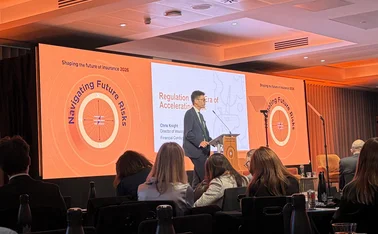
FCA’s Knight updates on cyber insurance report
Chris Knight, director of insurance at the FCA, has updated on the progress of its report into the take up of cyber insurance, and how the regulator has to keep pace with technological advancements.

Growing FCA attestation appetite a warning for brokers
The Financial Conduct Authority has increased the level of attestation requests dished out to insurance firms in recent years, and the serious regulatory tool is one brokers need to keep a keen eye on according to compliance specialists.

Why insurer oversight cannot become another regulatory box-ticking exercise
With regulatory workloads continuing to grow and the FCA maintaining its focus on customer outcomes, Insurance DataLab co-founder Matt Scott explains why brokers need a practical, evidence-led approach to insurer oversight.

FCA cancels insurance distribution business’ permissions
The Financial Conduct Authority cancelled Professional Liability Network’s permission to carry out regulated activities on 11 September 2026.