

Weathering the storm
While the view in the 1980s that brokers were 'dead men walking' proved to be untrue, similar things are now being said of personal lines brokers. Jane Bernstein assesses how well they are weathering the storm
If anyone understands the meaning of pressure, it is the personal lines broker. As if it was not enough to fend off competition from new channels as well as coping with regulatory demands, they have had to contend with others predicting their imminent demise. Personal lines brokers have fought hard to survive against the odds. The question is, will they remain resilient enough to prove their current critics wrong?
The debate over the future of the personal lines broker is well established but a long list of developments in the sector continue to add new fuel to the fire. The increasing commoditisation of products is currently testing most personal lines brokers, who are having to compete in a price-orientated market.
Brokers are also struggling against a misconception that customers can always get cheaper deals elsewhere. As Mark Townsend, chief operating officer at BDML Connect, comments: "Over the past few years, successful brokers have been able to re-engineer their businesses to enable them to compete in a price sensitive market and offer attractive prices to their customers."
Customer requirements
It is impossible to avoid the significance of price in the current market but brokers cannot afford to focus solely on providing the most competitive premium. The question is, are brokers that try to sell on factors other than price fighting a losing battle?
Townsend maintains that while there is a significant proportion of the market for whom price is a key determinant in the buying decision, the majority of customers are keen to ensure that they are buying a product that is well suited to their requirements. Kevan Aubrey, NIG's head of marketing agrees: "For many consumers competitive does not just mean the cheapest - it means the best deal in relation to cover, service and advice. It is the area of advice where the personal lines broker can really differentiate themselves and add value for the consumer."
Many brokers have undergone strategic shifts in their business plans in order to continue offering new services. However, in many ways, the long established added-value factors are still the best. Many maintain that it is the ability to provide a service that is both local and personal that continues to attract customers. Jim Jordan, proprietor of Nelson Jordan Insurances, emphasises: "It is pretty obvious that customers still want personal service." Jordan points in particular to the significance of assistance on claims, adding that where a broker has a high street presence then customers can still come into the office to sort out any problem with a real person. "Having a local point of contact is a big issue for clients," says Jordan.
Cross-selling is also nothing new but remains a valuable tool. Kate Penrose, MMA's head of commercial support, comments: "Brokers have to avoid seeing every customer as a private motor customer, for example, and recognise that they could also be a household and a commercial customer."
Dave Parry, business development director for Zurich UK Personal Insurances, believes cross-selling should happen more as a matter of course than as a specialist activity. "Do you really need to be cross-selling? Should it not be that your proposition is that you will insure everything? Supermarkets don't advertise the fact that they sell bread and then try and cross-sell other groceries to you once you get there."
Vital innovation
However, while some of the more established practices still add much value, that is not to say that brokers can rest on their laurels. Innovation as well as good customer service remains vital in order to survive. Parry asserts that those that are not adding value or trying to differentiate are making a fatal error. "If, however, you have realised that there are a group of customers out there who seek differentiated service and something a bit more personal, then the future will look good." Parry emphasises that apathy will kill a business, adding: "If brokers provide a bland telesales experience then they should expect to lose customers."
Mark Townsend, chief operating officer at BDML, comments: "In a market that is highly competitive and price driven, companies must find new ways to reach their customers. For this they must be one step ahead, researching customer trends to offer them products and services that they need - even before they realise they need them."
Aubrey asserts that: "The personal lines brokers in order to survive and prosper will need to continue to be adaptable to the changes in the competitive environment and essentially to technology. I believe there will always be a need to have the many different channels of sale to match the many needs of buying behaviour. If the personal lines brokers is not adding that something extra in addition to price then they will begin to struggle." Aubrey is confident in brokers' ability to meet these challenges. "Brokers have shown their adaptability since the direct writers came on the scene, and those that continue to do so will be able to match the market that requires their product offering."
There is a widely held belief in the value of offering niche lines of business in which to specialise. Lyndon Wood, chairman of Moorhouse, explains: "A good strategy would be for brokers to look at the sector of the market where there are only a few in the field. You are better off being one of three rather than one of hundreds."
The intermediated motor sector is one that has had to become particularly resilient to a price-driven market and to challenges from new distribution channels. So how vulnerable are intermediaries offering motor insurance in the current climate? Mark Grice, head of the broking broup at accountants Mazars, says there can be no doubt that intermediaries offering motor insurance have been squeezed in recent years, and the damage done is likely to be long term. Grice maintains that those brokers that purely rely on this class of business are extremely vulnerable, unless they specialise in some of the niche areas such as high risk drivers or specialist cars.
Aubrey observes that the direct writers have certainly made inroads into the motor market but that personal lines and motor brokers still have a place in the current and future market. Again, it is a question of adapting to survive. "What has happened is that they have had to change their business models in order to compete. There is no doubt overall that these brokers need to offer something additional to price and actively show this is part of the package," comments Aubrey.
In the run up to Financial Services Authority regulation, many predicted that the high street personal lines brokers would struggle to find the resources to meet the new requirements. However, many have weathered this particular storm and are appearing stronger having survived the experience.
"If anything, what the FSA has done is made everybody really stand up and be counted, and has made people take pride in their business," says Kate Mutter, Groupama's head of intermediary solutions. "It has made the broker proposition stronger. Brokers have always provided a good service but the FSA has given an extra credence to that." Jordan observes that it has been a question of formalising procedures that already existed and that "good brokers were doing all along."
There is no denying, however, that regulation has meant extra work for many. As Penrose points out: "It introduced time, which is a cost to a small broker." Penrose points to the importance of support in this area: "The brokers that from our point of view seem to be surviving it best are those that have joined a network or some kind of group of brokers that can provide the support and where they can share expertise. The networks have really added quite a lot of value in that sense in the last year."
Broker consolidation
Against the background of regulation and competition from other distribution channels, merger and acquisition activity has also continued to shape the personal lines broking market. Grice observes: "Consolidation in the market has undoubtedly impacted the personal lines broker disproportionately to the whole market. The personal lines broker consolidation in the broker market has been the unavoidable consequence of the commoditisation of personal lines insurance at the bottom end of the market."
The options do seem to be widening for the personal lines broker looking for a buyer, according to David Atkinson, managing director of Broke^r4Broker. He observes: "As far as commercial lines businesses buying personal lines brokers is concerned, there has always been some interest in cross-selling opportunities where, for example, directors of companies may be interested in high net worth products." Atkinson adds that: "Where personal service counts, traditional brokers can find opportunity."
New and emerging challenges will undoubtedly continue to test the standard personal lines broker. Wood believes the main challenges lie in market share, renewal retention and distribution. Wood adds: "I see the market reducing vastly during the next three years and more commercial players entering. There is a lot of complacency in the market place and, with new distribution channels opening up all of the time, it must be of concern."
The very fact that the debate over the high street personal lines broker has been going on for so long is testament to the brokers' ability to survive. They saw off the apparently fatal arrival of the direct writers and they have stood up to competition from supermarkets and online intermediaries. It now looks likely that they will meet the pressures of regulation and increasing commoditisation with the same determination.
That only leaves the question of what form the next major challenge will take.
Townsend concludes: "For the companies that succeed in reducing their costs by adopting innovative new operating models and achieve greater scales, the future holds promise."
THE FUTURE OF BROKERS IN UK PERSONAL LINES REPORT HIGHLIGHTS
At the end of last year, Datamonitor published a report entitled The Future of Brokers in UK Personal Lines. The report examined the future prospects for brokers in what it calls "the ultra competitive personal lines sector". It looks at the pressure brokers are under in light of Financial Services Authority regulation and advances made by other channels. It also asks whether broker models will need to change, whether high-street brokers will become extinct and which consumers will retain an affinity for brokers.
Use of the telephone within the broker channel has increased as brokers improve their accessibility and intermediaries adopt a quasi-direct model to stem the flow of business to the direct and brandassurance channel. Face-to-face contact has fallen sharply but insurance arrangement with a broker via the internet is gathering momentum.
The most successful insurance brokers are those that have managed to portray themselves as direct players. These have been able to compete with direct players most effectively, with the added advantage of offering a wider range of products for a greater number of risks.
Datamonitor predicts that the key qualitative factors exerting an influence on the future prospects of the broker channel will include: the rate of broker consolidation; shifts in product mix; consumer demand; technology; and niche specialisations. These factors will affect brokers of different sizes to various degrees of significance.
Source: Datamonitor.
Only users who have a paid subscription or are part of a corporate subscription are able to print or copy content.
To access these options, along with all other subscription benefits, please contact info@insuranceage.co.uk or view our subscription options here: https://subscriptions.insuranceage.co.uk/subscribe
You are currently unable to print this content. Please contact info@insuranceage.co.uk to find out more.
You are currently unable to copy this content. Please contact info@insuranceage.co.uk to find out more.
Copyright Infopro Digital Limited. All rights reserved.
As outlined in our terms and conditions, https://www.infopro-digital.com/terms-and-conditions/subscriptions/ (point 2.4), printing is limited to a single copy.
If you would like to purchase additional rights please email info@insuranceage.co.uk
Copyright Infopro Digital Limited. All rights reserved.
You may share this content using our article tools. As outlined in our terms and conditions, https://www.infopro-digital.com/terms-and-conditions/subscriptions/ (clause 2.4), an Authorised User may only make one copy of the materials for their own personal use. You must also comply with the restrictions in clause 2.5.
If you would like to purchase additional rights please email info@insuranceage.co.uk
More on Regulation

Which? demands ban on brokers charging high motor APRs
Which? has named and shamed motor insurance brokers charging high interest rates on monthly policies and called for a ban on the practice.

No ‘particular targets’ for insurance regulation simplification, says FCA
Consumer Duty will be a building block for any future work on the simplification of insurance regulations that affect brokers, according to David Geale, executive director of consumers, payments and competition at the Financial Conduct Authority.

FCA kicked off financial year with improved authorisation service bar one outlier
The Financial Conduct Authority has upped its game on authorisation service levels in categories affecting brokers, with improvements in four areas, but one notable outlier where the performance dipped.

FCA alerts of Kent-based broker clone
Quotemetoday.co.uk has made clear it has no affiliation with Quote Me Go as the Financial Conduct Authority has reported fraudsters have been impersonating the Kent-headquartered broker.
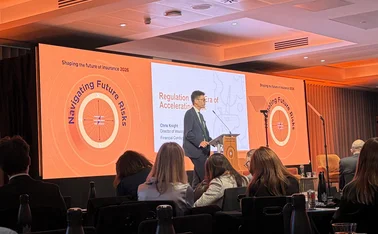
FCA’s Knight updates on cyber insurance report
Chris Knight, director of insurance at the FCA, has updated on the progress of its report into the take up of cyber insurance, and how the regulator has to keep pace with technological advancements.

Growing FCA attestation appetite a warning for brokers
The Financial Conduct Authority has increased the level of attestation requests dished out to insurance firms in recent years, and the serious regulatory tool is one brokers need to keep a keen eye on according to compliance specialists.

Why insurer oversight cannot become another regulatory box-ticking exercise
With regulatory workloads continuing to grow and the FCA maintaining its focus on customer outcomes, Insurance DataLab co-founder Matt Scott explains why brokers need a practical, evidence-led approach to insurer oversight.

FCA cancels insurance distribution business’ permissions
The Financial Conduct Authority cancelled Professional Liability Network’s permission to carry out regulated activities on 11 September 2026.