

In search of safe harbour
While many provincial brokers are eager to access Lloyd's for the skills and capacity unique to it, Lime Street is worried about losing some of its major players to insurance's island paradise - Bermuda. Marcus Alcock reports
The Lloyd's market has taken some pretty hefty hits in recent years, with asbestos, directors' and officers' and the like eating their way into the bottom line and forcing more than one syndicate into run-off. Then came the market's biggest ever single payout in the wake of the events of 11 September 2001.
There is absolutely no room to relax at the moment. Granted, 2002 and 2003 might have been relatively benign claims years, but the vicissitudes of the natural catastrophe market have really hit the balance sheet in the past couple of years, culminating in last autumn's Hurricanes Katrina and Wilma, which are expected to cost the market in excess of £1bn in net losses and mean that no profit is likely to be recorded in 2005.
Mixed messages
Given such a difficult 2005, the market could do with some good cheer and some has already been provided by the fact that investors have ploughed extra capital into the market, which has increased from £13.7bn to £14.7bn. Yet there are still signs of nervousness. Pundits are still uncertain as to what rates will really be like this year as a result of Katrina. And a potentially even bigger concern for the market in the long term was the decision by two of its biggest players - Amlin and Hiscox - to establish new companies in Bermuda. So just how good a shape is the old beast in, and are its long-term prospects that healthy?
Simon Sperryn, chief executive of the Lloyd's Market Association, is reasonably optimistic. "I think that most people are going into 2006 optimistically, which, I admit, does seem a bit perverse after the worst loss experienced by the industry," he says. "But people are expecting a good year, and rates have certainly hardened.
"It has been a very uncertain period," he continues. "At the end of this year, people have been very much leaving things until the last minute, which has meant that people did not really know what the reinsurance would cost. But investors have made their decision and at Lloyd's we now have a record amount of capital, which shows that the Lloyd's business model is a robust model."
According to Robert Miller, spokesman for the Association of Lloyd's Members, luck will once again play an important part in determining how successful or otherwise syndicates will be this year: "Even if we have a heavy hurricane season it doesn't make it a heavy loss season. It depends on luck as well - hurricanes can dodge towns. You have to be pretty unlucky to have a really bad disaster. So, all things being equal, it should be a better year."
But what about the threat from Bermuda? After all, despite the fact that capital support for the Lloyd's market in 2006 has been positive, the bald fact is that such capital pales into insignificance when compared to the billions that have been attracted to Bermuda in the wake of hurricane Katrina. After all, no one so far has decided to support the sort of ventures seen in Bermuda at the moment in the form of Harbor Point, Lancashire Re, Validus Re and others. Besides, as if the fact that the bulk of fresh capital is headed to the Atlantic rather than to Lime Street is not bad enough, to rub salt into the wounds, some of the biggest names supporting the establishment of new ventures in Bermuda are actually old Lloyd's stalwarts.
Thus, in November 2005, Amlin - currently the biggest reinsurer in the market - announced it is to form a Bermudian reinsurance company with initial capitalisation of $1bn (£0.56bn). This announcement was followed shortly by Hiscox's plans to establish a Bermuda-based insurance and reinsurance operation, which will be initially capitalised at $500m. And, in the case of Hiscox, it seems the damage to Lloyd's reputation could be even more severe in the coming months; Hiscox's ebullient chairman has said that the company is even considering re-domiciling entirely to the island.
It would seem, then, that the threat to Lloyd's from Bermuda now appears quite significant. Whereas Bermuda was once written off as a location merely for short-term opportunists that would not stand the test of time, its operators appear to be demonstrating a longevity and resilience to rebut such criticism. And the consequences for the London Market - and Lloyd's in particular - can be seen in the figures. In 2005, according to ratings agency Standard & Poor's, 13 of the top-40 global reinsurers were based in Bermuda, making it the fourth-largest reinsurance market in the world after Germany, the US and Switzerland. Significantly, S&P also noted that, for the first time, in 2004 Bermuda-based reinsurers' aggregate net written reinsurance premiums exceeded those of London-based reinsurers. Once the premium income of the class of 2005 is taken into account, the figures could well be much worse.
According to Sperryn, however, the rush to Bermuda is not viewed as a fundamental threat to Lloyd's, which, he says, is built on a different type of capital supplier. "The sort of capital we have in London underwrites insurance and is there for the long term," he says. "The managing agencies in Lloyd's are all competing against global players and need to have a balanced portfolio. So I do not see signs of Lloyd's weakening - I see it strengthening."
Greg Carter, managing director of Fitch Ratings in London, agrees that some of the new business being written in Bermuda is different to that written at Lime Street. "A lot of the class of 2005 are chasing a narrow range of risks and are backed by short-term capital," he says. "But I do not think there is an awful lot that Lloyd's can do about it. Part of it is winning the business, and it may be that it is easier to do that in Bermuda than in Lime Street."
"It is a concern," adds Miller. "But it is easy to exaggerate. They have made assurances that no new business will be taken from Lloyd's. But it is a pity that Bermuda is seen as a more attractive market than Lloyd's."
Of course, there is more to life than competition with overseas domiciles, and one area in which Lloyd's is expecting to witness progress next year is its continuing modernisation agenda. The focus for the time being is one of two main areas: moves towards establishing contract certainty and utilising an electronic repository for claims.
Contract certainty
Despite the fact the things are moving forward with regard to contract certainty, we should not expect fireworks this year, according to Sperryn: "By the end of the year we will achieved a large degree of contract certainty, but the journey towards this is one we set on before the Financial Services Authority intervened, and we will still be there by the end of 2006. But we will have met the FSA's regulations and be hugely down the road by the end of the year."
He predicts that the two areas that will take some time yet to resolve will be evidence of cover, with insurers taking over this traditional role from the broker, and dealing with signed lines.
Although contract certainty will be far from done and dusted this year, he adds that, as far as the market is concerned, a change every bit as revolutionary will take place when the electronic repository for claims files, built by Xchanging for use by the whole London Market, is finalised. Although he concedes that the claims protocols, now ageing, will have to be "dusted off" and re-worked, the move towards an electronic repository would nonetheless be a significant breakthrough in the LMA's estimation.
"The claims issue is about quality of service and internal costs," he says. "The claims community has got its act together here. The repository is only a piece of kit but the desire to use it and the opportunity it opens up for dealing with claims in a better way is enormous. There is only one file and everyone can access it at the same time - so everyone can inspect it at the same time and give agreement, whereas, at the moment, it is passed around by the broker."
Volatility
It seems that the market's appetite for reform is far from over. Last November, Lloyd's chairman Lord Levene outlined to the London Insurance Institute that then outgoing chief executive Nick Prettejohn was finalising a three-year plan, details of which were expected to be unveiled as Professional Broking went to press.
One component that observers will be expecting to witness as part of any modernising agenda will be a continued attempt by the corporation to reduce the extremes of volatility that have plagued the market in recent years. Indeed, when affirming Lloyd's insurer financial strength in December at 'A', rating agency Fitch expressed concern over the continued volatility in Lloyd's earnings and its relatively high risk concentration.
"It has been one of the negative rating factors in the past," comments Carter. "Lloyd's tends to outperform the market in the good times and underperform it in the bad times. One of the targets in setting up the Franchise Performance Board was to reduce volatility, and there has been a lot of good talk that all seemed to be good stuff and tangible. But then there came this spike in the results - we thought that the volatility was being addressed and then an extreme scenario comes along."
Nonetheless, he suggests, the work of the FPB and director Rolf Tolle may have helped, even with Katrina: "You could argue that, without the FPB, the results would have been a lot worse. The FPB has been looking at aggregation of natural catastrophe losses and windstorm losses."
It would appear, then, that Lloyd's is doing all it can to prepare for the worst excesses of the natural catastrophe market. But, with Bermuda looking increasingly attractive and the rating environment still uncertain, it looks like this is going to be a tough year for the market. Still, it has had to face considerably tougher conditions in the past and has pulled through with aplomb.
Only users who have a paid subscription or are part of a corporate subscription are able to print or copy content.
To access these options, along with all other subscription benefits, please contact info@insuranceage.co.uk or view our subscription options here: https://subscriptions.insuranceage.co.uk/subscribe
You are currently unable to print this content. Please contact info@insuranceage.co.uk to find out more.
You are currently unable to copy this content. Please contact info@insuranceage.co.uk to find out more.
Copyright Infopro Digital Limited. All rights reserved.
As outlined in our terms and conditions, https://www.infopro-digital.com/terms-and-conditions/subscriptions/ (point 2.4), printing is limited to a single copy.
If you would like to purchase additional rights please email info@insuranceage.co.uk
Copyright Infopro Digital Limited. All rights reserved.
You may share this content using our article tools. As outlined in our terms and conditions, https://www.infopro-digital.com/terms-and-conditions/subscriptions/ (clause 2.4), an Authorised User may only make one copy of the materials for their own personal use. You must also comply with the restrictions in clause 2.5.
If you would like to purchase additional rights please email info@insuranceage.co.uk
More on Regulation

Which? demands ban on brokers charging high motor APRs
Which? has named and shamed motor insurance brokers charging high interest rates on monthly policies and called for a ban on the practice.

No ‘particular targets’ for insurance regulation simplification, says FCA
Consumer Duty will be a building block for any future work on the simplification of insurance regulations that affect brokers, according to David Geale, executive director of consumers, payments and competition at the Financial Conduct Authority.

FCA kicked off financial year with improved authorisation service bar one outlier
The Financial Conduct Authority has upped its game on authorisation service levels in categories affecting brokers, with improvements in four areas, but one notable outlier where the performance dipped.

FCA alerts of Kent-based broker clone
Quotemetoday.co.uk has made clear it has no affiliation with Quote Me Go as the Financial Conduct Authority has reported fraudsters have been impersonating the Kent-headquartered broker.
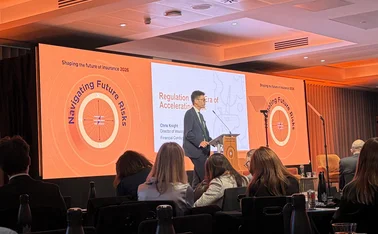
FCA’s Knight updates on cyber insurance report
Chris Knight, director of insurance at the FCA, has updated on the progress of its report into the take up of cyber insurance, and how the regulator has to keep pace with technological advancements.

Growing FCA attestation appetite a warning for brokers
The Financial Conduct Authority has increased the level of attestation requests dished out to insurance firms in recent years, and the serious regulatory tool is one brokers need to keep a keen eye on according to compliance specialists.

Why insurer oversight cannot become another regulatory box-ticking exercise
With regulatory workloads continuing to grow and the FCA maintaining its focus on customer outcomes, Insurance DataLab co-founder Matt Scott explains why brokers need a practical, evidence-led approach to insurer oversight.

FCA cancels insurance distribution business’ permissions
The Financial Conduct Authority cancelled Professional Liability Network’s permission to carry out regulated activities on 11 September 2026.