

Auditors' liability - the great debate begins
The Department of Trade and Industry's new paper on audit practice in the wake of Enron offers a chance to redefine the nature of accountants' professional liability
The financial scandals of Enron and WorldCom in the US, and now Parmalat in Europe, have further fuelled the debate on the role of auditors and their potential liabilities. Regulators and fund managers have lined up on one side to insist on a clear divide between auditors and their clients to ensure impartiality, while on the opposite side the accountancy profession says that auditors are facing unlimited potential liabilities caused by directors' negligence or fraud, which is ultimately contrary to public interest. Now, in the UK, both sides can voice their views following the launch of the Department of Trade and Industry consultation paper on directors' and auditors' liability.
The DTI consultation paper reveals clues on its line of thinking in relation to possible reform of auditors' liability. It leans fairly heavily on the recent Company Law Review and on the conclusions of the European Commissioner for the single market, Frits Bolkestein, that the EU will refrain from interfering in member states' jurisdictions on this issue. It also makes clear that the DTI will need considerable persuasion that any extension of the duty of care owed by auditors to third parties should be laid down by statute.
Accountancy's 'Big Four' - Ernst & Young, KPMG, PricewaterhouseCoopers and Deloitte & Touche - have lobbied for the introduction of proportionate liability for auditors, which is quite understandable, as they are often seen as the only deep-pocketed defendants. But the DTI has virtually dismissed this possibility.
The debate appears to rest mainly on the extent to which s 310 of the Companies Act 1985 will be amended to allow auditors to limit their liability.
If limited liability were permitted, the likely options would be either to let individual companies agree limitations of liability with their auditors, or grant auditors the ability to limit liability contractually, subject to guidelines set by the Secretary of State. Options might be that liability would be capped as a multiple of the audit fee or total fees paid to the auditor; as a multiple of the auditor's turnover; or at an arbitrary level - say £500m for the Big Four, £100m for second-tier firms, and so on.
The Big Four are lobbying for these changes, but it will not be an easy ride. The debate is under way; interested parties should submit their views to the DTI by 12 March 2004.
Only users who have a paid subscription or are part of a corporate subscription are able to print or copy content.
To access these options, along with all other subscription benefits, please contact info@insuranceage.co.uk or view our subscription options here: https://subscriptions.insuranceage.co.uk/subscribe
You are currently unable to print this content. Please contact info@insuranceage.co.uk to find out more.
You are currently unable to copy this content. Please contact info@insuranceage.co.uk to find out more.
Copyright Infopro Digital Limited. All rights reserved.
As outlined in our terms and conditions, https://www.infopro-digital.com/terms-and-conditions/subscriptions/ (point 2.4), printing is limited to a single copy.
If you would like to purchase additional rights please email info@insuranceage.co.uk
Copyright Infopro Digital Limited. All rights reserved.
You may share this content using our article tools. As outlined in our terms and conditions, https://www.infopro-digital.com/terms-and-conditions/subscriptions/ (clause 2.4), an Authorised User may only make one copy of the materials for their own personal use. You must also comply with the restrictions in clause 2.5.
If you would like to purchase additional rights please email info@insuranceage.co.uk
More on Regulation

Which? demands ban on brokers charging high motor APRs
Which? has named and shamed motor insurance brokers charging high interest rates on monthly policies and called for a ban on the practice.

No ‘particular targets’ for insurance regulation simplification, says FCA
Consumer Duty will be a building block for any future work on the simplification of insurance regulations that affect brokers, according to David Geale, executive director of consumers, payments and competition at the Financial Conduct Authority.

FCA kicked off financial year with improved authorisation service bar one outlier
The Financial Conduct Authority has upped its game on authorisation service levels in categories affecting brokers, with improvements in four areas, but one notable outlier where the performance dipped.

FCA alerts of Kent-based broker clone
Quotemetoday.co.uk has made clear it has no affiliation with Quote Me Go as the Financial Conduct Authority has reported fraudsters have been impersonating the Kent-headquartered broker.
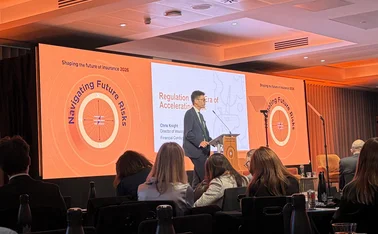
FCA’s Knight updates on cyber insurance report
Chris Knight, director of insurance at the FCA, has updated on the progress of its report into the take up of cyber insurance, and how the regulator has to keep pace with technological advancements.
Growing FCA attestation appetite a warning for brokers
The Financial Conduct Authority has increased the level of attestation requests dished out to insurance firms in recent years, and the serious regulatory tool is one brokers need to keep a keen eye on according to compliance specialists.

Why insurer oversight cannot become another regulatory box-ticking exercise
With regulatory workloads continuing to grow and the FCA maintaining its focus on customer outcomes, Insurance DataLab co-founder Matt Scott explains why brokers need a practical, evidence-led approach to insurer oversight.

FCA cancels insurance distribution business’ permissions
The Financial Conduct Authority cancelled Professional Liability Network’s permission to carry out regulated activities on 11 September 2026.