

A persuasive argument
Gaining political influence and the ear of those in power takes time and careful planning. Richard Adams charts the evolution to date of the insurance industry's progress through the political landscape
David Worsfold, secretary for the All Party Group on Insurance, considers that the insurance industry needs to engage more in political or legislative policy-making rather than lobbying after it has been formally proposed.
"Policy-makers like to hear from practitioners as they want to hear it 'from the horse's mouth'. As a whole, the industry needs to be more sophisticated as, traditionally, it has been better at being reactive, for example, with employers' liability and flooding. It must be more proactive to influence policy as it is being formed - and not just through MPs but policy groups and civil servants - before policy sees the light of day."
Worsfold also adds that this should not be left to trade associations.
He continues: "With the Financial Services Authority there is a need to get there before it publishes consultation to contend with any problems at that stage. And, if this is done behind closed doors, industry representatives need to get to agenda-setting days."
He cites the construction industry, which has achieved its house-building targets through political influence, and the travel industry, which famously avoided state regulation, as examples of influence to which the insurance industry should aspire.
A comparative and not too distant example of how this sophistication may be achieved by the insurance industry is Genesis. Essentially a think-tank, Genesis is part of a cohesive representation to government of small to medium-sized enterprise concerns along with the likes of the Confederation of British Industry, the Institute of Directors and the Federation of Small Businesses, which have a more traditional lobbying role.
John Mullin is the managing director of Composite Legal Expenses and a director of the Genesis initiative - which is affiliated with the All Party Parliamentary Small Businesses Group. With over 400 members, this is the largest of the all-party groups and, says Mullin, its interests often overlap with insurance and finance. "Genesis is very much a think-tank that seeks to be involved at the drawing-board stage," he adds. Indeed, the stated intention of Genesis is to participate fully in achieving the economic and structural reforms that will enable SMEs to flourish.
He continues: "Obviously, being an insurance man plus the fact that one of the prohibitive factors in setting up a business is often the insurance costs, it is vital that we are involved from the outset with any legislation that may affect SMEs in this way.
"Looking back to the liability crisis, a lot of small firms went out of business and we pressed for imaginative methods to resolve this through captives or mutuality - rather than just blaming compensation culture, which a lot of insurers opted to do."
Mullin also says a Genesis-type group, co-ordinated with other bodies of similar interests and made up of a variety of industry specialists, could help insurance exert more influence at the point of policy creation.
Eric Galbraith, chief executive of the British Insurance Brokers' Association, while adamant that the trade body is proactive, concedes the industry's influence could be greater. "This is very true and I would agree with the comment that, as an industry, we have to improve the way we do lobbying. When you look at the exemption of travel agents from general insurance regulation under the FSA, for example, that is huge influence, which the industry ought to be seeking."
Indeed, Galbraith is following in the footsteps of his predecessor Mike Williams in terms of getting involved with the All Party Group on Insurance.
Concerning BIBA's current lobbying activities, Galbraith says the organisation is no slouch. "BIBA has a huge variety of interests, ranging from representation in Brussels right through to continued relationships and dialogue with the Department for Work and Pensions and the regulator. BIBA also meets with opposition MPs and the Treasury - with which it has a very good understanding; they often seek our views on various issues."
Galbraith also adds that BIBA facilitates members' presentations to various governing powers. "I would also agree that policy-makers like to hear from practitioners and we regularly arrange for members to present to a range of influential organisations whether political or regulatory."
Galbraith also mentions its efforts to co-ordinate all-party groups or bodies with similar concerns such as liaising with technical working parties and the Association of British Insurers over the issue of uninsured driving.
ABI spokesman Malcolm Tarling argues that the insurers' trade body has a track record of being involved with crises or industry issues at an early stage. "I disagree that we aren't proactive enough, and having such a broad church of life and general insurers does not make us less effective because the issues are different."
He cites the recent comments of Elliot Morley, Minister for Environment and Agri-Environment, who announced that funds would continue to be supplied to the Department for Environment Food and Rural Affairs for flood defences and that it would keep careful watch on the issue. This, Tarling adds, was due in no small part to the ABI's lobbying. "In this recent announcement, Morley made mention of the persuasive argument put up by the ABI when we stepped in in advance of the spending review." Tarling also makes the point that work such as assembling such bodies as the Trades Union Congress and the CBI in some forums is not headline-making but, nonetheless crucial in gaining understanding in groups strategically significant to specific issues.
While some consensus exists that the insurance industry has a way to go before it has the clout of some, with issues such as compensation culture, rehabilitation, insurance fraud and affordability/availability currently receiving attention, insurance concerns are higher on the present government's agenda than ever before. And this reflects the fact that the industry's efforts with lobbying would seem to be slowly but surely moving in the right direction.
Only users who have a paid subscription or are part of a corporate subscription are able to print or copy content.
To access these options, along with all other subscription benefits, please contact info@insuranceage.co.uk or view our subscription options here: https://subscriptions.insuranceage.co.uk/subscribe
You are currently unable to print this content. Please contact info@insuranceage.co.uk to find out more.
You are currently unable to copy this content. Please contact info@insuranceage.co.uk to find out more.
Copyright Infopro Digital Limited. All rights reserved.
As outlined in our terms and conditions, https://www.infopro-digital.com/terms-and-conditions/subscriptions/ (point 2.4), printing is limited to a single copy.
If you would like to purchase additional rights please email info@insuranceage.co.uk
Copyright Infopro Digital Limited. All rights reserved.
You may share this content using our article tools. As outlined in our terms and conditions, https://www.infopro-digital.com/terms-and-conditions/subscriptions/ (clause 2.4), an Authorised User may only make one copy of the materials for their own personal use. You must also comply with the restrictions in clause 2.5.
If you would like to purchase additional rights please email info@insuranceage.co.uk
More on Regulation

Which? demands ban on brokers charging high motor APRs
Which? has named and shamed motor insurance brokers charging high interest rates on monthly policies and called for a ban on the practice.

No ‘particular targets’ for insurance regulation simplification, says FCA
Consumer Duty will be a building block for any future work on the simplification of insurance regulations that affect brokers, according to David Geale, executive director of consumers, payments and competition at the Financial Conduct Authority.

FCA kicked off financial year with improved authorisation service bar one outlier
The Financial Conduct Authority has upped its game on authorisation service levels in categories affecting brokers, with improvements in four areas, but one notable outlier where the performance dipped.

FCA alerts of Kent-based broker clone
Quotemetoday.co.uk has made clear it has no affiliation with Quote Me Go as the Financial Conduct Authority has reported fraudsters have been impersonating the Kent-headquartered broker.
FCA’s Knight updates on cyber insurance report
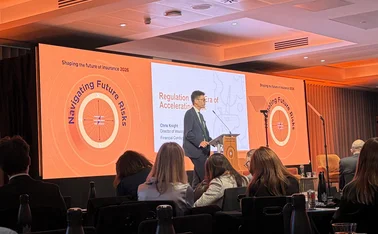
Chris Knight, director of insurance at the FCA, has updated on the progress of its report into the take up of cyber insurance, and how the regulator has to keep pace with technological advancements.
Growing FCA attestation appetite a warning for brokers
The Financial Conduct Authority has increased the level of attestation requests dished out to insurance firms in recent years, and the serious regulatory tool is one brokers need to keep a keen eye on according to compliance specialists.

Why insurer oversight cannot become another regulatory box-ticking exercise
With regulatory workloads continuing to grow and the FCA maintaining its focus on customer outcomes, Insurance DataLab co-founder Matt Scott explains why brokers need a practical, evidence-led approach to insurer oversight.

FCA cancels insurance distribution business’ permissions
The Financial Conduct Authority cancelled Professional Liability Network’s permission to carry out regulated activities on 11 September 2026.