

A leap of faith
A recent survey revealed a resurgence in interest among brokers in networks, despite the rise and demise of many prior to 14 January. Now that brokers are operating in a regulated environment, Marcus Alcock asks whether their renewed interest signifies the coming of age for networks
Despite the criticism that many networks have received in the past couple of years and the fact that so many brokers have resolutely refused to sign up to the concept so far, they could be making a comeback. Of those brokers surveyed in the Mazars Insurance Broker Survey of 2005, more than one-third (36%) said they were considering joining a network or alliance, compared with 27% in 2004, marking a resurgence of interest.
According to John Dawson, head of insurance services at Misys Insurance Management, the main factor in the resurgence of interest can be attributed to the advent of statutory regulation by the Financial Services Authority. "Brokers have gotten through January 2005 and are looking at networks to achieve competitive advantage," he says.
However, he adds that the renewed interest in networks is also a result of continuing market consolidation and segmentation: "It is not just larger insurers that are segmenting their agency bases, smaller insurers are beginning to do the same, which leaves brokers with an uphill struggle to gain access to markets and satisfactory service levels. They are finding it increasingly difficult to 'walk alone'. Participation is also becoming more attractive to brokers due to an ever-increasing range of facilities and advantages being offered as each network competes harder for business. For example, Countrywide has, in the last 12 months, launched a total of 50 new advantaged products and facilities."
Network appeal and benefits
For many advocates of the network route, it is precisely this ability to offer its members a supposedly enhanced range of benefits that lies at the heart of the appeal of the network in the modern market. "The positive sides of networks are economies of scale - it is nothing more complicated than that," says Grant Ellis, managing director of the Broker Network.
"We have a 17-strong compliance team headed by a compliance boffin. We use his knowledge and the team's knowledge to provide a commonsense approach to how a broker does business. For an individual broker to do that, it has to be of sufficient size to do so under its own steam, so we are talking about national brokers really."
Ellis warms up to his theme: "The same applies to marketing. We have a team with a wealth of experience to offer insurance brokers, for example, did you know that plasterers are receptive to direct mail but not to the telephone?"
It is not just the better-known networks that feel that what lies at the heart of their appeal is the value-added service they provide. Elaine Pyke is chief executive officer of FarmWeb, which claims to be the only national network of agricultural insurance specialists, established in 1997. "What we do is different because we deal in a niche area. We have taken this specialist area - agriculture - and developed products and services for people who specialise in it. Ours is a national network and we provide benefits for everyone; the insurer receives a quantifiable return and the customer gets the benefit of nationally negotiated rates."
Pyke says that, as far as the members of FarmWeb are concerned, joining the network also provides a number of benefits. "When it comes to national negotiations we have bargaining power and also provide specific support in a niche area that they would not otherwise get. We provide public relations and marketing, technology and introductions - we do the lead generation for them."
Nonetheless, Pyke recognises that many brokers will still be wary about what exactly they are letting themselves in for by signing away their independence. "There might be a perception by the individual broker that we are not doing what they want, but we cannot be everything to everyone. That said, we involve all of our members in our decision-making process, so we are just about to introduce new technology and, having consulted widely on that over a two-year period, we have come up with what they asked for. But we cannot satisfy all of the people all of the time - and joining a network is a giant leap of faith."
Loss or retention of independence
Understandably, for many brokers, one of the most difficult aspects of signing up to a network is the perceived loss of independence and there is no doubt that a certain amount of sacrifice is involved in such a move. Yet many network advocates are convinced that there is in fact a wide diversity of operations out there that cater for the different needs of brokers, and that this is far from being an homogeneous environment. "Whether or not brokers decide to join a network depends on their individual circumstances," Dawson says.
"Certain types of networks will be appropriate for one broker, but not another. Brokers that require and are willing to pay for on-site Financial Services Authority support and hand-holding through the compliance process, or those who want an exit route, can join organisations such as Willis and BNL. It is these more prescriptive networks that are attractive to brokers looking to strengthen their commercial offering, while being happy to forgo their independence."
He maintains, however, that there are other options available for the more staunchly independent broker, the type that was not tempted by the plethora of start-ups that cropped up towards the end of 2003 but which have singularly failed to tempt so many businesses to their fold. "Brokers that wish to retain their independence and want complete control of their agency agreements and the running of their business can join organisations such as Countrywide and its equivalents," Dawson claims.
"These independent networks offering both personal and commercial lines advantages are attractive to brokers that wish to decide their own future strategy." Ultimately, brokers get what they pay for, he says, adding: "On-site FSA support and hand-holding through the compliance process, for example, will have a high cost associated with it. Brokers need to look closely at the network's fee structure and whether they wish to pay a relatively low flat fee or percentage of gross written premium. Many brokers find committing significant volumes of business to a defined insurer panel too prescriptive and are concerned about the impact this will have on their local relationships and the risk of losing agencies."
There is no doubt that, despite the findings of this year's Mazars survey, the historical reality has been that brokers have either chosen to remain independent or, quite simply, to take the money and run by selling out in recent months. Signing up to a network, with the perceived loss of autonomy and the fees associated with it, has been viewed as an inferior option to cash upfront via either the sale of a minority stake to a major player such as Folgate or the sale altogether to one of the national brokers.
One key industry figure who has direct experience of the difficulty that networks have had in attracting support is Lloyd Hanks, broker sales manager at Allianz Cornhill. Until last April he was managing director of Camberford Law's attempt at a broker network, Network Extra, which chairman Richard Sheikh conceded at the time has struggled to achieve a sufficient level of support, with many brokers "unwilling to commit to placing 100% of their business through a network" (PB, Breaking News, 23 April 2004).
Of course, Network Extra has been far from the only venture to have struggled in this way, and Hanks appreciated that some brokers may well have a misunderstanding about what a network is for: "Often there is a perception in the industry that networks are out for themselves, but that is not the case," he says, adding that "Many brokers join for the wrong reason because they cannot get an agency agreement under their own name."
Network potential
He is adamant nonetheless that, from the insurer's point of view, networks have a great deal going for them: "The pros for me are that, provided they are set up correctly and brokers can retain independence, they have vast potential, enabling brokers to be part of the bigger picture and sharing best practice. Another of the key benefits is central marketing support such as sales initiatives and branded products on behalf of insurers."
The administrative benefits of networks are also important for an insurer, he adds: "The more you can tie [brokers] into a network, the better it is for insurers because you have got one mouth to feed, as much of the selling process is done from a single hub."
Clearly there is enthusiasm for networks as far as insurers are concerned, but will this enthusiasm finally be mirrored by the vast number of brokers who have thus far failed to be tempted? The key, continues Ellis, lies in the quality of the proposition: "The problem is that, for every good network, there is a range of people who call themselves a network and the not-so-good networks that 'tar the brush'.
"Forming a network seems to be the flavour of the month, but a word of caution I would add is to examine the track record and talk to the customers. If they do not have the resources, the existing members will tell you." He adds that the process works both ways and the networks themselves also need to be discriminating: "I want to deal with quality brokers, so the vetting that occurs is absolutely key. I would be the first to admit that we have not got it right all of the time, but we have got better."
Tesh Patel, who heads up strategy and development for commercial business at Royal & SunAlliance, agrees that what matters at the end of the day is the quality of the network and its members. "We had a whole host of networks that came up prior to 14 January; the networks that added value to the end-customer survived and the rest did not.
"It is helpful to know your objective before setting up a network," he explains, outlining that the network founder may be aiming for a degree of consistency but, if it is established as a loose collection of businesses, then not everyone may be working along the same lines and following the brand.
Patel suggests the key question that brokers need to answer is more fundamental than whether or not to join a network: "The issue is not whether it is a network or not, or whether it is a big player or a small player. What is important is whether it is sustainable. Is it better, or more robust than the competition?" Besides, he says, there is still a lot to happen in the broking sector before networks really have their day: "I would be surprised if we get a number of new networks setting up - I think there is still room for consolidation."
This viewpoint is shared by Dawson: "Insurers have decided which networks they are going to back - the networks that influence business placement and have an established strategic foothold in a consolidating broker market. Start-ups do not have the collective strength or buying power of the more established networks and are, therefore, unable to offer brokers the same access to markets and advantaged pricing and remuneration from day one."
"Insurers have also become wise to start-ups that, in the past, promised volumes of business but have been unable to deliver," he adds. "In my view, there is simply no room in the general insurance broker market for start-ups to replicate the existing network solution to succeed."
Only users who have a paid subscription or are part of a corporate subscription are able to print or copy content.
To access these options, along with all other subscription benefits, please contact info@insuranceage.co.uk or view our subscription options here: https://subscriptions.insuranceage.co.uk/subscribe
You are currently unable to print this content. Please contact info@insuranceage.co.uk to find out more.
You are currently unable to copy this content. Please contact info@insuranceage.co.uk to find out more.
Copyright Infopro Digital Limited. All rights reserved.
As outlined in our terms and conditions, https://www.infopro-digital.com/terms-and-conditions/subscriptions/ (point 2.4), printing is limited to a single copy.
If you would like to purchase additional rights please email info@insuranceage.co.uk
Copyright Infopro Digital Limited. All rights reserved.
You may share this content using our article tools. As outlined in our terms and conditions, https://www.infopro-digital.com/terms-and-conditions/subscriptions/ (clause 2.4), an Authorised User may only make one copy of the materials for their own personal use. You must also comply with the restrictions in clause 2.5.
If you would like to purchase additional rights please email info@insuranceage.co.uk
More on Regulation

Which? demands ban on brokers charging high motor APRs
Which? has named and shamed motor insurance brokers charging high interest rates on monthly policies and called for a ban on the practice.

No ‘particular targets’ for insurance regulation simplification, says FCA
Consumer Duty will be a building block for any future work on the simplification of insurance regulations that affect brokers, according to David Geale, executive director of consumers, payments and competition at the Financial Conduct Authority.

FCA kicked off financial year with improved authorisation service bar one outlier
The Financial Conduct Authority has upped its game on authorisation service levels in categories affecting brokers, with improvements in four areas, but one notable outlier where the performance dipped.

FCA alerts of Kent-based broker clone
Quotemetoday.co.uk has made clear it has no affiliation with Quote Me Go as the Financial Conduct Authority has reported fraudsters have been impersonating the Kent-headquartered broker.
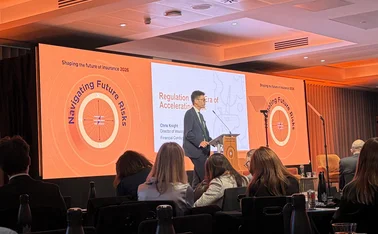
FCA’s Knight updates on cyber insurance report
Chris Knight, director of insurance at the FCA, has updated on the progress of its report into the take up of cyber insurance, and how the regulator has to keep pace with technological advancements.

Growing FCA attestation appetite a warning for brokers
The Financial Conduct Authority has increased the level of attestation requests dished out to insurance firms in recent years, and the serious regulatory tool is one brokers need to keep a keen eye on according to compliance specialists.

Why insurer oversight cannot become another regulatory box-ticking exercise
With regulatory workloads continuing to grow and the FCA maintaining its focus on customer outcomes, Insurance DataLab co-founder Matt Scott explains why brokers need a practical, evidence-led approach to insurer oversight.

FCA cancels insurance distribution business’ permissions
The Financial Conduct Authority cancelled Professional Liability Network’s permission to carry out regulated activities on 11 September 2026.