

Fingers on the button
Richard Adams: The surveys show brokers' disappointment with insurer service. There is criticism of ...
Richard Adams: The surveys show brokers' disappointment with insurer service. There is criticism of call centres, offshoring and a lack of technical skills. Has the industry dumbed down? And, given the pressure on insurers to reduce overheads is there likely to be any change in future?
Cathie Bruce: I think the customers are satisfied with the service they receive. It is clear we have some way to go, and service expectations have shifted dramatically over the past five years. We issued 77 million documents and the Financial Ombudsman only had 4000 complaints - if we take that as a measure, have we really got it that wrong?
Eric Galbraith: Some of our members have concerns about irritating levels of service - minor issues around policy documentation. Overall service is improving but too slowly. The British Insurance Brokers' Association has an annual survey that helps insurers look at the service they provide brokers - it will be out towards the end of this year.
Kevin Young: We recently had a meeting with Eric and other regional brokers, and one of the topics we discussed was the constraints of contract certainty and providing policy documentation within 28 days. We believe the accuracy of the policies have gone down and it appeared that some were being rushed to comply with the contract certainty period. We found that a lot of the policies we received had been sent back to be corrected. Timing has improved but not the accuracy. One of the problems is legacy IT systems, and I'm constantly worried when I read of more of staff cuts and redundancies - we are a people business and I don't see how service can improve when we are cutting the numbers.
Simon McGinn: Allianz has fallen out of the top five in terms of service and from our point of view our policy production has improved but we took some tactical decisions in the first quarter as to the degree we wanted to be competitive - all of our internal research boils down to responsiveness. We tend to focus around whether we can produce a policy document on time and it is a broader issue than that.
Dominic d'Inverno: It is difficult to make generalisations about service. The fact that some-one can go from number one to number four in such a short space of time means that you have to look at certain insurers.
Simon McGinn: Our strategy is about opening up offices rather than closing them down. That means brokers come to us with more complicated cases, whereas the more of run-of-the-mill stuff they churn through call centres in a more straightforward way. We need to do both. It depends on each insurer, for some of the bigger guys size and scale is absolutely critical - they can be bigger and cheaper. For those who don't have that size and scale we have to choose other strategies to deliver a better service.
Steve Williams: Within this industry we don't have a service offer - it is not part of our core philosophy. It is not filtering out from the boardroom to the customer.
Richard Adams: Moving on to regulation, wranglings over specific issues such as handling client money and commission disclosure aside, do you think the Financial Services Authority is listening to the market and acting in an acceptable way as result, and are they now going in the right direction with the move to principles based regulation?
Kevin Young: They are listening more than they were. The FSA were in attendance at our meeting at BIBA. Although they were prepared to go away and think about what we said. We now have to practice what we preach and it is a two-way thing. I certainly learned a lot from the FSA in that meeting and I think they learned a lot as well.
Dominic d'Inverno: We need to bear in mind it has been less than 18 months [since the introduction of regulation]. I think we will look back in 10 years time and say the FSA did respond relatively quickly. Sometimes you need to stand back a bit more.
Cathie Bruce: They are grasping the differences between the general insurance and life and pension markets. They are more prepared to listen and ultimately the customer is not tied into a policy for 25 years, rather it is 12 months and customers can move on.
Stephen Wall: From our perspective, regulation has been quite positive. We are in danger of a broking community that is talking itself into problems. We have to be careful we don't intellectualise too much over points of principle. There is a rumbling at press time and they make themselves well heard: if you don't follow this particular route you end up like the independent financial adviser market. There is no reason to end up similar to the IFA market unless we force ourselves.
Eric Galbraith: We are a different market and we should have our positioning on this. Originally, we were shoehorned into an existing environment. If we have a continual dialogue with the FSA, we can try and make sure we influence that position. They have to listen to us, and they are. We have focus group meetings. I prefer a principle based approach and that is quite a challenge to us as an industry to work on that.
Richard Adams: The feedback to the principle-based approach is that some brokers are feeling paranoid because it is not spelled out for them.
Cathie Bruce You can't have it both ways. If you look at the Treating Customers Fairly area - some people are saying you haven't spelled out what you want us to do.
Richard Adams: There are so many firms you can't have a prescriptive approach to everybody.
Mark Grice: There are already 1400 pages! You have to come back a long way to make it a principle-based approach.
Eric Galbraith: The FSA are also transferring some of the regulation requirements to BIBA - they [the FSA] should be the enforcement group. However, we need our own principles and we need to raise the standards beyond that so regulation becomes part of everyday business.
Stephen Wall: We are supposed to know the trends in our clients and about the complaints they are making. Although some may see what the FSA is asking as onerous, a lot of it is good principles. We have an approved contact at the FSA, get to know them and they give you advice and work with you - they have been more than fair. If our handbooks are wrong it's not on purpose. I would rather somebody tell me before getting sued.
Simon McGinn: If you go in with the wrong attitude there are going to be problems. However, if you engage in constructive dialogue it can be an extremely useful exercise.
Stephen Wall: We like to have a bit of a moan but often brokers don't know what they are moaning about.
Kevin Young: There is a difference between the size of the broker. We have a compliance officer, a finance director and a relationship with a contact at the FSA. It is more difficult for the smaller broker who doesn't have that kind of infrastructure.
Dominic d'Inverno: I don't think we as an industry are very good at managing those incremental costs. People are talking about 0.5% across the financial services industry but ours is 5%. Brokers need to become smarter at it.
Richard Adams: Can the costs be put onto the customer or is it too competitive?
Eric Galbraith: This is up to each individual broker. Some brokers put it on a policy charge, others will absorb the cost.
Dominic d'Inverno: Sometimes we don't know actually know what the additional cost is.
Richard Adams: There is positive feedback from the surveys. Regulation by the FSA is one of the largest, if not the largest, projects to be visited upon the UK insurance industry, do you have views on when it will achieve its objectives?
Eric Galbraith: The environment we are in is too expensive and over-elaborate to be able to respond to the general insurance market. On the positive side, I hope in the longer term we will recognise some of the benefits of consumer protection. The consumer does not see there is benefit yet.
Kevin Young: Initially it was expensive but we have more systems set up that make it more everyday business. I believe we appear to be more professional, even if we were professional beforehand. The best document we have produced is our regulatory business plan. It was a pain to do it but looking at it afterwards it was really good because it wasn't a sales document but an objective view.
Dominic d'Inverno: The biggest issue is training and competence. If this is the catalyst to put a more robust framework in place, then it has achieved a number of goals. On the flip side it has already had a big impact in preventing some financial crime in brokerages and insurance companies.
Steve Williams: Talking to brokers, the area of training and competency is one of the surprising benefits. The issue of staff retention - teams are moving around the market left, right and centre - and finding quality staff is very difficult. Is that same benefit being felt within insurance companies?
Simon McGinn: It becomes apparent to us very quickly which brokers have got it nailed or are much more competent in the regulatory environment. I like to think we respond to that. Regulation is not a lump of work - it is a journey that doesn't reach its destination.
Steve Williams: There is now more being spent on training and development. Something like Axa Campus has gone down extremely well
Richard Adams: Will the benefits filter through to the general public?
Dominic d'Inverno: Yes and no. If the market hardens - yes. However, people are taking a number of short cuts at the moment because of the soft market.
Stephen Wall: The general public are being hit with every second advert being for a direct insurer. Tesco Insurance, Direct Line, whoever it is, they are tapping away at our constituency and there is something unspoken in there, claiming that you don't need a broker. When you see that red telephone it says cut out the middle man and that applies in all areas. We now have brokers calling themselves direct.
Dominic d'Inverno: I don't agree - it is making the customer more conscious that there is a better deal out there for them.
Cathie Bruce: What is a better deal? There are lots of people hiding behind curiously branded names on the television - in fact it is the same old people finding a different way to sell something a bit cheaper to people who are following a price-driven message. The reality of it hits home when they make a claim or use the service they've bought and discover it doesn't meet their expectations because the person who sold it to them had no knowledge or technical expertise in actually treating customers fairly and giving them the right policy for their needs
Stephen Wall: I don't want to criticise the direct market. I was trying to make a point about cultural perception - insurance is advertised a lot and none of it by brokers
Kevin Young: Price is an issue but that is also as a result of the soft market, which brokers as well as insurers contribute towards. Insurance is hardly a sexy subject but it is not like going out and buying a new BMW.
Dominic d'Inverno: You've just shattered my illusions.
Eric Galbraith: The government wants the consumer to have advice. There is a dichotomy about what is happening about insurers' multi-distributional channels and there could be an uneven playing field with regard to what the broker has to say to the consumer, compared to the direct player. That's a move we referred to as gold plating - why did the FSA change that position? The broker is going to be in a position where they have to do a lot more work than the direct writer - that is going to be a challenge.
Richard Adams: Regulation is often quoted as a catalyst accelerating the trend of consolidation and the contraction of traditional insurance distribution firms. Are comparisons with life insurance now valid and useful, for example, when statutory regulation was introduced it sparked consolidation and the trend of networks. Are there other comparable experiences that may offer a clue as to what general insurance distribution will look like in the future?
Cathie Bruce: Is it fair to say that regulation is the catalyst for consolidation? Maybe, it was the straw that broke the camel's back.
Mark Grice: It is a big factor for small brokers. There is also the age profile.
Cathie Bruce: It's demographics and economics that has caused it to happen rather than regulation.
Nick Southan: Some brokers are having a field day. We have fewer bigger sites doing more business. It is all positive overall but there are fewer players. We have seen a tremendous amount of it going on.
Dominic d'Inverno: I think we would still be seeing consolidation despite regulation.
Nick Southan: A survey showed that over 65% of our brokers were nearing the age of 60. Everything came together - you are either going to hack it and carry on, or exit.
Kevin Young: The age profile is very important. In the acquisitions we have made we are seeing people who have reached the age where they want to retire, rather than people in their forties saying regulation is too much for me - I need to sell up.
Dominic d'Inverno: It is an honourable way for brokers to bow out.
Steve Williams: There are lots of small provincial brokers being bought out but regulation has made it very difficult to set up your own firm.
Nick Southan: Interestingly enough, one in every 10 systems we sell a month will be for a new start up and that wasn't the case two years ago and they tend to be younger guys.
Eric Galbraith: The challenge is for a dynamic market and more of an opportunity for new start-ups. The FSA quoted new people entering the market and I challenged the figures because the numbers they were quoting were quite high. I'd like to find out more about that.
Nick Southan: They tend to be people who have fallen out of big brokers, have seen what technology can do, and started their own business. There is also more money available.
Kevin Young: Goodwill could become a problem in 2008, unless people do it properly then that could be a problem.
Simon McGinn: There are going to be those individuals of with an entrepreneurial nature that rage against being in a large organisation - big consolidators have to behave like big companies - and some individuals will drop out to do their own thing.
Richard Adams: While imarket seems to be the only initiative that has the potential to become an industry standard, would you say brokers' reluctance is due to previous IT failures? Do you think imarket's success is likely to be a slow burning affair or is this despondency among brokers a major threat to a positive outcome?
Stephen Wall: Nobody has ever come to me and said 'can I sit in your office for an hour and convince you to use this because it is going to be great?'
Eric Galbraith: Brokers won't be able to put their own products on it and it is of limited application. It is ideal for certain areas of the market. Most of our members have been very cautious about it and it is a shame.
Nick Southan: Within industry initiatives like this, there tends to be not very much transparency about what's really going on. There is an independent body managing a group of insurers who are all competitors and you don't get an awful lot of information about what trade is going on anyway. From the brokers' perspective, they are waiting to see the tangible, significant benefits. If somebody says to you that by moving over your small to medium-sized enterprise business onto imarket you will be able to sell more, make bigger margins and provide better service - you are going to do it. I think we are pretty much on the cusp of that happening There doesn't appear to be a plan B.
Stephen Wall: At individual brokers there is a plan B and there's a plan A actually.
Nick Southan: My own company has invested another £1m this last financial year in its development and hasn't had a single penny back. Everybody else must be doing it. There is an awful amount of investment going in and it is a big risk for us.
Simon McGinn: It comes down to having products and insurers on it to make it work.
Nick Southan: We are so far along that it has to work. The good news is when we reach that situation and it is useable and end-to-end - at least we have a critical mass of brokers who can start using it - which might get some momentum going. We have roadshows booked [Professional Broking Roadshows] to promote it and are expecting to roll it out at the beginning of January.
Cathie Bruce: There is still a lot of misunderstanding in the market as to what imarket is. Polaris and imarket didn't do themselves any favours by over-promising and under-delivering two years ago. They will admit that was an issue. Can I make this point - it does work! The insurers and software houses have not pulled out all the stops to deliver the product. The technology works, it is capable of trading, and imarket is trying to get seven insurers and two underwriting agency partners to agree on a common set of standards with one set of questions and get that out through all the software houses and get something back from them. The problem arises because of the resources required in the individual insurers' IT departments to make all those tubes connect together. The software houses need to meet those standards as well.
Richard Adams: Is it just for packaged stuff?
Cathie Bruce: No it is capable of writing fairly complex risks.
Stephen Wall: In my area of business not one of the insurers has really pushed imarket.
Simon McGinn: That is for the reasons Cathie articulates. Imarket works, we trade some products on imarket and we need to trade all of our products, on all of the software houses, on imarket. In the long run the economic argument of imarket will win over. People will choose it because it will be the cheapest way of transacting business between insurers and brokers. The protocol will be able to be used for niche trading and also schemes.
Dominic d'Inverno: This reminds me of the film Groundhog Day. Nobody can deny the massive benefits. However, there seems to be so many different parties with their own agendas - it is difficult to pull them altogether and this is why there is doubt as to whether it will move on.
Simon McGinn: I think there will come a tipping point when you have enough insurers and software houses on there - when that is - I don't know.
Steve Wall: Once you have an agreed question set - how does a broker differentiate itself from other brokers? For example, I have a great question about chippies, by commoditising you are using the 80/20 principle and quite often the money is in the 20.
Simon McGinn: I would argue that all you are commoditising is the process. If you want to have 'one killer question about a chippy' then that can happen. You will need to identify those markets in advance.
Eric Galbraith: How can everybody keep spending this money? Somebody has got to stand up and do it properly.
Cathie Bruce: From Groupama's prospective, it has had its products on imarket for some time and I believe it has devoted a resource towards it. If you want, as an industry, imarket to succeed then it has to have priority in your IT department. Why isn't it succeeding? Because it doesn't do what the market expect. When it does, it will deliver.
Richard Adams: Are insurers going to turn off their extranets?
Simon McGinn: An extranet will be linked into it.
Nick Southan: It is no use to our brokers unless it links into their systems, and we have a lot of different systems.
Simon McGinn: They are very complex projects. We are running six projects and some of the problems are at our end and some of them at the software house's.
Eric Galbraith: Do insurers have an imarket head - somebody who is dedicated to make it work?
Cathie Bruce: Yes.
Simon McGinn: Yes
Mark Grice: There are so many parties involved, somebody somewhere is going to say we aren't making enough money, we are going to pull the plug and the whole thing will come crumbling down. I think there could be a point - where somebody says we are not putting any more money into this.
Nick Southan: I think it is more likely somebody somewhere is going to do it quick.
Cathie Bruce: There are around 2000 brokers registered to use it and it does around 25,000 transactions a month. If you haven't looked at it recently, now is the time. If there are improvements needed to the front end then that has to come from brokers.
Kevin Young: We haven't looked at it for 18 months.
Nick Southan: We have brokers using our system that sit on a user group who keep us informed of what is going on.
Kevin Young: The frustration is that two years ago I went to the office after a BIBA conference saying this looks really good - but then, absolutely nothing.
Nick Southan: The same applies with electonic data interchange personal lines - one of the big suppliers linked thousands of brokers to it - the insurers was the carrot and stick and approach of 'we will knock 10% off your motor claims, and then if you don't use EDI you won't have an agency with us'. I agree about the big business, our research shows it will be used for the smaller packaged stuff, certainly initially, because for big complex risks there is more personality and dialogue involved.
Stephen Wall: I'm interested in it. Nobody has asked me to use it.
Richard Adams: What would convince you to use it?
Stephen Wall: If I was convinced it was going to add something to the process, whether it be high volume/low volume, scheme/non-scheme - a broker needs to be involved but it is not the brokers' job to seriously push it forward. There are not many brokers who have enough clients to make that happen across the whole industry. I can only make it happen in my own little world. I'm not sure if that will have enough impact to push the project forward.
Andrew Tjaardstra: There is a lot of work going into it, it will be interesting to see how far it has evolved in a year's time.
Nick Southan: If you have the two biggest software companies having it both working, then this will be working to millions of customers. At the moment it is only working sporadically in small areas.
AT THE ROUND TABLE
Guests
Cathie Bruce, distribution and customer services director, Groupama
Dominic d'Inverno, managing director, London and South east, Primary Broker Services
Eric Galbraith, chief executive, British Insurance Brokers' Association
Mark Grice, insurance partner and head of broking, Mazars
Simon McGinn, north and Midlands trading director, Allianz Cornhill Commercial
Nick Southan, marketing manager, Software Solutions Partners
Stephen Wall, managing director, Bollington Group
Steve Williams, general manager, Fusion
Kevin Young, chairman and founder, Argyll Insurance Brokers
Hosts
Professional Broking
Richard Adams, editor
Andrew Tjaardstra, senior reporter.
Only users who have a paid subscription or are part of a corporate subscription are able to print or copy content.
To access these options, along with all other subscription benefits, please contact info@insuranceage.co.uk or view our subscription options here: https://subscriptions.insuranceage.co.uk/subscribe
You are currently unable to print this content. Please contact info@insuranceage.co.uk to find out more.
You are currently unable to copy this content. Please contact info@insuranceage.co.uk to find out more.
Copyright Infopro Digital Limited. All rights reserved.
As outlined in our terms and conditions, https://www.infopro-digital.com/terms-and-conditions/subscriptions/ (point 2.4), printing is limited to a single copy.
If you would like to purchase additional rights please email info@insuranceage.co.uk
Copyright Infopro Digital Limited. All rights reserved.
You may share this content using our article tools. As outlined in our terms and conditions, https://www.infopro-digital.com/terms-and-conditions/subscriptions/ (clause 2.4), an Authorised User may only make one copy of the materials for their own personal use. You must also comply with the restrictions in clause 2.5.
If you would like to purchase additional rights please email info@insuranceage.co.uk
More on Regulation

Which? demands ban on brokers charging high motor APRs
Which? has named and shamed motor insurance brokers charging high interest rates on monthly policies and called for a ban on the practice.

No ‘particular targets’ for insurance regulation simplification, says FCA
Consumer Duty will be a building block for any future work on the simplification of insurance regulations that affect brokers, according to David Geale, executive director of consumers, payments and competition at the Financial Conduct Authority.

FCA kicked off financial year with improved authorisation service bar one outlier
The Financial Conduct Authority has upped its game on authorisation service levels in categories affecting brokers, with improvements in four areas, but one notable outlier where the performance dipped.

FCA alerts of Kent-based broker clone
Quotemetoday.co.uk has made clear it has no affiliation with Quote Me Go as the Financial Conduct Authority has reported fraudsters have been impersonating the Kent-headquartered broker.
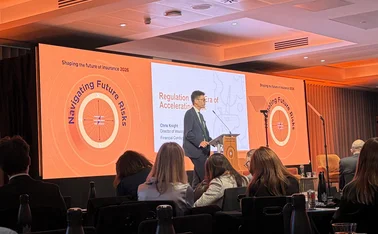
FCA’s Knight updates on cyber insurance report
Chris Knight, director of insurance at the FCA, has updated on the progress of its report into the take up of cyber insurance, and how the regulator has to keep pace with technological advancements.

Growing FCA attestation appetite a warning for brokers
The Financial Conduct Authority has increased the level of attestation requests dished out to insurance firms in recent years, and the serious regulatory tool is one brokers need to keep a keen eye on according to compliance specialists.

Why insurer oversight cannot become another regulatory box-ticking exercise
With regulatory workloads continuing to grow and the FCA maintaining its focus on customer outcomes, Insurance DataLab co-founder Matt Scott explains why brokers need a practical, evidence-led approach to insurer oversight.

FCA cancels insurance distribution business’ permissions
The Financial Conduct Authority cancelled Professional Liability Network’s permission to carry out regulated activities on 11 September 2026.