

Temperature's rising
Increased employers' liability premiums and rising costs of professional indemnity cover mean brokers are feeling the heat. However, sparks will fly if they are tempted to skimp on business protection cover, says Rachel Gordon
They may be experts in advising on risk but most brokers have been faced with premium increases for their own businesses this year. As a result, many have been tempted to under-insure, at a time when adequate business protection is more important than ever.
Graeme Trudgill, technical officer for the British Insurance Brokers' Association, warns brokers that they can never have too much insurance.
He says: "Brokers should carefully examine the levels of their property cover and look at increasing their legal expenses cover. If they do not already have it, they may want to look at buying directors' and officers' cover."
D&O insurance is becoming increasingly popular, with insurers offering the cover for smaller firms. Jonathan Quail, managing director of broker Alliance Insurance Management, oversees the purchase of cover across his company's four branches.
AIM is a young business, trading for four years and with 35 staff, but Quail still sees D&O as vital. He says: "D&O cover is essential for us but I think it's relevant for all brokers, a firm of any size could face legal action."
Brokers are probably already reeling under the burden of increased employers' liability premiums, in addition to the cost of professional indemnity cover. Many may be tempted to cut corners and buy cheap legal expenses cover as part of their property policy package but Trudgill warns brokers that specialist policies probably make sense in the light of growing employment-related litigation. A further issue is impending Financial Services Authority regulation.
These threats are tackled in DAS' regulatory and employment protection policies, launched through BIBA at its conference this year. BIBA members that buy the policy are supported through disputes with the FSA and any employment-related difficulties they face.
"It is right that forward-looking brokers are rewarded and this insurance provides real peace of mind," says Trudgill. "What is more, if the worst should happen there is the benefit of having access to a DAS-approved solicitor, who will be someone who really understands the issues."
But Ray Kneeshaw, sales and marketing manager for DAS, points out that the insurance does not pay for brokers that break the rules. He explains: "We uphold the principle that every broker facing an investigation has the right to a fair defence and the policy will pay for this. These legal costs could be more than any fine. The discounts now on offer, together with the premium guarantee, will protect far-sighted brokers until the beginning of 2007."
He adds: "This effectively takes brokers through the transition and into the first couple of years of regulation."
There are three versions of the cover. The first is based on DAS' employment practices protection, the second adds tax, bodily injury, property protection or contract protection, and the third adapts the less comprehensive cover offered by Commercial Legal Protection.
Ian Mantel, principal of Hastings-based Manor Insurance Brokers, says legal expenses is an essential part of cover, though he believes a property claim is more likely. He says: "Brokers that look for a cheap deal are not doing themselves any favours."
Mantel's business is covered by Norwich Union. He explains: "NU is solid and professional enough to tackle a major claim were I unfortunate enough to sustain one. I did have a glass claim a while ago and had no problems being paid, but I do take time to assess what limits I should be insured to each year. A broker should look at their business in the same way as they would a client."
Package product
However, Mr Mantel believes he is being short-changed on professional indemnity cover. The vast majority of UK brokers buy this policy as part of a package product, covering the risks common to most small and medium-sized enterprises. Norwich Union, Axa and Allianz Cornhill are among those in the market but, perhaps surprisingly, brokers do not get special rates on this cover. Indeed, Royal & SunAlliance avoids targeting intermediaries altogether because of what it perceives as the 'conflict of interest'.
Jamie Marchant, marketing director for Groupama, says most brokers pay the usual rate. However, he adds that many insurers reimburse the commission on insurance sold to brokers, effectively adding a discount. He says: "Most brokers buy standard office contracts but I think more will start to obtain and buy cover online."
Groupama backs Polaris imarket, the general insurance industry electronic trading portal linking insurers and intermediaries. Marchant says: "We are piloting our new Optima office contract, which will be sold on imarket, from January. It will be launched a few months later."
Few will admit that insurers offer brokers any special deals on insurance.
As Trudgill says: "No matter what they say, some insurers are likely to be providing brokers with relatively good deals but there is nothing specifically organised for brokers. The last one I can remember was offered by Commercial Union and involved discounted IT equipment as an incentive."
Colin Calder, Axa's broker development manager, worked for CU in a previous role and confirms that this was the case. However, he says this was a benefit of days gone by. "We had a good scheme for CU's Club Elite brokers but this is not something you would find nowadays."
He says Axa insures a considerable number of brokers but they are treated in the same way as any other business customer. "We do see brokers as key customers and hopefully that comes across in the service we give them," he says. "There is no special arrangement in terms of price, although we do take risk management into account."
Calder is keen to promote Axa's business continuity pack. "It is something brokers can provide to their customers but I'd emphasise that it is equally relevant for them. The pack offers a whole suite of information that can help them sort out their disaster planning - and it's free."
Business continuity is certainly a topical area and one in which the FSA seems to be taking an interest. The FSA's managing director, Michael Foot, recently spoke at a business continuity conference where he stated: "It is vital that responsibility for business continuity management is lodged at a senior executive level to ensure it is sufficiently resourced so it becomes part of business as usual for the firm."
He continues: "In our Consultation Paper 142 on operational risk we set out some expanded guidance on business continuity and we'll be confirming our proportionate approach when we publish our response to the consultation shortly. Although the priority focus is on key firms and markets, our guidance applies to the other 12,000 firms we regulate. And my message for these is that if you neglect your business continuity and in consequence you cannot withstand an emergency event, then it is essentially your business that is at risk."
While planning is vital, ensuring there is money to pay for lost business hours is too. Again, business interruption cover is included in most package policies but brokers who feel they are particularly at risk can buy higher sums insured.
Brokers reliant on telephone business coming from one call centre do face a problem - if the call centre goes down they instantly stop trading.
Paul Harrison, director at Berry Birch & Noble, says this problem could have devastating affects for his firm.
He says: "We feel it is essential to be covered for full loss of revenue for our personal lines business, which is reliant on our call centre. We take more than 2000 calls a day and if the phones went down we would lose a huge amount of business."
Harrison says BBN has faced this worst-case scenario but was saved from rocketing insurance premiums by its telephone provider, Cable & Wireless.
The company provided compensation for the revenues lost in the downtime.
Harrison says: "I'd recommend covering for a high amount where there is a single site. We also operate an independent financial adviser arm with some 12 regional offices and it would be less serious there. In addition, we have recently moved into commercial lines, purchasing two brokers in this area, but I think business continuity is also less vital there. We have BI cover in these cases but it is only for increased cost of working, which is considerably cheaper."
Once general insurance arrangements have been made, brokers with staff are faced with further protection issues. Sharon Curd, press office with Allianz Cornhill, says smaller intermediaries can often take a creative approach to staff benefits and perks, even if they cannot afford the most generous pension provision or the high cost of private medical insurance.
"A group personal accident policy is generally reasonably priced and will mean staff have some cover," she says. "Annual business travel is another popular option. We would always check a broker is up to date with company vehicles too. Every year brokers should have a spring-clean and work out what they can afford and how they can put together the best package."
She continues: "E-risks are a growing area and cover against data protection errors and omissions are also available. Brokers producing material on their website or in newsletters should also consider libel cover and key person insurance can also be valuable for senior managers."
Key person insurance, usually provided by life companies, invariably involves high sums insured and as result may be priced out of reach for some brokers. A more philanthropic option could be a group cash plan and there is now a plethora of these to choose from.
One of the largest providers, HealthSure, provides schemes for a number of brokers. Head of marketing Raman Sankaran says: "The cost of PMI has been rising for years - it is often too expensive even for senior staff only. A cash plan on the other hand is good value and is something that you don't have to be ill to claim for. Glasses and dental treatment are included, as are a range of helplines."
Choosing business protection cover is becoming more complex as more products are targeted at the market and insurers need to focus more on this core customer base. Brokers, it seems, are becoming increasingly important insurance buyers and their buying power should be recognised.
Only users who have a paid subscription or are part of a corporate subscription are able to print or copy content.
To access these options, along with all other subscription benefits, please contact info@insuranceage.co.uk or view our subscription options here: https://subscriptions.insuranceage.co.uk/subscribe
You are currently unable to print this content. Please contact info@insuranceage.co.uk to find out more.
You are currently unable to copy this content. Please contact info@insuranceage.co.uk to find out more.
Copyright Infopro Digital Limited. All rights reserved.
As outlined in our terms and conditions, https://www.infopro-digital.com/terms-and-conditions/subscriptions/ (point 2.4), printing is limited to a single copy.
If you would like to purchase additional rights please email info@insuranceage.co.uk
Copyright Infopro Digital Limited. All rights reserved.
You may share this content using our article tools. As outlined in our terms and conditions, https://www.infopro-digital.com/terms-and-conditions/subscriptions/ (clause 2.4), an Authorised User may only make one copy of the materials for their own personal use. You must also comply with the restrictions in clause 2.5.
If you would like to purchase additional rights please email info@insuranceage.co.uk
More on Regulation

Which? demands ban on brokers charging high motor APRs
Which? has named and shamed motor insurance brokers charging high interest rates on monthly policies and called for a ban on the practice.

No ‘particular targets’ for insurance regulation simplification, says FCA
Consumer Duty will be a building block for any future work on the simplification of insurance regulations that affect brokers, according to David Geale, executive director of consumers, payments and competition at the Financial Conduct Authority.

FCA kicked off financial year with improved authorisation service bar one outlier
The Financial Conduct Authority has upped its game on authorisation service levels in categories affecting brokers, with improvements in four areas, but one notable outlier where the performance dipped.

FCA alerts of Kent-based broker clone
Quotemetoday.co.uk has made clear it has no affiliation with Quote Me Go as the Financial Conduct Authority has reported fraudsters have been impersonating the Kent-headquartered broker.
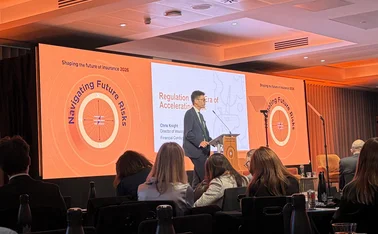
FCA’s Knight updates on cyber insurance report
Chris Knight, director of insurance at the FCA, has updated on the progress of its report into the take up of cyber insurance, and how the regulator has to keep pace with technological advancements.

Growing FCA attestation appetite a warning for brokers
The Financial Conduct Authority has increased the level of attestation requests dished out to insurance firms in recent years, and the serious regulatory tool is one brokers need to keep a keen eye on according to compliance specialists.

Why insurer oversight cannot become another regulatory box-ticking exercise
With regulatory workloads continuing to grow and the FCA maintaining its focus on customer outcomes, Insurance DataLab co-founder Matt Scott explains why brokers need a practical, evidence-led approach to insurer oversight.

FCA cancels insurance distribution business’ permissions
The Financial Conduct Authority cancelled Professional Liability Network’s permission to carry out regulated activities on 11 September 2026.