

Laundered funds could land you in hot water
While money-laundering rules do not apply to intermediaries, all firms are subject to the Proceeds of Crime Act 2002, which does affect brokers
Sub-sections 327 to 329 of Part 7 of the Proceeds of Crime Act 2002 deal with money-laundering. Section 328 makes it an offence for a person or firm to enter into, or become concerned in, "an arrangement, which he knows or suspects facilitates (by whatever means) the acquisition, retention, use or control of criminal property by or on behalf of another person".
The obligations under s328 of POCA were considered by the Court of Appeal in Bowman v. Fels. The Court of Appeal held that s328 'arrangements' did not apply to solicitors acting in the ordinary conduct of legal proceedings. Further, a disclosure report could not override legal professional privilege. This position was clarified by the Law Society Guidelines, published in the wake of Bowman on 13 September 2005, the main gist of which are that "a solicitor should not make a report unless there is prima facie evidence that he is being used in the furtherance of crime". However, the case of Bowman is only relevant to solicitors that can rely upon legal professional privilege.
If cover is arranged by a broker for a legitimate transaction using the proceeds of crime, the broker could also be implicated with the money-launderer unless they can demonstrate reasonable grounds for not reporting any suspicions. To avoid being implicated with the money-launderer, any suspicion of money-laundering should be reported to the National Criminal Intelligence Service.
Given the risk-management issues, brokers should ensure the systems and controls recommended by the Financial Services Authority are in place for anti-money-laundering, and all staff dealing with client monies are properly trained in these procedures. Compliance with the due-diligence procedures should ensure that clients are carefully identified, whether based offshore or in the UK, and that monies passing through a firm's business account can be traced to the source.
The real cost of due diligence and its proportionality in the insurance sector is currently under review by the FSA, in partnership with the Financial Services Practitioner Panel. A consultation paper was published in July 2005 with a view to streamlining and cutting back on the approved persons regime and also to delete the Money Laundering Sourcebook from the handbook. Responses to the paper are currently under review and it is understood that there has been positive feedback from the industry to remove the Money Laundering Sourcebook. A timeframe for the release of the new policy statement is likely to be issued in the new year.
Only users who have a paid subscription or are part of a corporate subscription are able to print or copy content.
To access these options, along with all other subscription benefits, please contact info@insuranceage.co.uk or view our subscription options here: https://subscriptions.insuranceage.co.uk/subscribe
You are currently unable to print this content. Please contact info@insuranceage.co.uk to find out more.
You are currently unable to copy this content. Please contact info@insuranceage.co.uk to find out more.
Copyright Infopro Digital Limited. All rights reserved.
As outlined in our terms and conditions, https://www.infopro-digital.com/terms-and-conditions/subscriptions/ (point 2.4), printing is limited to a single copy.
If you would like to purchase additional rights please email info@insuranceage.co.uk
Copyright Infopro Digital Limited. All rights reserved.
You may share this content using our article tools. As outlined in our terms and conditions, https://www.infopro-digital.com/terms-and-conditions/subscriptions/ (clause 2.4), an Authorised User may only make one copy of the materials for their own personal use. You must also comply with the restrictions in clause 2.5.
If you would like to purchase additional rights please email info@insuranceage.co.uk
More on Regulation

Which? demands ban on brokers charging high motor APRs
Which? has named and shamed motor insurance brokers charging high interest rates on monthly policies and called for a ban on the practice.

No ‘particular targets’ for insurance regulation simplification, says FCA
Consumer Duty will be a building block for any future work on the simplification of insurance regulations that affect brokers, according to David Geale, executive director of consumers, payments and competition at the Financial Conduct Authority.

FCA kicked off financial year with improved authorisation service bar one outlier
The Financial Conduct Authority has upped its game on authorisation service levels in categories affecting brokers, with improvements in four areas, but one notable outlier where the performance dipped.

FCA alerts of Kent-based broker clone
Quotemetoday.co.uk has made clear it has no affiliation with Quote Me Go as the Financial Conduct Authority has reported fraudsters have been impersonating the Kent-headquartered broker.
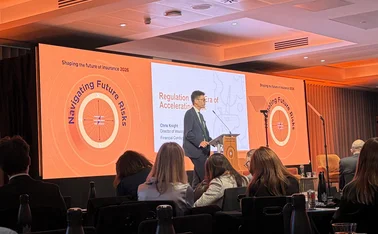
FCA’s Knight updates on cyber insurance report
Chris Knight, director of insurance at the FCA, has updated on the progress of its report into the take up of cyber insurance, and how the regulator has to keep pace with technological advancements.

Growing FCA attestation appetite a warning for brokers
The Financial Conduct Authority has increased the level of attestation requests dished out to insurance firms in recent years, and the serious regulatory tool is one brokers need to keep a keen eye on according to compliance specialists.

Why insurer oversight cannot become another regulatory box-ticking exercise
With regulatory workloads continuing to grow and the FCA maintaining its focus on customer outcomes, Insurance DataLab co-founder Matt Scott explains why brokers need a practical, evidence-led approach to insurer oversight.

FCA cancels insurance distribution business’ permissions
The Financial Conduct Authority cancelled Professional Liability Network’s permission to carry out regulated activities on 11 September 2026.