

Glossary - Glossary of terms
A guide to commonly-used terms under statutory regulation
ARROW visit - The FSA has developed the ARROW risk-assessment framework with the following objectives:
- To help the FSA meet its statutory objectives by focusing on key risks.
- Influence resource allocation to make efficient and effective use of limited resources
- Use appropriate regulatory tools to deal with risks or issues
- Undertake proportionally more work on a thematic (or cross-sectional) basis
ARROW stands for Advanced Risk Response Operating frameWork and describes how the Financial Services Authority assesses the risk posed by individual firms. Firms are assigned to one of four supervision categories, with category 'A' representing firms that are viewed as 'high impact', i.e. in the event of their collapse, the impact to customers would be high.
These firms can expect a close and continuous relationship, while those in category 'D' can expect little or no individual contact.
Appointed representative - Someone who carries out activities that are part of the business for which their principal has accepted responsibility in writing.
Business standards - The detailed requirements relating to firm's day-to-day business.
Client - Any person with or for whom a firm conducts or intents to conduct business.
Cooling-off period - The right of consumers to cancel policy coverage within a set time limit (see Distance Marketing Directive).
Commercial customer - Someone who purchases cover on behalf of their business, trade or profession.
CPD - Continued professional development pertains to the regulators requirement for each member of an organisation to be fit for purpose. In line with the regulator's requirements for processes and competence to be transparent, this must be demonstrable, i.e. by having received documented training and assessment material relating directly to an employee's job function.
Dispute reolution: complaints - Refers to the detailed requirements for handling complaints via the Financial Ombudsman Service arrangements.
Distance Marketing Directive (DMD) - The Directive of the Council and Parliament published the Distance Marketing Directive (FSA Consultation Paper 196) on 23 September 2002 on distance marketing of consumer financial services (No. 2002/65/EC). The DMD aims to protect retail consumers who deal with a financial services firm or acquire a financial services product through the use of distance means such as post, fax, internet and telephone. Its main aims are to ensure they are given minimum standard information about the firm with which they propose to deal and the product or service being offered; and have the right to cancel a range (but not all types) of contracts once entered into.
Enforcement - Where a firm intentionally or unintentionally fails to meet certain requirements, disciplinary enforcement action may be taken.
Execute - Carry into effect or perform a transaction, whether as a principal or as an agent.
Financial Ombudsman Service (FOS) - The scheme where certain disputes may be resolved quickly and with minimum formality by an independent person.
Financial promotion - An invitation or inducement to engage in investment activity.
Financial Services Authority (FSA) - The independent non-governmental body given legal powers by the Financial Services and Markets Act 2000 to regulate the UK financial services industry.
The Fit and Proper Test for Approved Persons - The minimum standards for becoming and remaining an approved person.
ICOB - The Insurance: Conduct of Business sourcebook. The requirements applying to firms with insurance business customers.
IMD - The Insurance Mediation Directive.
Integrated Prudential Sourcebook - Prudential requirements for insurers, groups, mortgage firms and insurance intermediaries.
Introducer - An individual appointed by a firm or an appointed representative to introduce business or distribute non-real-time financial promotions.
Money laundering - The requirements for anti-money-laundering systems and controls.
Moral hazard - The risk arising from the character and management style of the insured or their employees.
Network - An independent intermediary that has five or more appointed representatives or whose appointed representatives (fewer than five) have between them 26 or more financial advisers.
Principles for business - The fundamental obligations of all firms under the regulatory system.
Professional indemnity insurance - A contract of insurance that indemnifies a firm against financial losses that may occur as a result of negligence.
Senior management arrangements, systems and controls - The responsibilities of directors and senior management.
Statements of Principle and Code of Practice for Approved Persons - The fundamental obligations of approved persons.
Supervision - The regulatory powers of the FSA to monitor and maintain set standards in the industry including enforcement action.
Threshold conditions - The minimum standards for becoming and remaining authorised.
TOBA - Terms-of-business agreement. Issued by insurers to agents, TOBAs set out a framework for the business relationship between the two and should incorporate the FSA's high-level principles. The arrangements set out in TOBAs should also make this relationship clear and transparent in defining and allocating the respective responsibilities and rights in the agreement to each party.
Utmost good faith (uberrima fides) - A contract of insurance is a contract based on the principle of utmost good faith. It requires proposers to give all relevant information to the insurer and requires insurers to deal openly and honestly with policyholders.
Only users who have a paid subscription or are part of a corporate subscription are able to print or copy content.
To access these options, along with all other subscription benefits, please contact info@insuranceage.co.uk or view our subscription options here: https://subscriptions.insuranceage.co.uk/subscribe
You are currently unable to print this content. Please contact info@insuranceage.co.uk to find out more.
You are currently unable to copy this content. Please contact info@insuranceage.co.uk to find out more.
Copyright Infopro Digital Limited. All rights reserved.
As outlined in our terms and conditions, https://www.infopro-digital.com/terms-and-conditions/subscriptions/ (point 2.4), printing is limited to a single copy.
If you would like to purchase additional rights please email info@insuranceage.co.uk
Copyright Infopro Digital Limited. All rights reserved.
You may share this content using our article tools. As outlined in our terms and conditions, https://www.infopro-digital.com/terms-and-conditions/subscriptions/ (clause 2.4), an Authorised User may only make one copy of the materials for their own personal use. You must also comply with the restrictions in clause 2.5.
If you would like to purchase additional rights please email info@insuranceage.co.uk
More on Regulation

Which? demands ban on brokers charging high motor APRs
Which? has named and shamed motor insurance brokers charging high interest rates on monthly policies and called for a ban on the practice.

No ‘particular targets’ for insurance regulation simplification, says FCA
Consumer Duty will be a building block for any future work on the simplification of insurance regulations that affect brokers, according to David Geale, executive director of consumers, payments and competition at the Financial Conduct Authority.

FCA kicked off financial year with improved authorisation service bar one outlier
The Financial Conduct Authority has upped its game on authorisation service levels in categories affecting brokers, with improvements in four areas, but one notable outlier where the performance dipped.

FCA alerts of Kent-based broker clone
Quotemetoday.co.uk has made clear it has no affiliation with Quote Me Go as the Financial Conduct Authority has reported fraudsters have been impersonating the Kent-headquartered broker.
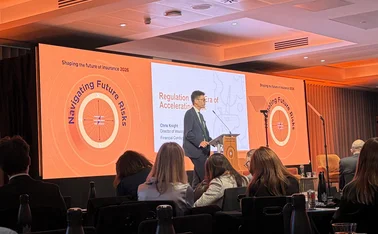
FCA’s Knight updates on cyber insurance report
Chris Knight, director of insurance at the FCA, has updated on the progress of its report into the take up of cyber insurance, and how the regulator has to keep pace with technological advancements.

Growing FCA attestation appetite a warning for brokers
The Financial Conduct Authority has increased the level of attestation requests dished out to insurance firms in recent years, and the serious regulatory tool is one brokers need to keep a keen eye on according to compliance specialists.

Why insurer oversight cannot become another regulatory box-ticking exercise
With regulatory workloads continuing to grow and the FCA maintaining its focus on customer outcomes, Insurance DataLab co-founder Matt Scott explains why brokers need a practical, evidence-led approach to insurer oversight.

FCA cancels insurance distribution business’ permissions
The Financial Conduct Authority cancelled Professional Liability Network’s permission to carry out regulated activities on 11 September 2026.