

Open your eyes
The growing problem of fraud is one set to continue for brokers. Gary Dixon points out the warning signs and explains how to be vigilant
Besso, the insurance intermediary that was fined £20,000 by the Financial Services Authority in April for failing to approve the appointment of a senior manager, is not the first and certainly will not be the last company to employ a convicted fraudster in a position of trust. Oaktree Financial Services is just one example of a company severely damaged by fraud perpetrated against the company's own clients, which also resulted in principal Stephen Higham being given a five-year jail term. Similarly, Preston Whiteside's clients still wait to hear the end result of the fraud perpetrated against the firm back in 2003, while the court case progresses.
These examples illustrate one of the major areas of fraud common in the financial community - fraud against a company's clients. The other area is fraud against the company itself.
On the face of it, fraud amongst brokers is not very common. However, the fact that few incidents come to light does not mean that it is not going on. If statistics from accountancy firm BDO Stoy Hayward are to be believed, UK employee fraud was up 80% in 2005 compared with 2004, so this is a growing trend and one brokers will see more and more.
Typical scams include the creation of forged cover notes or policies. Fraudsters have been known to issue false policies with realistic wordings but with an insurer that does not exist or, more commonly, where a binding authority exists, the fraudster issues a policy beyond the remit of the authority. The simplest example is to issue documentation for a valid policy but not to remit the details or money to the insurer, therefore leaving them off cover while believing they have full cover.
Sophisticated networks
Identity fraud has to be the largest single fraud risk to all brokers, large or small. The fact that some candidates standing in the recent local government elections, as reported in the London media, were unable to vote because their identities had been stolen just serves to show how widespread this problem has become.
Sophisticated networks of criminals are entering companies as employees to access the personal information of customers, or in some cases other employees and stealing identity information. This is not limited to people employed to work with the data who have permitted access - cleaning staff and other contractors represent a risk. These stolen identities are used by fraudsters to take out bogus policies, steal from existing accounts, open new business accounts or take over existing accounts. The latter two approaches in particular can be further abused by criminals seeking to cover their tracks while processing the proceeds of their crime through the financial system.
Fraud is a growing problem and, rather than become more difficult to commit, these days it is actually more easy despite the increase in regulations and compliance. It is also less easy to spot. Despite the proliferation of software systems on the market, few seem able to flag-up or track suspicious looking transactions.
Changes in the broking community over the past five to 10 years have added significantly to the problem of fraud. Many older and experienced brokers have been forced out of the market as a result of mergers and market consolidation. The old way of broking and the old-style brokers that adopted a caring and informed position have been replaced by a younger, less knowledgeable, less experienced management base. Those older brokers would often have been able to smell if something was not quite right with a piece of business or a transaction. Cost cutting during the lean years stripped away a layer of middle management that contained invaluable knowledge and skills that have disappeared rather than been handed down.
The number of brokers is diminishing. The proliferation of direct insurance business over the last decade has seen another level of control removed from the buying process. Call centre staff for direct insurers do not actually require an enquiring mind while punching in the questionnaire answers, when going through the information gathering for a proposed quote.
The complexity of the products on offer and the market itself all add to the ease with which fraud can be committed. Insurers rushing to design websites with integral rating systems over the past five years or so have introduced a much higher degree of risk of manipulation by fraudsters. Financially, people are paying for policies and premiums direct and once the money has been sent - usually electronically - it is difficult to stop. The elimination of paperwork and the reduction of bureaucracy actually means that there is less time to stop and reflect before going ahead.
Fraud is about money. If brokers focus on how money comes into and out of the broking firm, and into and out of the insurer, there will always be an opportunity to spot fraud, be it evidence of names changed on documents, forged transactions, or money sent to the wrong recipient.
Lack of segregation
Those most at risk are smaller high-street brokers, often dealing with personal lines rather than commercial and, therefore, with a higher throughput of business. One of the main reasons for this is the lack of segregation of duties. In larger firms, the responsibility for money and assets is divided between different people with differing levels of controls and a separate supervisory control for the release of money. Larger brokers have had to pay more attention to areas where conflicts may exist and usually have better controls in these areas, as well as more resources to back them up. Smaller firms have to be more pragmatic, and it is often the case that with fewer staff, they will each play a part in all aspects of the insurance transaction and therefore be more able, if so inclined, to forge other elements of the work.
That said, large firms are also at risk from an employee fraudster working alone or in collaboration with criminals on the outside. Many large brokers have relatively poor internal controls in place and operate with de-motivated staff who content themselves with simply conducting their part of the overall process without enquiring sufficiently into discrepancies.
One of the most common types of fraud against the employing company is that of an employee siphoning-off business to other brokers for a kick-back, or diverting business to themselves or another family member. It is difficult to cater for this kind of fraud since it is often perpetrated by trusted members of staff. The only sensible measure brokers can take is to prevent it happening in the first place by assessing potential employees' applications properly before recruitment and making sure that references are always taken up. Typically, if an account handler tries this kind of scam they will have probably tried it before somewhere else. Also, potential employers should always be wary of new recruits who have a history of changing jobs after only short periods of time. This may well be because they have managed to commit a fraud and are looking to move on before being found out or, alternatively, not having managed to commit fraud, they move on looking for easier pickings.
Training and supervision is vital - especially for all new employees, who should be monitored to determine their level of knowledge and any future training and development requirements. Frequently, frauds are committed to cover-up after a bad mistake. Most serious frauds take place at senior manager, director and proprietor level, driven by greed or desperation. Employee vetting, training and supervision should not stop at junior manager and administration positions.
One tip that brokers currently do not use but should perhaps adopt from the banking and financial community - which has had to adopt stringent anti-fraud measures for many years - is a compulsory two weeks continuous holiday each year for all staff that handle client money. Any member of staff that has taken money, or is moving other money around between accounts to cover their tracks ("teeming and lading") is far more likely to be caught given a period of time away from work. There is nothing like time to increase the likelihood of any misdemeanour coming to light. Employees involved in a fraud will not want to take a holiday. They will want to be at work to be in control of things and keep covering their tracks.
One of the reasons why fraud will continue to grow in broking firms is because there are very few people with the external perspective necessary to spot fraud and stop it.
Companies would not normally think about getting external help to assess vulnerability to attack from a fraudster. About the only time an outsider comes in to see if things are being managed properly is when a broker outsources its compliance work to a specialist firm, or when the accountant comes calling. However, given that last year small to medium-sized broking firms were exempted by the government from statutory audits, they are now unlikely to employ an auditor.
In actual fact, even if they did, they would ordinarily be of no help at all in this matter, as auditors specifically disclaim their liability in the event of fraud. They simply are not engaged to look for it. This is a shame as nobody is better placed than an auditor to look in a broker's own books to spot fraud, yet despite this, and because of their own fears over liability, they run a mile from it. Brokers are still required to have an audit of client money but, again, the auditor will be looking at compliance with specific Financial Services Authority client money rules and will not look for fraud.
Prevention measures
The FSA is not going looking for fraud either, and it never will, as it expects management to put in place appropriate systems and controls to safeguard client assets. However, the FSA's recent announcement that it will conduct more than 200 visits to wholesale and retail firms to review client money handling will go some way towards assessing the control environment for fraud. The FSA claims that part of its raison d'etre is to protect consumers. You would think, therefore, that it would be more interested and active in promoting measures to prevent fraud that directly affect consumers but the number of regulated firms makes this impractical.
Ultimately, fraud is down to the wrong sort of person. Fraud is committed by individuals, who are always determined and becoming ever more ingenious in their methods. As business becomes more complex, so will the fraudsters. In turn, brokers need to be ever more suspicious, vigilant and likewise determined to spot them. Fraudsters are thankfully not around every corner but all brokers need to look carefully at their business operations to minimise the likelihood of their business being affected in the wrong way.
Gary Dixon, Chief executive officer, Compliance.co.uk.
Only users who have a paid subscription or are part of a corporate subscription are able to print or copy content.
To access these options, along with all other subscription benefits, please contact info@insuranceage.co.uk or view our subscription options here: https://subscriptions.insuranceage.co.uk/subscribe
You are currently unable to print this content. Please contact info@insuranceage.co.uk to find out more.
You are currently unable to copy this content. Please contact info@insuranceage.co.uk to find out more.
Copyright Infopro Digital Limited. All rights reserved.
As outlined in our terms and conditions, https://www.infopro-digital.com/terms-and-conditions/subscriptions/ (point 2.4), printing is limited to a single copy.
If you would like to purchase additional rights please email info@insuranceage.co.uk
Copyright Infopro Digital Limited. All rights reserved.
You may share this content using our article tools. As outlined in our terms and conditions, https://www.infopro-digital.com/terms-and-conditions/subscriptions/ (clause 2.4), an Authorised User may only make one copy of the materials for their own personal use. You must also comply with the restrictions in clause 2.5.
If you would like to purchase additional rights please email info@insuranceage.co.uk
More on Regulation

Which? demands ban on brokers charging high motor APRs
Which? has named and shamed motor insurance brokers charging high interest rates on monthly policies and called for a ban on the practice.

No ‘particular targets’ for insurance regulation simplification, says FCA
Consumer Duty will be a building block for any future work on the simplification of insurance regulations that affect brokers, according to David Geale, executive director of consumers, payments and competition at the Financial Conduct Authority.

FCA kicked off financial year with improved authorisation service bar one outlier
The Financial Conduct Authority has upped its game on authorisation service levels in categories affecting brokers, with improvements in four areas, but one notable outlier where the performance dipped.

FCA alerts of Kent-based broker clone
Quotemetoday.co.uk has made clear it has no affiliation with Quote Me Go as the Financial Conduct Authority has reported fraudsters have been impersonating the Kent-headquartered broker.
FCA’s Knight updates on cyber insurance report
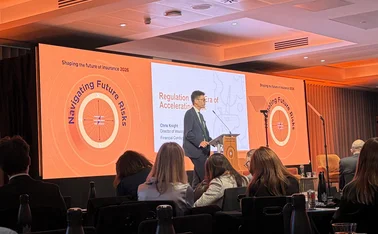
Chris Knight, director of insurance at the FCA, has updated on the progress of its report into the take up of cyber insurance, and how the regulator has to keep pace with technological advancements.

Growing FCA attestation appetite a warning for brokers
The Financial Conduct Authority has increased the level of attestation requests dished out to insurance firms in recent years, and the serious regulatory tool is one brokers need to keep a keen eye on according to compliance specialists.

Why insurer oversight cannot become another regulatory box-ticking exercise
With regulatory workloads continuing to grow and the FCA maintaining its focus on customer outcomes, Insurance DataLab co-founder Matt Scott explains why brokers need a practical, evidence-led approach to insurer oversight.

FCA cancels insurance distribution business’ permissions
The Financial Conduct Authority cancelled Professional Liability Network’s permission to carry out regulated activities on 11 September 2026.