

Local planning - Rooting for trouble
What happens when protecting and preserving the amenity value of a tree is prized above a home? Your staff should be aware of the Court of Appeal's recent answer
In Perrin v. Northampton Borough Council and Others (2007), the claimants' property was damaged by subsidence caused by a neighbour's oak tree. An arboriculturalist recommended the tree be felled. The oak tree, however, was subject to a tree preservation order, meaning the local planning authority's consent was required before any work on the tree could done. The LPA refused consent and a subsequent appeal to the Secretary of State was also rejected.
The claimants brought declaratory proceedings on the basis that s198(6)(b) of the Town and Country Planning Act (1990) provided statutory exemption to the effect that no TPO shall apply to the cutting down, uprooting, topping or lopping of any trees "... so far as may be necessary for the prevention or abatement of a nuisance". The LPA argued that felling the tree was not necessary as other, albeit potentially costly, engineering solutions were available. The court in the first instance held that the word necessary simply provides a link between the possible tree works and abatement of the nuisance; it was irrelevant that alternative methods of stabilising the property were available. It concluded that the purpose of s198(6)(b) is that a TPO will not apply where there is an actionable nuisance and so the neighbours were free to undertake works to the oak tree that avoided the need for the property to be underpinned.
However, on 19 December 2007, the Court of Appeal disagreed and reversed the decision. It held that the underlying purpose of the legislation was to preserve trees subject to a TPO. It would therefore be counterintuitive to ignore other steps that may be taken, except those to the tree itself. S198(6) should not be interpreted restrictively and all the circumstances should be considered, including alternative engineering solutions.
This ruling is a blow to homeowners and is likely to result in more properties being underpinned, at considerable cost to insurers. It remains to be seen whether or not the claim will be subject to an appeal to the House of Lords. If faced with a claim concerning a tree protected by a TPO, brokers should alert insurers and their client immediately of the difficulties and likely delays involved in dealing with it. Once sufficient evidence has been obtained of the alleged nuisance, an arboriculturalist may be appointed to apply to the LPA for permission to remove the tree. If the LPA is unwilling to consent to any tree works then insurers should seek further legal advice on alternative remedies and any potential for the payment of compensation from the LPA under s203 of the Act.
- Paul Leighton, partner and Jacob Stacey, solicitor, commercial and property risks, Beachcroft.
Only users who have a paid subscription or are part of a corporate subscription are able to print or copy content.
To access these options, along with all other subscription benefits, please contact info@insuranceage.co.uk or view our subscription options here: https://subscriptions.insuranceage.co.uk/subscribe
You are currently unable to print this content. Please contact info@insuranceage.co.uk to find out more.
You are currently unable to copy this content. Please contact info@insuranceage.co.uk to find out more.
Copyright Infopro Digital Limited. All rights reserved.
As outlined in our terms and conditions, https://www.infopro-digital.com/terms-and-conditions/subscriptions/ (point 2.4), printing is limited to a single copy.
If you would like to purchase additional rights please email info@insuranceage.co.uk
Copyright Infopro Digital Limited. All rights reserved.
You may share this content using our article tools. As outlined in our terms and conditions, https://www.infopro-digital.com/terms-and-conditions/subscriptions/ (clause 2.4), an Authorised User may only make one copy of the materials for their own personal use. You must also comply with the restrictions in clause 2.5.
If you would like to purchase additional rights please email info@insuranceage.co.uk
More on Regulation

Which? demands ban on brokers charging high motor APRs
Which? has named and shamed motor insurance brokers charging high interest rates on monthly policies and called for a ban on the practice.

No ‘particular targets’ for insurance regulation simplification, says FCA
Consumer Duty will be a building block for any future work on the simplification of insurance regulations that affect brokers, according to David Geale, executive director of consumers, payments and competition at the Financial Conduct Authority.

FCA kicked off financial year with improved authorisation service bar one outlier
The Financial Conduct Authority has upped its game on authorisation service levels in categories affecting brokers, with improvements in four areas, but one notable outlier where the performance dipped.

FCA alerts of Kent-based broker clone
Quotemetoday.co.uk has made clear it has no affiliation with Quote Me Go as the Financial Conduct Authority has reported fraudsters have been impersonating the Kent-headquartered broker.
FCA’s Knight updates on cyber insurance report
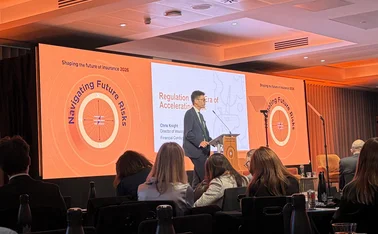
Chris Knight, director of insurance at the FCA, has updated on the progress of its report into the take up of cyber insurance, and how the regulator has to keep pace with technological advancements.
Growing FCA attestation appetite a warning for brokers
The Financial Conduct Authority has increased the level of attestation requests dished out to insurance firms in recent years, and the serious regulatory tool is one brokers need to keep a keen eye on according to compliance specialists.

Why insurer oversight cannot become another regulatory box-ticking exercise
With regulatory workloads continuing to grow and the FCA maintaining its focus on customer outcomes, Insurance DataLab co-founder Matt Scott explains why brokers need a practical, evidence-led approach to insurer oversight.

FCA cancels insurance distribution business’ permissions
The Financial Conduct Authority cancelled Professional Liability Network’s permission to carry out regulated activities on 11 September 2026.